

Renesas Electronics has introduced a 650 V-class bidirectional GaN switch, the TP65B110HRU, aimed at power-conversion designs including solar microinverters and AI data center power stages. The device is built to block both positive and negative current in a single part with integrated DC blocking, replacing conventional back-to-back FET implementations with one switch.
In many high-power conversion designs, unidirectional silicon or SiC switches only block current in one direction when off, which tends to push architectures toward multi-stage conversion with multiple bridge circuits. Renesas’ pitch for bidirectional GaN is fewer switches for single-stage conversion, with the company pointing to solar microinverters as an example: it says a typical design can use two high-voltage bidirectional devices, eliminate intermediary DC-link capacitors, and cut switch count versus back-to-back approaches.
For data center engineers, bidirectional switching is most interesting where AC-DC and DC-DC stages are constrained by efficiency targets, density, and switching losses. Reducing device count can simplify layouts and potentially reduce conduction and switching loss contributors, but the real test will be how these parts behave in hard-switching and high dv/dt environments at scale.
Device architecture and electrical claims
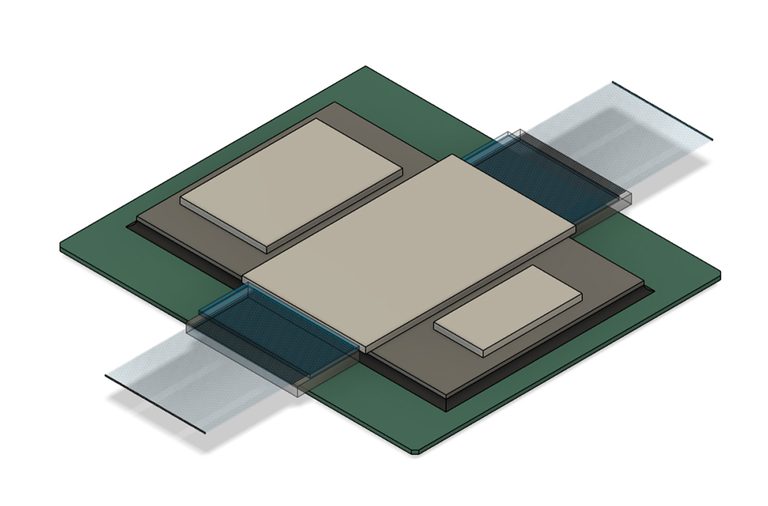
Renesas says the TP65B110HRU combines a high-voltage bidirectional depletion-mode (d-mode) GaN chip co-packaged with two low-voltage silicon MOSFETs. The MOSFETs are specified with a 3 V high threshold voltage, ±20 V maximum Vgs, high gate margin (±20 V), and built-in body diodes intended to support efficient reverse conduction. Compared with enhancement-mode (e-mode) bidirectional GaN devices, Renesas says its approach works with standard gate drivers and doesn’t require negative gate bias, which it describes as enabling a simpler, lower-cost gate loop design while maintaining fast, stable switching in soft- and hard-switching operation.
Renesas also calls out use in hard-switching topologies such as a Vienna-style rectifier, citing >100 V/ns dv/dt capability with “minimum ringing and short delays during on/off transitions.” In a “real-world single-stage solar microinverter implementation,” the company says the architecture demonstrated >97.5% power efficiency by eliminating back-to-back connections and slow silicon switches.
Key specs and packaging
Renesas lists these features for the TP65B110HRU: ±650 V continuous peak AC and DC rating, ±800 V transient rating, 2 kV Human Body Model ESD protection (HBM and CDM), 110 mΩ typical Rss,on at 25 °C, 3 V typical Vgs(th), no negative drive required, >100 V/ns dv/dt immunity, 1.8 V VSS,FW freewheeling diode voltage drop, and a TOLT top-side cooled package with an industry-standard pin-out.
Availability and eval hardware
Renesas says the TP65B110HRU is available “in quantity” now. The company also lists an evaluation kit, RTDACHB0000RS-MS-1, intended for testing different drive options, detecting AC zero crossings, and implementing ZVS soft switching.
Source: Renesas