
HRL Laboratories has announced Low-Chill, a single-phase, direct-to-chip liquid-cooling technology it says is designed to increase GPU and rack power density in data centers while avoiding the cost and complexity of two-phase cooling systems. HRL says the approach supports low-water-usage cooling architectures by enabling higher coolant temperatures and compatibility with dry air coolers.
HRL reports the work was developed under the US Department of Energy Advanced Research Projects Agency Energy (ARPA-E) COOLERCHIPS program. The company says Low-Chill increases processor cooling capability by 40 percent or reduces pumping power by more than ten times, extending the practical limits of single-phase liquid cooling for artificial intelligence (AI) and high-performance computing (HPC) data centers. HRL also says the processor-level thermal performance allows hotter coolant loops that can reduce water use by enabling heat rejection through dry air coolers instead of evaporative systems, depending on the facility heat-rejection architecture.
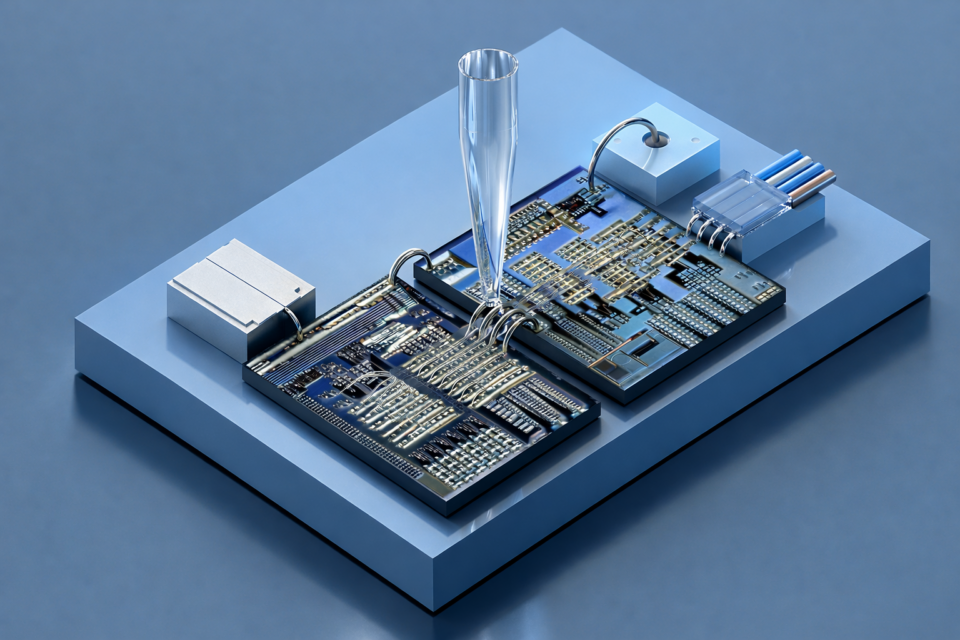
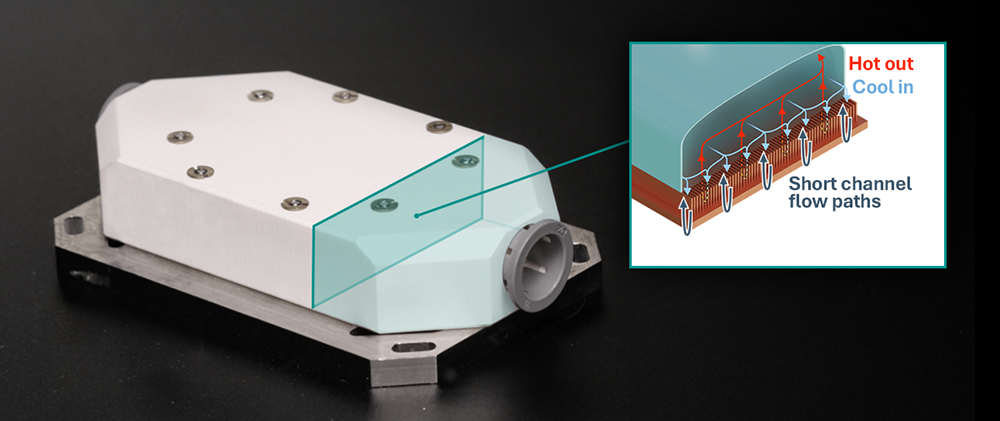
HRL says the core design is a new cooling-block architecture that uses an engineered 3D-printed manifold to distribute coolant through hundreds of short flow paths directly over the processor. By distributing coolant uniformly across the die, HRL says the design addresses constraints of conventional cooling blocks such as long flow channels and friction losses.
In testing, HRL reports a thermal interface resistance of 8.2 °C/kW, pressure drop below one psi per cooling block, and pumping power requirements of less than one percent of rack information technology (IT) power at the block level. HRL also reports removing 40 percent more heat load than state-of-the-art cooling blocks under equivalent pumping power, and supporting warm and hot cooling with up to 70 °C coolant inlet temperatures.
HRL says these results enable cooling up to 3 kW for a single 750 mm2 die, with a design scalable to higher powers for larger multi-chip modules, and support heat fluxes up to 400 W/cm2. HRL also claims it can meet NVIDIA’s anticipated Rubin and Feynman GPU cooling needs, and function as a drop-in replacement for existing data center cooling systems. “We designed this technology with real data center constraints in mind,” said Christopher Roper, Principal Investigator at HRL and technical lead for the COOLERCHIPS effort. “By rethinking how coolant is delivered at the block level, we can cool far more powerful processors using single-phase liquid cooling that fits within today’s data center architectures and operational risk profiles.”
Source: HRL Laboratories