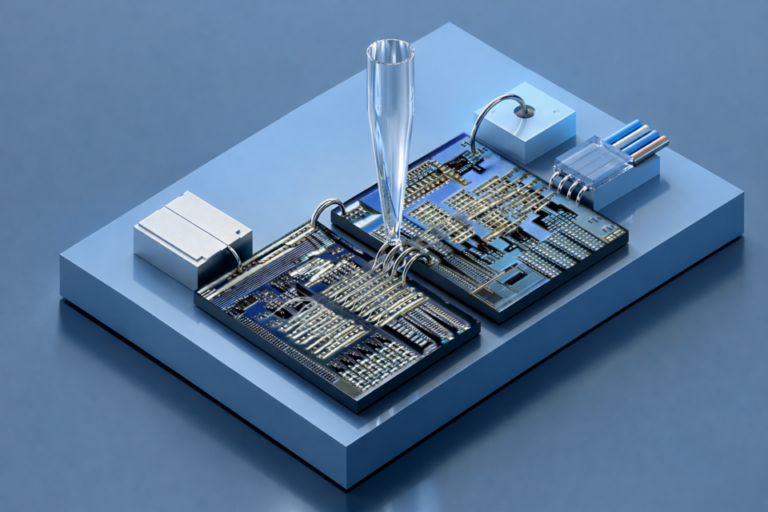


HyperLight has introduced a family of 400G-per-lane thin-film lithium niobate (TFLN) photonic integrated circuits (PICs) aimed at next-generation AI interconnects. The company is positioning the new devices for optical links where bandwidth, signal integrity, and power efficiency are becoming harder to maintain as lane rates climb.
HyperLight lists low insertion loss, low drive-voltage operation, and “exceptional electro-optic bandwidth” as core characteristics of the 400G-per-lane PICs. The company says those attributes are intended to support energy-efficient, high-performance 400G-per-lane optical links, and to provide the electro-optic bandwidth and low-voltage operation needed as electronic ICs hit practical limits at higher speeds.
For data center engineers tracking how AI clusters will scale, 400G-per-lane optics matter because lane rate is a direct lever on aggregate port bandwidth and system density. But moving to higher lane speeds tends to tighten the margins on power, thermal design, and signal integrity across the module, the host, and the network. If the optical engine can reduce electrical drive requirements and optical loss, it can ease some of that integration pressure at the transceiver and switch faceplate level.
HyperLight says the TFLN devices combine high modulation efficiency with extremely low optical loss, and that they enable transmitter architectures using single- or dual-laser configurations. The PICs are manufactured using the company’s TFLN Chiplet Platform, which HyperLight describes as designed for scalable production of high-performance TFLN photonic devices.
“While 400G-per-lane pushes the limits of many technologies from a bandwidth perspective, TFLN provides ample bandwidth margin while maintaining low drive voltage,” said Mian Zhang, CEO of HyperLight. “This enables excellent manufacturability while significantly reducing module power.”
Broadcom tied the PICs to its DSP roadmap: “HyperLight’s high-bandwidth TFLN transmitter PIC, combined with Broadcom’s Taurus DSP platform, enables exceptional signal integrity and energy efficiency for next-generation optical interconnects,” said Vijay Janapaty, Vice President and General Manager of Broadcom’s Physical Layer Products Division. Eoptolink CEO Richard Huang added that the TFLN PIC “reduces the need for dedicated external drivers, lowers laser count, and simplifies module integration—ultimately improving power efficiency, cost, and reliability.”
Source: HyperLight