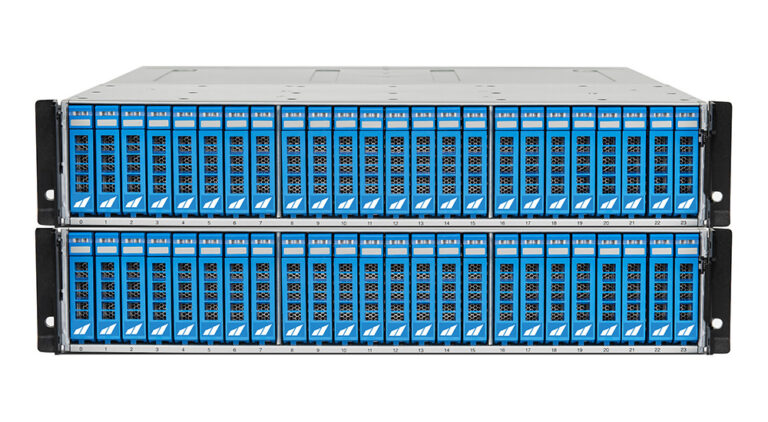
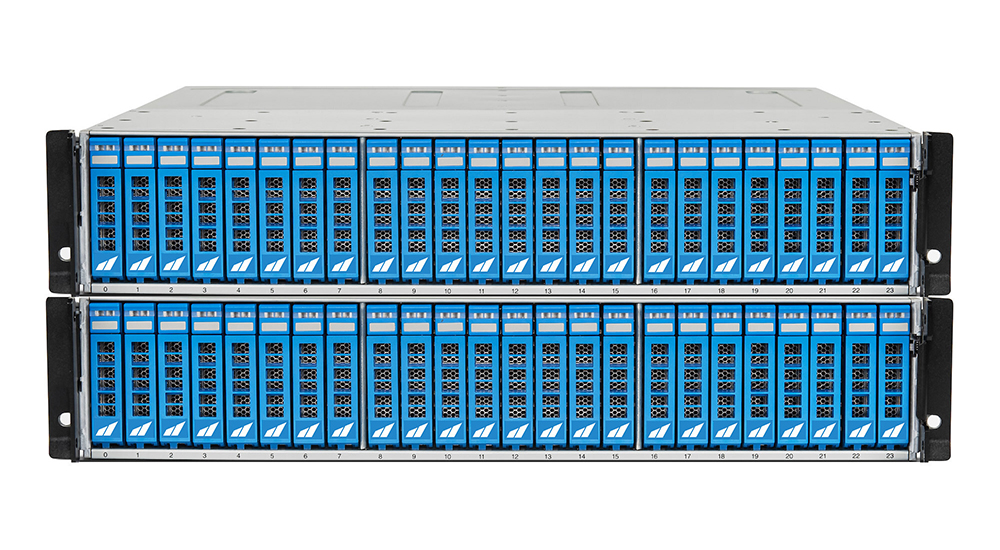
Nimbus Data has introduced FlashMax, a next-generation multiprotocol all-flash storage platform for the modern data center. It combines block, file, and object services in a single system and adds PCIe-based expansion, rack-level resiliency, and hardware-accelerated data reduction “all within a single namespace,” the company says. The goal, Nimbus Data reports, is to reduce operational complexity while improving capacity efficiency, performance, and cost predictability as deployments scale.
FlashMax supports NVMe over Fabrics (TCP and RoCEv2), Fibre Channel, iSCSI, Network File System (NFS), Server Message Block (SMB), and Simple Storage Service (S3) in one platform with a flexible capacity pool. Nimbus Data says block, file, and object storage can coexist within one namespace to reduce silos and simplify capacity expansion. Connectivity options include up to 400G Ethernet and 64G Fibre Channel, targeting workloads such as virtualization, containers, databases, analytics, data warehouses, digital media, and unstructured data.
For efficiency and cost, Nimbus Data says FlashMax uses hardware-accelerated block-level deduplication and compression to reduce raw capacity needs along with power and rack-space requirements. The platform uses industry-standard Non-Volatile Memory Express (NVMe) solid-state drives (SSDs), which Nimbus Data positions as an alternative to proprietary flash modules.
FlashMax also adds DirectLink, a native Peripheral Component Interconnect Express (PCIe) interconnect architecture that Nimbus Data says connects expansion capacity directly to IO controllers with dedicated PCIe bandwidth. Nimbus Data contrasts this with “legacy expanders and daisy-chaining,” claiming DirectLink avoids oversubscription and “latency stacking.” With DirectLink, Nimbus Data reports FlashMax can support over 20 PB raw capacity (up to 100 PB effective) in one namespace.
On resiliency, Nimbus Data says FlashMax uses a patented parallel write-through architecture that commits writes directly to flash rather than Dynamic Random-Access Memory (DRAM), eliminating controller-to-controller cache mirroring and cache destaging. Nimbus Data also claims rack-level failure resilience in one system: one FlashMax system can span separate racks and survive a total rack failure, using built-in synchronous mirroring across racks while presenting “a single redundant namespace.” For management and data services, Nimbus Data says Omni provides fleet-wide monitoring, telemetry, and API-based automation, and FlashMax includes immutable snapshots, remote replication, end-to-end checksums, Redundant Array of Independent Disks (RAID) protection, hardware encryption, and ransomware protection; Nimbus Data adds that software is licensed per system rather than per terabyte.
Source: Nimbus Data