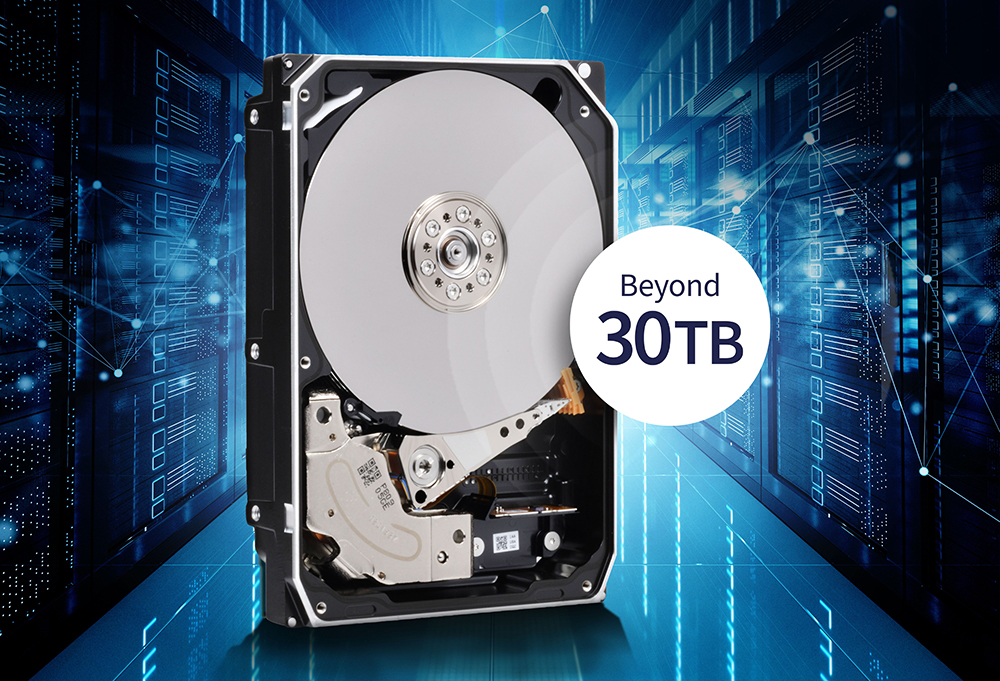
Toshiba has begun sampling M12 Series 3.5-inch nearline hard disk drives for hyperscale and cloud service providers, using Shingled Magnetic Recording (SMR) to reach 30 TB to 34 TB capacities. The company also plans to start sampling Conventional Magnetic Recording (CMR) nearline HDD models with capacities up to 28 TB in the third quarter of 2026.
The M12 Series pairs SMR with Toshiba’s Flux Control Microwave-Assisted Magnetic Recording (FC‑MAMR) technology in a helium-filled drive design. Toshiba also calls M12 its first nearline HDD to use a glass substrate, a change it says increases durability and enables thinner designs.
On the data path, M12 uses a host-managed SMR architecture, where the host system manages data placement and rewrite behavior within the drive. That matters because SMR raises areal density by overlapping tracks, but the overlap can penalize random writes. Host-managed SMR pushes more responsibility into the storage stack, which can be a clean fit for environments that already control data layout tightly, but it’s not a drop-in swap for every nearline workload.
Toshiba rates the M12 SMR drives at a maximum data transfer rate of 282 MiB/s, which it describes as about an 8% improvement versus the previous generation. The company also states power consumption efficiency per terabyte (W/TB) is about 18% lower than prior generations.
For reliability and duty cycle, the M12 Series is designed for 24/7 operation with an annual workload rating of 550 TB. Toshiba lists MTTF/MTBF at 2.5 million hours and an annualized failure rate (AFR) of 0.35%.
Toshiba also said it plans to introduce next-generation products based on Heat Assisted Magnetic Recording (HAMR) and 12-disk configurations in upcoming quarters.
Source: Toshiba