
Delta used NVIDIA GTC to detail a set of 800 VDC power, cooling, and microgrid products aimed at NVIDIA’s next-generation “AI factory” data center architecture. The lineup centers on in-row 800 VDC power racks, liquid-to-liquid coolant distribution units (CDUs), and a microgrid stack that pairs conversion, generation, and storage.
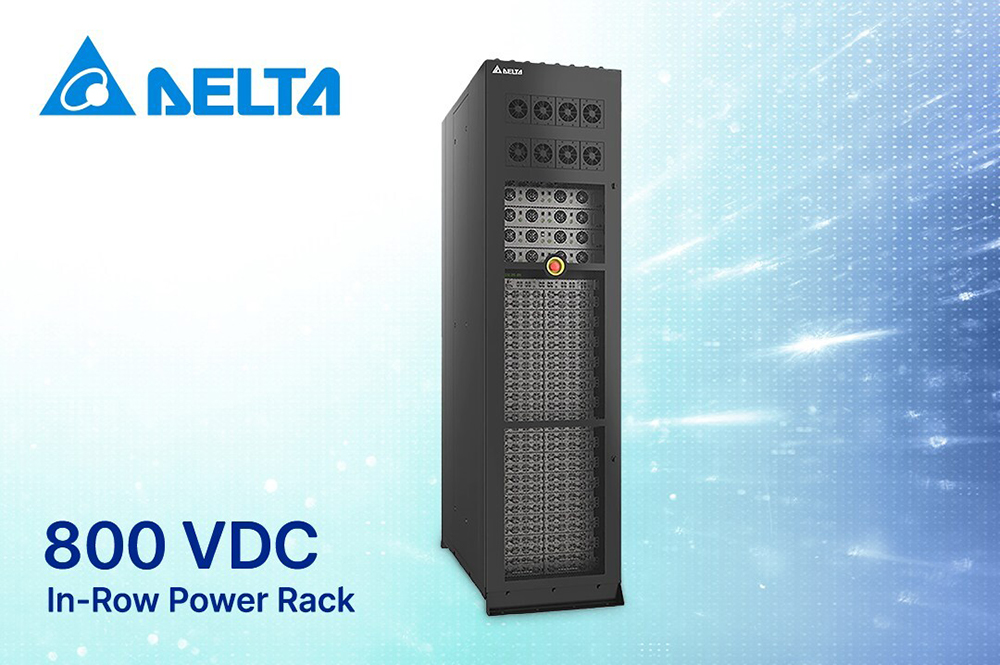
On the power side, Delta described an 800 VDC In-Row 660 kW Power Rack configuration built from six 110 kW power shelves. Each shelf includes an embedded 80 kW battery backup unit (BBU), for 480 kW of total embedded BBU capacity per rack. Delta also listed AC-to-DC efficiency “up to 98%” for the system, supported by newly developed 18.5 kW AC/DC power supply units (PSUs). For NVIDIA MGX-based systems, Delta also highlighted 1RU 90 kW DC/DC power shelves, 1RU power capacitance shelves, and a management switch.
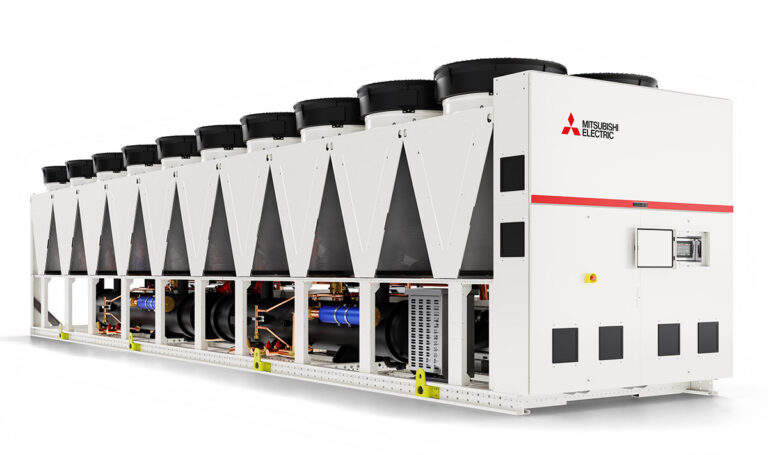
For liquid cooling, Delta introduced a 2.4 MW liquid-to-liquid CDU rated for 2,400 kW of cooling capacity. The unit uses self-contained 800 VDC electrical pumps with an n+1 redundant pump design, and Delta stated an approach temperature as low as 4° C. Footprint is listed as 1,500 mm (W) × 1,200 mm (D) × 2,286 mm (H). Delta also showed a 3 MW L2L CDU rated up to 3,000 kW, with 1.5 LPM/kW and 50 psi hydraulic performance, and a scaling mode of up to eight units operating as a group. For NVIDIA GB300 NVL72, Delta described a 4RU in-rack 140 kW L2L CDU using plate-type heat exchangers to move heat from a secondary (server-side) liquid loop to the facility water system.
Those numbers matter because 800 VDC distribution and high-capacity liquid cooling both target the same constraint in AI buildouts: delivering more usable power and heat rejection per footprint without turning deployment into a bespoke engineering project. But “up to” efficiency and best-case approach temperatures are the kind of metrics operators will want to validate under real rack loads, real water temperatures, and real maintenance constraints.
Delta’s microgrid stack combines solid state transformers (SST), solid oxide fuel cells (SOFC), all-in-one energy storage systems, and an energy management system. Delta said the microgrid is designed to handle step-load changes on millisecond scales while maintaining tight voltage regulation for AI workloads, and it stated SST efficiency “as high as 98.5%” while converting medium-voltage AC to 800 VDC. Franziskus Gehle, vice president at Delta Electronics (Americas), said, “As AI systems push electrical and thermal limits, we are excited to showcase…solutions that are designed for how future AI factories are actually built, powered, cooled, and operated efficiently.”
Source: Delta Electronics (Americas)