
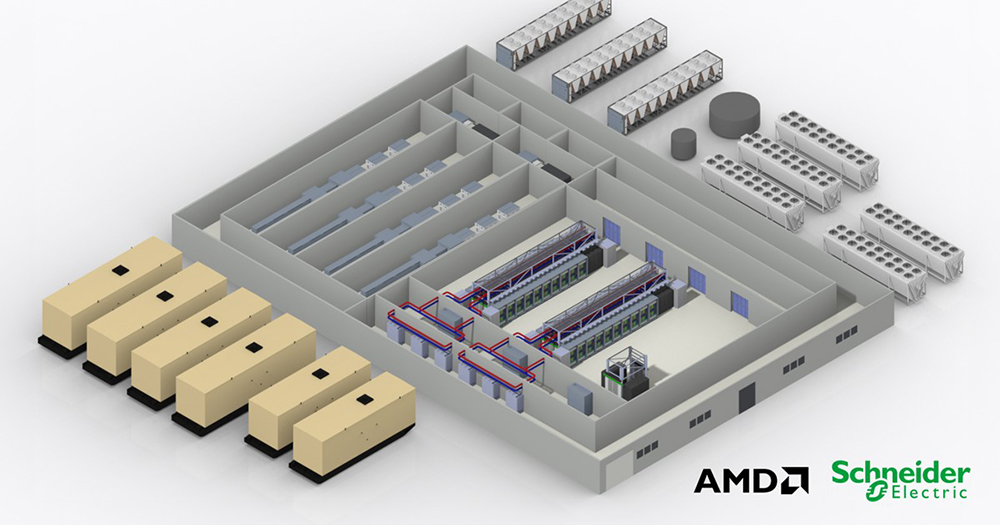
Schneider Electric and AMD have jointly developed and validated a reference design for the AMD Helios rackscale solution, aimed at speeding deployment of high-density AI infrastructure while reducing integration risk and complexity. The design targets what both companies describe as “AI Factory” builds, spanning greenfield sites and high-density retrofits.
The reference design is built around the AMD Helios rackscale platform, which AMD says is powered by AMD Instinct MI455X GPUs, 6th Gen AMD EPYC CPUs, AMD Pensando Vulcano NICs, and the ROCm software ecosystem. Schneider Electric and AMD describe the document as a pre-validated blueprint that ties compute, networking, power, and cooling requirements together so operators can plan and deploy faster.
On the facility side, the design supports AI racks up to 246 kW and modular, multi-cluster deployments with AI clusters up to 10.4 MW of IT capacity. For cooling, it calls out liquid cooling options using Motivair by Schneider Electric CDU-based systems, plus hybrid air/liquid approaches that are described as capable of removing up to 84% of heat.
The reference design is structured around four technical areas: facility power, facility cooling, IT space, and lifecycle software. Validation work cited includes electrical and thermal design using ETAP and EcoStruxure IT Design CFD simulation tools. The package also includes an “Integrated Electrical Digital Twin” capability to model, analyze, and manage infrastructure performance, and support from AVEVA’s Unified Operations Center for real-time monitoring and operational visibility.
Reference designs can be genuinely useful when rack power densities are this high, because power train choices, cooling topology, and control/monitoring tooling quickly become interdependent. But the practical value will come down to how closely an operator’s site constraints match the assumptions baked into the design—especially around liquid cooling architecture, heat-rejection strategy, and the operational model for monitoring and maintenance.
Schneider Electric Executive Vice President, Secure Power & Data Centers Manish Kumar said, “Through our collaboration with AMD, we’re delivering an engineering-backed reference design that bridges the gap between advanced AI compute platforms, energy tech, and real-world data center implementation.” AMD Executive Vice President and General Manager, Data Center Solutions Business Group Forrest Norrod added, “By working with Schneider Electric to create a validated reference design, we are giving customers a practical blueprint to accelerate high-density AI deployments, reduce integration risk and scale with greater confidence and efficiency.”
The companies say the reference design can achieve PUE as low as ~1.12 at full load. It has been validated to ANSI standards for US deployments, and Schneider Electric and AMD say they plan to extend the framework to support IEC standards for future global implementations.
Source: Schneider Electric