When an AI cluster transitions between training and inference, grid demand can surge by tens of megawatts, up to 100 MW, in a burst. When the cycle ends, it collapses just as suddenly. Without power-smoothing measures, a swing like that can excite the natural frequencies of a generator’s turbine shaft and set up a power oscillation between the data center and the machine. Left undamped, the oscillation stresses the generator, shortens its lifespan, or produces power swings ugly enough to trip protection equipment and disconnect parts of the system.
Kale Ewasiuk’s job is to make sure those interactions show up in a simulator before they show up on the grid. He’s an applications engineer at RTDS Technologies, the Winnipeg company whose real-time digital simulator solves a full electromagnetic transient model of the grid every 50 microseconds, fast enough that physical controllers, protection relays, and even GPU racks can be wired into the simulation and can’t tell it from the real thing.
The technique was born at the transmission scale, from the need to validate HVDC converters too nonlinear and control-complex for steady-state modeling, which resolves a three-phase circuit into an RMS equivalent and goes blind to anything faster than the 60 Hz fundamental.
Now the same problem has arrived at the data center gate, and the rules are flipping to match. Ride-through requirements that interconnection agreements once imposed only on generators are starting to land on large electronic loads, and some utilities already require an EMT model before a data center can connect. Meanwhile transmission planners work on five-to-10-year horizons while data centers want hundreds of megawatts in 1.5 to two years.
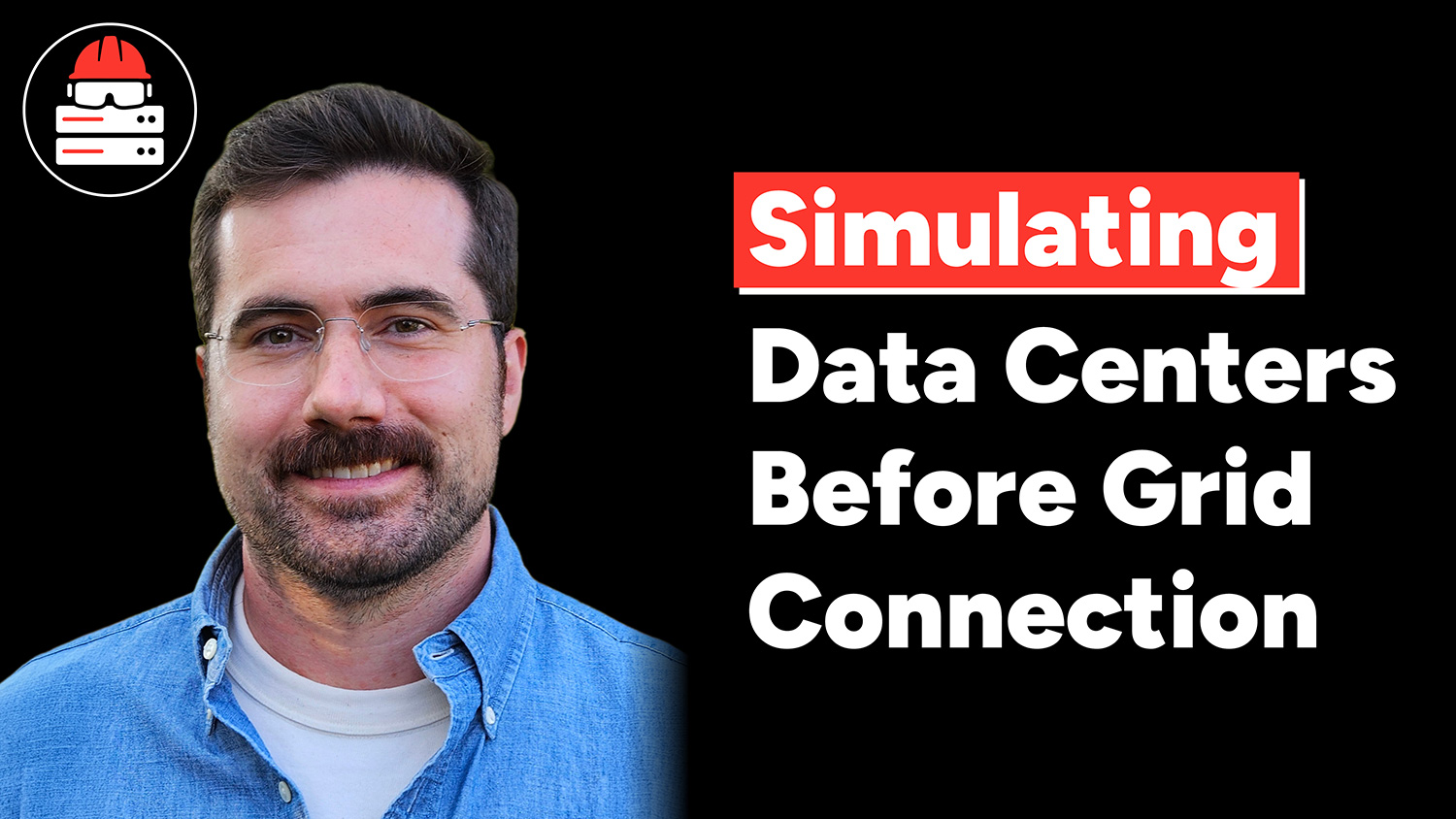
The Data Center Engineer sat down with Ewasiuk to talk about what electromagnetic transient (EMT) simulation and hardware-in-the-loop (HIL) testing actually do, where a data center stops acting like a load and starts acting like a microgrid, and which transients worry him most.
Watch the full interview
The following is our conversation, lightly edited for length and clarity.
Can you explain hardware-in-the-loop and electromagnetic transient simulation in practical terms?
We’re providing the matrix to simulate the real world that the equipment thinks it’s in.
Kale Ewasiuk: A lot of the electrical engineers listening will have probably heard of SPICE programs before. EMT is sort of a subset of the SPICE algorithm. The idea is that you take a circuit and you break down the elements, like the capacitors, the inductors, the switches, and the sources, and you resolve it into an equivalent current source and resistor. Each time step, you modify those resistances and current sources to give yourself a step-by-step simulation of your electrical circuit. Something that I love: the first thing you learn in electrical engineering is Ohm’s law and Kirchhoff’s current law, and that is basically at the heart of the EMT algorithm.
Thanks to parallel processing with real-time simulation, you may be able to solve your circuit in real time. What that means is, if you have a 50-microsecond time step, your computation system that’s simulating the circuit is solving each iteration, each step of the wave, in that 50-microsecond time step or less. That’s a big if. It’s easier said than done.
But what this allows engineers to do is interface with that computation system that’s simulating the circuit. This allows us to connect devices like controllers or relays so that they think they’re connected to the actual grid. These controllers or relays can’t differentiate between the signals they’re receiving, whether they come from a current transformer or from the simulator itself.
A fun analogy I like to give: real-time digital simulation and hardware in the loop is like putting your equipment in the matrix, where we’re providing the matrix to simulate the real world that the equipment thinks it’s in.
At what point does traditional modeling stop being enough?
EMT simulation allows you to simulate those control complexities as well as those events that happen much faster than the fundamental frequency.
Ewasiuk: It might be easier to answer if I take a step back and discuss the origins of RTDS. In the past, HVDC systems, which stands for high-voltage direct current, were a new technology, and engineers needed to understand how these HVDC systems would interface with the transmission grid.
RTDS was designed to simulate this very nonlinear and very control-complex equipment so that engineers could understand how these converters interact with the grid, but also, as the grid evolves, how is this converter going to behave?
Traditional modeling typically involves steady-state analysis and transient analysis, and both of these methodologies resolve a three-phase circuit into its RMS equivalent. In other words, you take a three-phase AC group like you would see in your overhead transmission lines, resolve that into a single line, and simulate the circuit from there. What this forbids you from doing, though, is studying events that happen faster than the fundamental frequency. EMT simulation allows you to simulate those control complexities as well as those events that happen much faster than the fundamental frequency, which will be 60 hertz in North America and 50 hertz in Europe.
What are the risks if we get these interactions wrong in the real world?
Ewasiuk: Firstly, the power system is an incredibly large machine. A really good quote that I once heard, and it has stuck with me my entire life, is: the power system is the largest machine that humans have ever built. The idea behind that is that the machines spinning up in Winnipeg, Manitoba, where I live, are electromagnetically coupled to the machines down in Florida, provided there’s an electrical path there. If you make a mistake on one end of the system, those mistakes can propagate.
Another thing to add: there’s a ton of risk associated with making changes to the power system. It’s incredibly expensive, but also people’s wellbeing is at stake. It’s not very practical to take an outage for a city to test a new generator that you want to install. So it’s a better approach for an engineer to simulate it, try a bunch of different designs or control parameters or special protection schemes, and gain that confidence before proceeding with a multimillion or billion-dollar investment.
Where are HIL and EMT used most effectively today: utilities, renewables, EV infrastructure?
In the context of data centers, you may have a GPU rack, and you want to test its performance and how it interfaces with a solid-state transformer.
Ewasiuk: All of the above. But first I’ll mention: when I met you at the conference, you saw a sign that said 800 volts HVDC, right? There’s this new data center architecture. Well, in my world, HVDC refers to 800 thousand volts. So starting at the highest voltage level, that was the genesis of RTDS Technologies, the need for validating control systems.
Going down the scale a little bit, microgrids would be a very popular application for our tool. You would have a centralized microgrid controller that coordinates things like voltage references, energy references for battery storage, timing the closing and opening signals of breakers to resynchronize or disconnect with the grid. And again, back to the matrix analogy: the microgrid controller doesn’t know that it’s not connected to the actual grid, provided your simulation for your hardware-in-the-loop model is accurate. Moving down the scale a little further, renewable sources like solar and wind inverters, validating the control systems behind those.
Another emerging application is power hardware-in-the-loop. So far I’ve mentioned the idea of interfacing with a controller or a relay. What power hardware-in-the-loop involves is connecting a power amplifier and controlling that amplifier via the hardware-in-the-loop simulator. In the context of data centers, for example, you may have a GPU rack, and you want to test its performance and how it interfaces with a solid-state transformer. What you could do is model the solid-state transformer and the rest of the power grid using a tool like RTDS. The RTDS would conduct the simulation of the grid, but translate what the equivalent impedance, voltage, and current should be for the load that you’re testing, like the GPU rack.
Another very popular application is protection testing. I mentioned that you can connect signals to the RTDS simulator. You can also connect Ethernet-based devices. A very popular topic right now is the digital substation. The idea is that you would have equipment like protection systems and controllers connected over a network, and you can test that out with the RTDS simulator and de-risk your system to things like cybersecurity attacks, but also just validate the fundamental operation of the devices that you’re programming.
Hyperscale facilities are starting to look more like complex power systems than traditional loads.
A data center is a lot smaller in footprint than the traditional power system. That makes protecting the internal equipment of the data center a lot more complex.
Ewasiuk: Yeah, absolutely. These data centers are starting to look basically like microgrids. We have a mixed fleet of resources in there, whether it’s electronic load, but also generating assets or energy storage assets like backup batteries or diesel generators. Some renewables can be tied in as well.
Those are where the similarities lie. But I could also add where the differences start to become apparent. A data center is a lot smaller in footprint than the traditional power system. That makes protecting the internal equipment of the data center a lot more complex. It also increases the interaction between controllers, mostly because there’s just less impedance between the equipment being run in the data center. Another huge difference is the resource mix. In these data centers, the load is mostly going to be electronic load. In the conventional power system, most of the load will be your conventional passive load or motors.
At what scale does a data center start behaving more like a utility asset than a traditional load?
Ewasiuk: There are a few different ways to look at it. You could look at it in terms of its electrical effects. As the data center increases in its capacity, in its megawatts, the influence on the grid will increase. Its ability to change the frequency of the grid will become apparent.
But also, from an interconnection standpoint, there are a lot of influences. As these data centers scale up into the hundreds of megawatts, infrastructure needs to be built to support them, whether it’s transmission lines or capacitors to prop up the voltage. And a very interesting conflict that we’re seeing is the lead times between these sorts of things. To build transmission lines, you’ve got to go through environmental regulations. Just the time it takes to build a 100-kilometer transmission line is significant. A lot of planners are usually looking at things in the five to 10-year range, where these data centers want hundreds of megawatts in the next 1.5 to two years.
So there’s a very big mismatch between the two. And because of that mismatch, we’re starting to see data centers employ more internal energy production, like solar or wind, as well as backup energy for when the grid has to disconnect.
Power densities are clearly increasing. What failure points or unknowns are going to start showing up?
As AI workload cycles transition between training and inference, you could see a sudden burst of energy demand in the tens to 100-megawatt range.
Ewasiuk: I think the largest unknown that we’re going to see—and spoiler alert, EMT can help solve this—is the interaction between the control system and the grid. Take an inverter-based resource like a data center, which is fundamentally driven by a UPS or, in the future, a solid-state transformer. The control system likes to act fast. The traditional power system likes to operate slow. It uses the rotating mass of generators to supply and adjust as load changes. And because of the difference in speed between the two, some kind of nasty interactions can occur.
One of them in particular is the ramp rate of some of these AI loads. As AI workload cycles transition between training and inference, you could see a sudden burst of energy demand in the tens to 100-megawatt range. And once that cycle is done, you see a sudden collapse.
So without any power-smoothing measures, that sudden change of power can do a few things. One, it’s going to increase the frequency of the grid, so the grid’s going to have to respond to that. The generators are going to have to shed a bunch of power when that power drops. Or it’s going to excite frequencies in the power system, which may correspond to the shaft of a generator’s turbine. Those natural frequencies can interact with each other, and that can create this power oscillation between the data center and the generator. If not damped properly, through control systems or through a well-designed power system, they can increase the mechanical stress on the generator, decreasing its lifespan, or create nasty power swings, which can cause protection equipment to trip and disconnect parts of the system.
Which of these transient events concern you the most?
Ewasiuk: It would be the power ramp rates and the cause of oscillation. A common thing that you’ll hear in transmission planning is that frequency is king. Frequency, at least in the traditional grid, represents the balance of power between what you’re producing and what you’re consuming. Transmission operators keep a steady eye on the frequency of the grid at all times, and most grids will operate frequency within 1%. They want to keep it at 60 hertz the entire time. As that load suddenly swings, the generators will have to keep up, or some other measures will have to take place.
Because of problems like this, we’re seeing a lot of data center builders contemplating how to smooth out the power their data center is consuming. We have things like battery energy storage systems. There are things like STATCOMs, which can operate more quickly. Devices like the solid-state transformer might be able to help out with that. But there’s a lot of uncertainty with how these topologies are going to look in the next couple of years, which adds another challenging element for electrical engineers in the power system space.
Interconnects are changing, but how are the requirements changing?
Ewasiuk: One very interesting change that we’re seeing: traditionally, the interconnection requirements would stipulate ride-through requirements for generators. I mentioned previously that the generators are typically what regulate the frequency. What we’re seeing now is ride-through requirements for data centers. Say a frequency or voltage excursion occurs on the grid, and the data center disconnects so that it can go on battery backup and ignore the disturbance. That’s not going to be desirable from a grid perspective, because if a voltage excursion occurs and then a large load disconnects, that’s going to compound the issue. So a very big change that we’re starting to see is these ride-through requirements for data centers and, in particular, large electronic loads.
Are utilities becoming more cautious about their interconnection approvals?
Ewasiuk: On one hand, yes. On the other hand, there’s such a drive, and there are so many economic incentives to be made here, that the large influx of data centers could be the thing that moves the needle and gets the transmission system to develop a lot quicker than it has traditionally. So yes, transmission owners are very cautious, especially with unusual interconnection requests. But as we get more comfortable with data center technologies and how to study them, especially through tools like EMT, confidence will go up.
Another aspect: I’m speaking toward things like a capacity perspective. Transmission planners like to look at the system in terms of, can we supply this given load at this given time? Another side of the coin is looking at the power system in terms of energy. Do we have enough water in the hydro dams to supply power for the next one to 10 years? Are we going to have enough solar energy to supply this? Are we going to have enough diesel, enough natural gas? That adds another complexity to the system, which is probably going to drive a lot more renewables to be installed.
And these issues that I’m talking about with data centers, the fast-acting control systems and how they’re interacting with the grid, these issues aren’t unknown to us. We’ve seen this with a lot of renewable energy systems. These problems might start to pop up more. But on the other hand, power engineers now have a better grasp on how to fix issues with integrating inverter-based resources. EMT is a tool we can use to better define how to fix the problems that have occurred with IBRs in the past, and help us design our control systems so that issues like control interactions don’t come into play.
Do you see a future where HIL or EMT validation becomes a requirement for utilities and transmission operators?
Ewasiuk: We’re already seeing it with some utilities. The interconnection requirements that a transmission-owner utility stipulates require what is necessary to connect a piece of equipment to the grid. Traditionally, you would see very strict requirements for generators. But as these data centers are acting a little bit more like heavy inverter-based resources as well as generators, and due to their complex control profiles, they need to be better understood. So we are seeing some utilities require EMT simulation for data centers. Previously, we have seen it for inverter-based resources like renewables or HVDC.
Where should an engineer designing or supporting data center infrastructure today be paying more attention?
Ewasiuk: Thinking about things from a planning and transmission-owner perspective, I think having accurate and detailed models of the system you want to install is important, and it is going to become more important as grid interconnection requirements start mandating these models. I would also pay attention to how these interconnection requirements are evolving over time, because that might shape the design of your data center.
From my experience conducting these planning studies, any lack of information, or assumptions that have to be made by the planning engineer, can result in significant delays in the study process. From the data center perspective, having that detailed simulation model is not only beneficial for you to understand your data center, how it’s going to interact with the grid, and how you need to protect for it. It’s also incredibly useful for the people planning to interconnect your data center to the grid, because they need to understand how faults are going to impact the system with this data center connected. As the grid evolves, are we still going to be able to accommodate this data center?
It’s not just looking at whether the data center will fit into the grid today, but will it fit into the grid in 10 to 30 years? Having a detailed model from the get-go is of utmost importance.
Do you think we’re collectively underestimating anything?
Ewasiuk: I think we were perhaps underestimating how quickly these topologies are changing, and how the assumptions we have about data centers could be incorrect. The conventional power system is full of synchronous generators and static var compensators. We really understand these things well, and we have good models for them. But because data center topologies are changing, and new technologies like 800-volt DC with a solid-state transformer are becoming more popular, we don’t exactly know, for example, where the energy storage is going to be. Is it going to be on the 800-volt DC link? Is it going to be on the medium-voltage connection? These assumptions can greatly change the results of the study.
So I think it’s about trying to be agile and understanding that these technologies can change. The outcome of studying a generic data center model today, and there aren’t very many of those, might be vastly different from what you actually receive for your model data in six months.