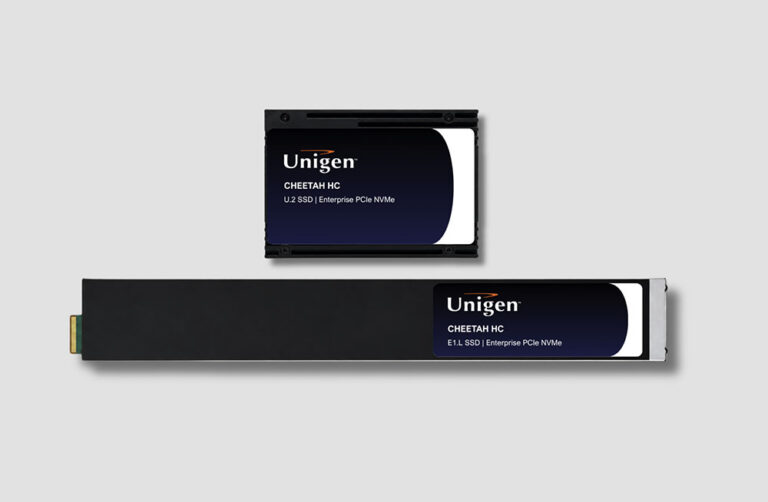
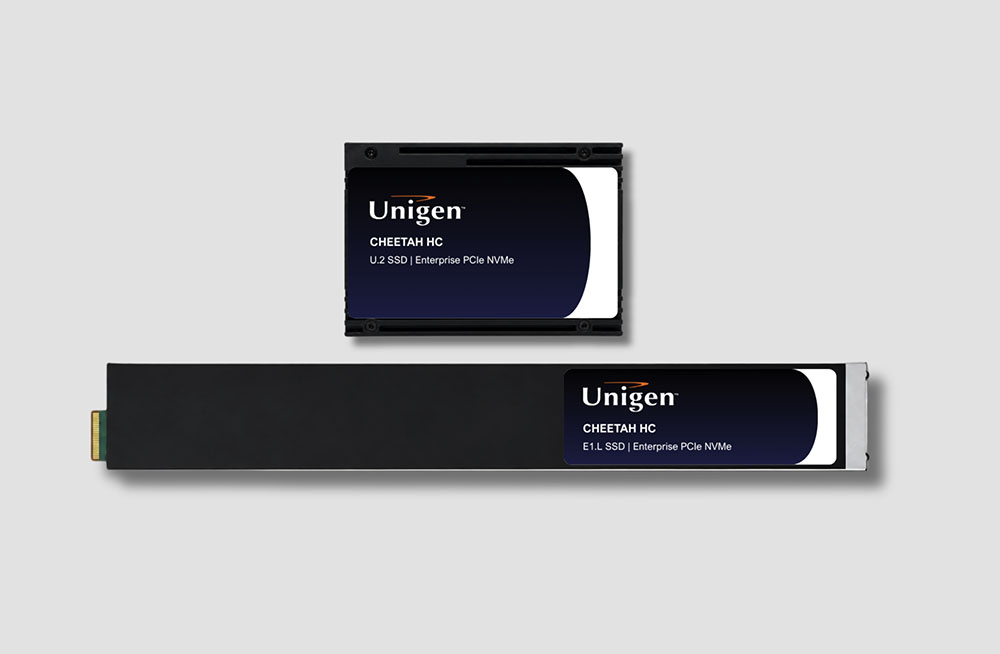
Unigen has introduced the Cheetah enterprise SSD series, adding two PCIe Gen5 x4 NVMe 2.0 product families aimed at AI infrastructure and hyperscale storage: Cheetah Storage Class Memory (SCM) SSDs for low-latency tiers and Cheetah High Capacity (HC) SSDs for dense capacity tiers. Unigen says both families are now in production.
The Cheetah SCM line is positioned for write-heavy and latency-sensitive work, with endurance ratings up to 60 DWPD for random workloads and 80 DWPD for sequential workloads. Unigen lists a 16-channel NAND architecture with a DDR5 interface, and it’s offered in U.2, E1.L, E1.S, and E3.S form factors for deployment flexibility across server and storage platforms.
On the capacity side, Cheetah HC SSDs target large dataset storage while staying on the same PCIe Gen5 x4 NVMe 2.0 interface. Unigen specifies 16 NAND channels and a DDR5 interface, plus “advanced security features.” Capacities scale up to 122 TB in U.2 and E1.L form factors.
For data center architects, the practical takeaway is straightforward: Unigen is pitching a two-tier NVMe storage approach where the SCM drives are used for active datasets, caching, scratch space, and write acceleration, while the HC drives hold larger, colder datasets such as model files, training data, embedding databases, and archives. That’s a familiar pattern in AI clusters, where mixing endurance-optimized and capacity-optimized SSDs can be an easier lever than trying to make one drive type satisfy every workload constraint.
Unigen lists intended deployments that include AI training clusters, LLM infrastructure, GPU inference farms, hyperscale cloud storage, HPC, enterprise storage arrays, vector databases, disaggregated storage architectures, and GPU Direct Storage environments.
Source: Unigen