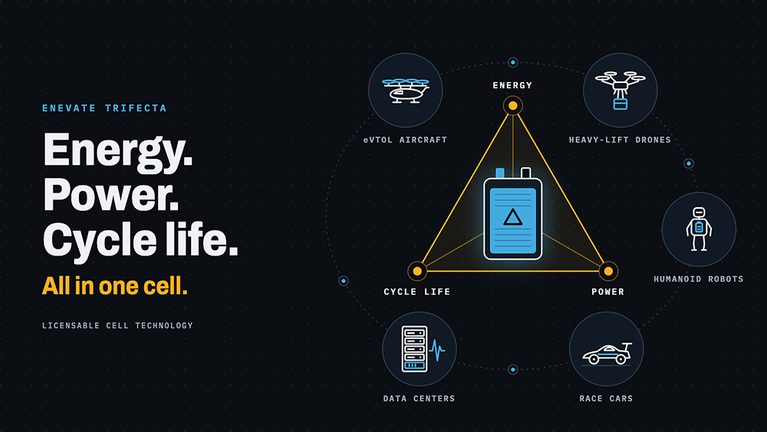
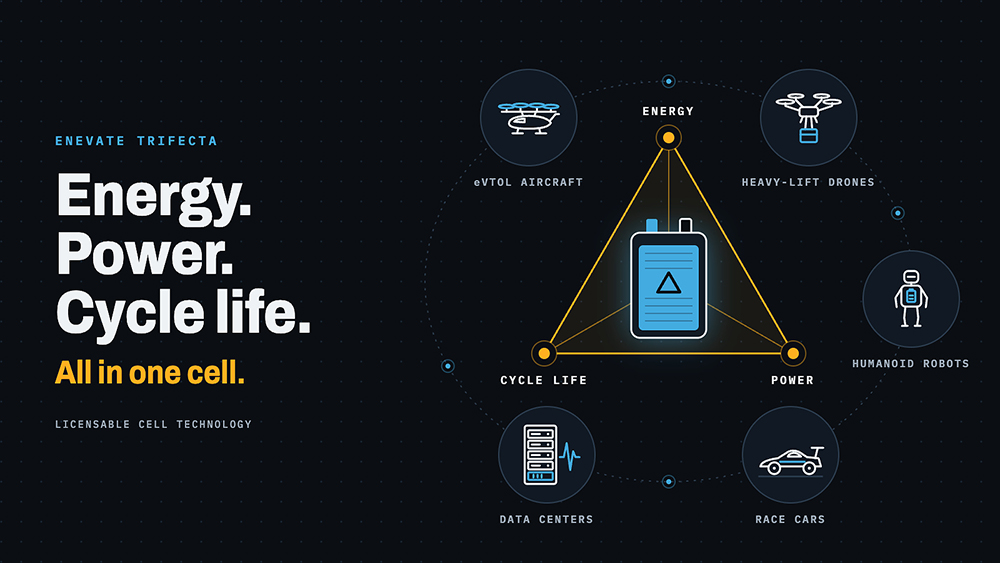
Enevate Technologies has introduced Trifecta, a licensable battery cell technology it says is designed to reduce the usual tradeoffs between energy density, power capability, and cycle life. The company is targeting use cases that include drones, humanoid robots, race cars, data center power systems, and eVTOL aircraft.
Trifecta is presented as a set of five modeled cell configurations, each with a stated energy density (Wh/kg), discharge/charge rate (C-rate), and expected cycle life. Enevate says the designs build on a successful proof of concept with earlier prototype cells.
Trifecta configurations and modeled targets
Trifecta Surge is listed at 400 Wh/kg, 40 C, and 500 cycles, with example applications including racing, data center power, and heavy-lift drones. Trifecta Prime is listed at 425 Wh/kg, 20 C, and 1,000 cycles, aimed at humanoid robots, commercial drones, and eVTOL. Trifecta Sprint is listed at 480 Wh/kg, 20 C, and 20–50 cycles for high-power, limited-use systems.
On the higher-energy, lower-rate end, Trifecta Endurance is listed at 475 Wh/kg, 1 C, and 1,000 cycles for long-life platforms at moderate power. Trifecta Range is listed at 545 Wh/kg, 1 C, and 20–50 cycles for long-endurance and single-mission drones.
For data center operators, the headline implication is power density: higher Wh/kg can reduce pack mass and footprint, while high C-rate capability is a direct input into how aggressively a battery can support fast charge and high peak discharge. But the numbers here are modeled design targets, not shipping cell specifications, so engineers should treat them as a starting point for validation work, not a drop-in procurement spec.
Benjamin Park, CEO of Enevate Technologies, said, “Engineers have spent years designing around their batteries. Trifecta flips that. We want to have open conversations about how our technology can change how you design things.”
Enevate says it works with customers to match or tailor a configuration, and then helps get cells built “by a licensee, through a custom build, or by the customer’s existing supplier.” The company is also inviting battery manufacturers to license Trifecta to produce cells for their own customers.
Source: Enevate Technologies