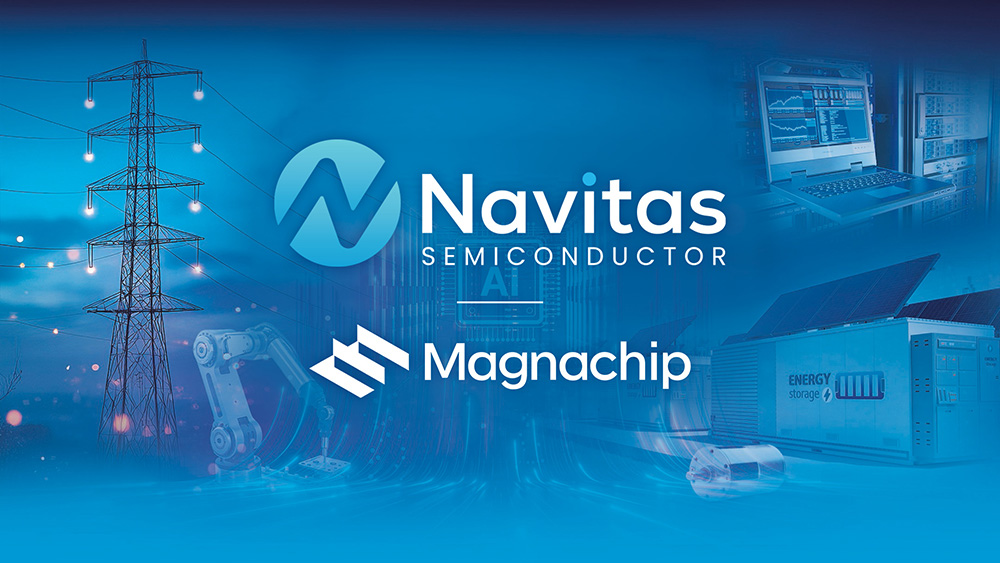
Navitas and Magnachip have entered a license agreement aimed at speeding adoption of high-voltage (HV) and ultra-high-voltage (UHV) silicon carbide (SiC) devices. The deal gives Magnachip access to Navitas’ GeneSiC technology portfolio across 1200 V, 2300 V, 3300 V, and higher voltage classes, with an initial focus on power markets in Korea.
Under the agreement, Magnachip will license Navitas’ GeneSiC Trench-Assisted Planar (TAP) technology to enter HV and UHV SiC. The companies said the arrangement also provides Magnachip access to Navitas’ SiC supply chain and materials ecosystem, with the goal of supporting faster market entry.
A key technical and operational detail is where the technology is expected to land: the companies said the SiC technology is planned to be ported, qualified, and internalized at Magnachip’s fab in South Korea. If that qualification work proceeds as planned, Magnachip would be able to build devices based on Navitas’ established SiC device platforms while keeping continuity with the existing materials and supply base that supports them.
For data center operators, HV and UHV SiC adoption doesn’t show up as a single “data center” part number, but it matters upstream. Higher-voltage power conversion is a recurring theme in grid infrastructure, energy storage, and industrial electrification, and wide-bandgap devices like SiC are one of the tools designers use when efficiency, voltage capability, and reliability targets start getting harder to meet with conventional silicon.
Navitas President and CEO Chris Allexandre said, “By licensing our proven GeneSiC technologies and supporting Magnachip through our supply-chain and materials ecosystem, we are creating a path to scale advanced SiC solutions more rapidly while enabling a deeper, long-term collaboration between our companies.” Magnachip CEO Chae Lee said the GeneSiC technology “complements our existing MOSFET and power semiconductor portfolio” and is intended to help serve customers requiring “higher efficiency, higher voltage capability and more reliable power conversion solutions.”
The companies also said the agreement includes broader engagement beyond SiC, with additional partnership areas expected to be detailed later.
Navitas and Magnachip did not disclose pricing or a commercialization timeline in the information released.
Source: Navitas