
Stored Energy Systems (SENS) is promoting its PowerCab2 integrated DC UPS system as an alternative to traditional battery-room-based DC power designs for large data center campuses, including gigawatt-scale builds. The company’s pitch is straightforward: consolidate critical DC power functions into a compact, factory-tested platform that reduces footprint and infrastructure cost in PDCs and E-houses.
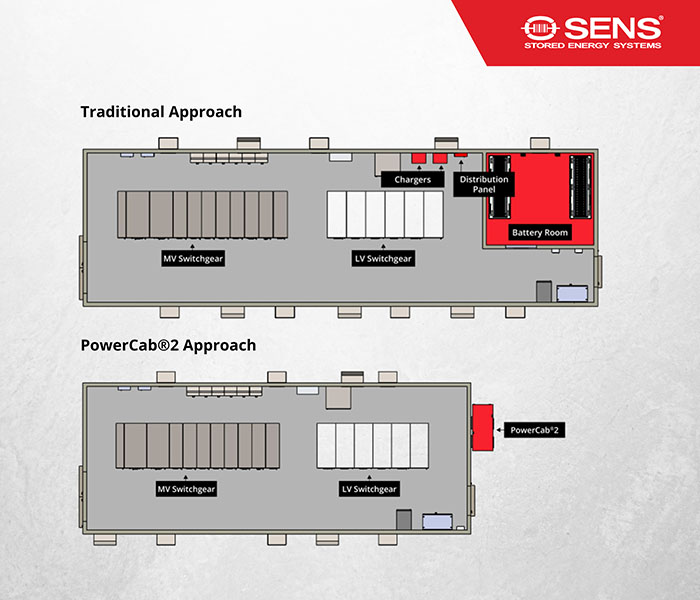
PowerCab2 is designed to replace a conventional data center battery room and “hundreds of discrete DC power components,” while eliminating the need for a dedicated battery room. SENS estimates the system can reduce PDC and E-house footprints by about 20% or more, cut onsite integration work, and potentially accelerate deployment because the platform is factory-engineered and factory-tested.
For campus-scale planning, SENS quantifies the footprint and cost impact in terms many owners and EPCs will recognize. PowerCab2 typically removes more than 300 ft² of dedicated battery-room space from a PDC or E-house. Using an estimated installed cost of $850/ft², SENS calculates that as roughly $255,000 in capital savings per structure. With a 1 GW campus potentially containing about 80 to 300 PDCs or E-houses, the company estimates savings of $20 million to $80 million, which it also expresses as roughly $20,000 to $80,000 per MW of campus capacity.
Those are big numbers, but they’re also the kind of estimates that depend heavily on local construction economics and how each operator defines and allocates “battery room” space inside a broader electrical building. Still, the underlying engineering idea is familiar: reduce the number of field-installed components and interfaces, shrink the physical footprint, and shift labor risk from the jobsite to a factory environment.
On electrical options, SENS lists support for 24 VDC, 48 VDC, 125 VDC, and 240 VDC control and station power, along with multiple battery chemistries. Redundancy options include N+1, N+N, and dual-bus configurations. The system is available in NEMA 1 and NEMA 3R enclosures, rated for operation from −40°C to 55°C.
SENS also makes a broad market adoption claim, stating that 80% of hyperscale and colocation data center campuses in the United States use SENS DC power technology, representing multiple gigawatts of capacity.
“Data center campuses are growing to gigawatt scale, yet DC power still consumes valuable space in PDCs and E-houses,” said Eric Solanyk, Vice President, Mission Critical Power Systems at SENS. “Our PowerCab platform changes that architecture by bringing critical DC power functions together in one factory-engineered system. At campus scale, this solution delivers significant project savings while providing the scalability and reliability these facilities require.”
Source: Stored Energy Systems (SENS)