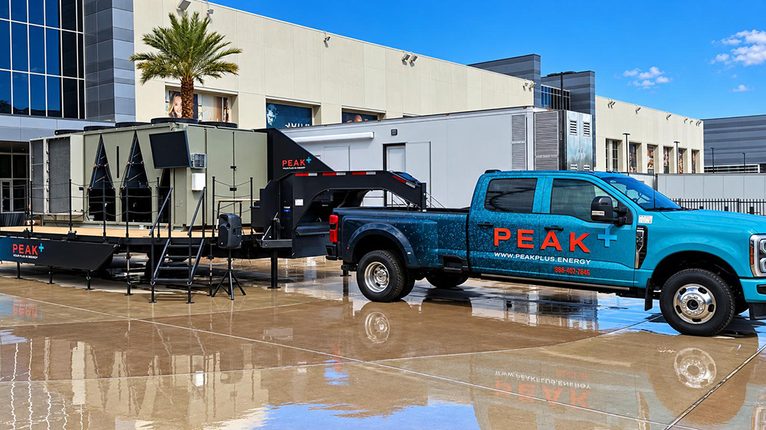

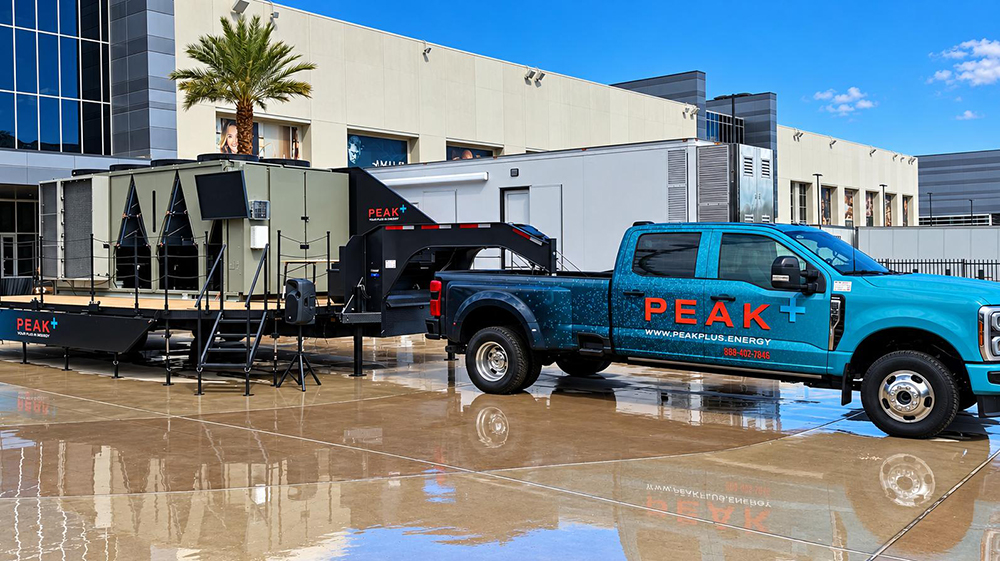
Peak+ Energy has built a mobile “Adiabatic Pre-Cooling in Action” demo truck to show data center operators how adiabatic pre-cooling can reduce peak condenser entering-air temperatures on air-cooled equipment. The trailer-mounted unit is designed to let engineers see an operating system, not just a static display.
The demo truck integrates two Peak+ adiabatic pre-cooling products, Peak+ CORE and Peak+ HALO, on a trailer-mounted air-cooled chiller. Peak+ says the setup includes working condenser fans, a live water supply, and functional controls so visitors can watch adiabatic assist operate in real time.
What’s on the trailer
Peak+ CORE is built for v-coil style air-cooled chillers. Peak+ describes it as factory- or field-installable, integrating directly in front of the condenser coil. The company also says CORE is intended to prevent chiller derate driven by recirculation and/or generator exhaust.
Peak+ HALO is a frame-based system that wraps around existing equipment. Peak+ lists supported targets as air-cooled chillers, dry coolers, DX units, remote condensers, and generator inlets, and says HALO fits both new construction and retrofits. The company calls it the option “when deep temperature drops are required.”
Adiabatic pre-cooling is a familiar tool for air-cooled heat rejection in hot ambient conditions, but the practical tradeoffs are always the same: water consumption, maintenance burden (media, nozzles, water quality management), and how well controls avoid over-wetting while still delivering a meaningful entering-air temperature drop. A mobile, instrumented demo is useful because it lets facilities and mechanical teams inspect the mechanical layout and controls approach up close before committing to a site trial.
“Data center operators are demanding adiabatic assist systems with low water usage and easy maintainability to mitigate high ambient temperatures,” said Paul Heapy, Vice President of Business Development at Peak+. “Bringing this demonstration unit directly to the people making cooling decisions for the next generation of digital infrastructure gives them the opportunity to experience firsthand how our system uses minimal water to precisely suppress the entering air temperature before it enters the coils.”
Source: Peak+ Energy