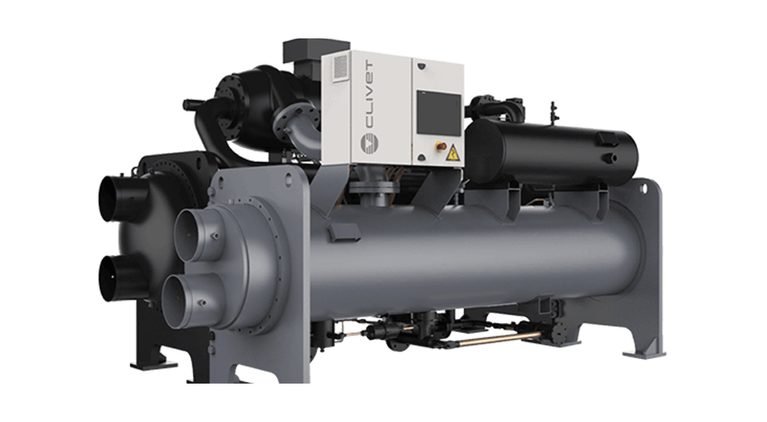
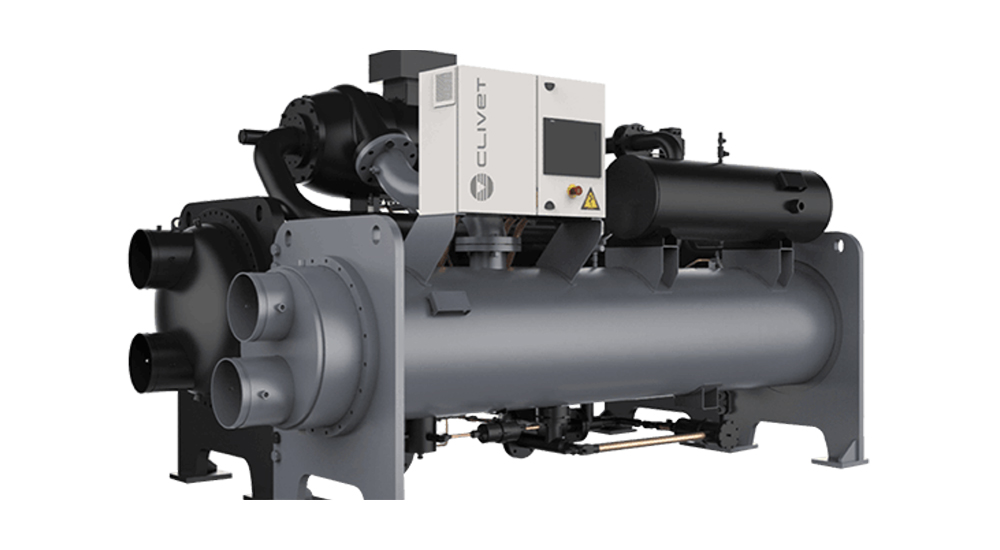
Clivet used OCP Global Summit 2026 to unveil a next-generation magnetic-bearing centrifugal compressor and a “full-chain” liquid cooling solution aimed at GW-scale AI data centers. The company also received a “2026 GW-Scale Open AIDC Excellent Technical Presentation Award” tied to a talk on next-generation AI data center cooling architecture.
In that presentation, Dr. Yunxiao Ding, Director of the Research Institute at Midea Building Technologies, described an approach built around what Clivet characterized as a “magnetic cooling source” and a “cooling-continuity architecture.” The company’s technical framing starts with liquid-cooled AI infrastructure where cold-plate supply temperatures rise toward 45 °C, expanding free-cooling operating windows and increasing interest in dry heat rejection under water constraints.
Clivet outlined three engineering challenges for systems designed to prioritize free cooling while keeping mechanical cooling as backup: delivering efficiency across a wide operating range, maintaining smooth two-way transitions between free cooling and mechanical cooling without interruptions, and integrating higher-performance cooling equipment into constrained footprints while preserving space for heat exchange and maintenance.
The centerpiece compressor design pairs an independent dual-shaft, variable-speed drive architecture with selectable single-stage and two-stage operation. Instead of a traditional single-shaft, same-speed dual-stage structure, each impeller has its own variable-frequency drive. Under higher pressure ratios, both shafts operate at different speeds for compression; under lower pressure ratios, the second stage shuts down and bypasses, shifting the compressor into single-stage mode.
Clivet reported two headline performance claims for that operating flexibility: compressor power reduced by up to 40% at the same cooling capacity, and maximum inlet flow at low pressure ratios increased by approximately 70%. Those are big numbers on paper, but in practice the value will come down to whether the compressor and controls can hold stable operation through seasonal swings and fast mode changes without causing oscillations upstream in the liquid loop.
For transitions, Clivet described “single-stage startup and preconditioning” to manage both directions of switching. Moving from free cooling to mechanical cooling, the single-stage path is intended to rapidly build system flow and cooling capacity to shorten recovery time after power interruptions. In the reverse direction, Clivet said single-stage preconditioning can smooth system fluctuations to avoid cooling interruptions during the mode change.
On packaging, Clivet said it nested outboard bearings into volute recesses, integrated multifunctional components, and used compact motors so the dual-shaft drive architecture maintains the same axial dimensions as a traditional single-shaft unit.
Midea also noted it appeared on NVIDIA’s MGX ecosystem participating company list at the event.