
Supermicro is working with Nokia to deploy AI-RAN (Artificial Intelligence-Radio Access Networks) using the NVIDIA Aerial RAN Computer platform, aiming to push accelerated compute from distributed cell sites to centralized network hubs. The stack combines Supermicro infrastructure, NVIDIA accelerated computing, and Nokia RAN software so radio workloads and AI workloads can run on shared infrastructure closer to the access network.
For operators designing edge compute footprints, the practical implication is straightforward: if RAN and inference can share the same hardware pool, you can place GPU capacity where latency and locality matter, without standing up a separate edge AI platform at every location. But this also raises the usual engineering questions around power, thermals, and operational boundaries when telecom and AI stacks converge on the same boxes.
The companies describe the target applications as proximity- and predictability-sensitive services, including voice AI, vision AI, physical AI, and internal uses like autonomous network operations. The platform is also positioned as supporting “AI for RAN” and “AI on RAN,” alongside broader distributed AI services.
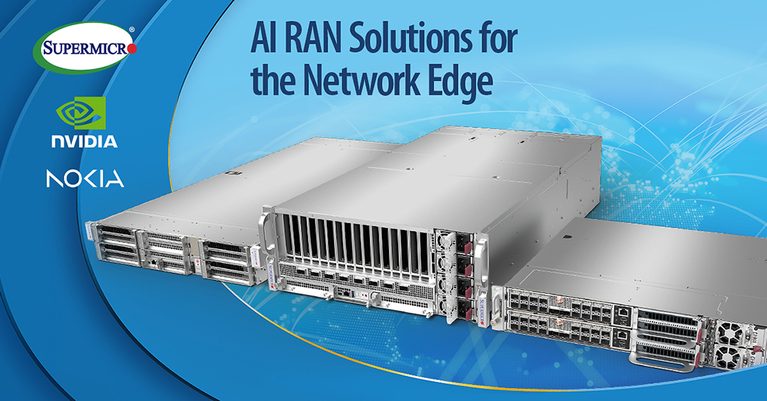
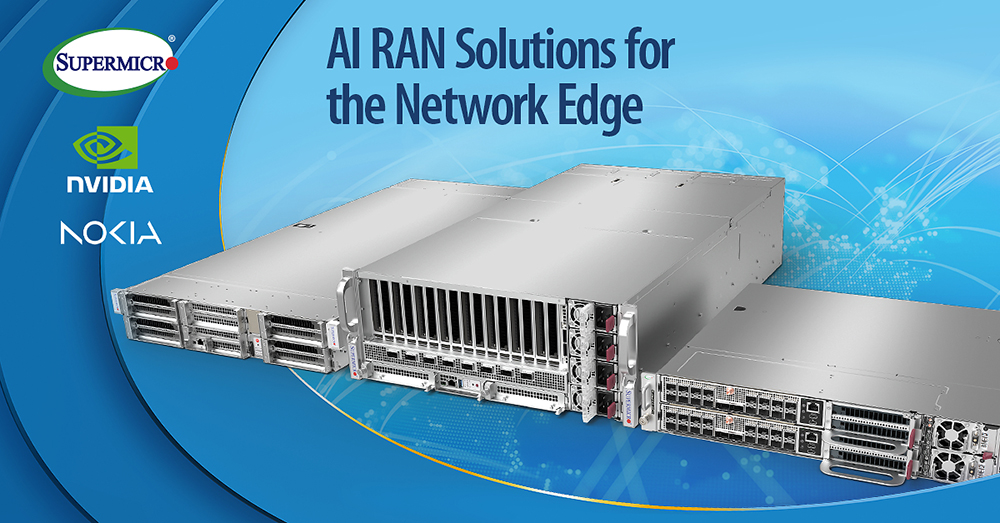
On the hardware side, Supermicro detailed systems built around NVIDIA ARC (Aerial RAN Computer) for three deployment tiers:
For distributed cell sites, Supermicro cited an ARC MGX 2U short-depth platform and a dual-node ARC-Pro in a 429 mm chassis. In the ARC-Pro configuration, each node pairs an NVIDIA Grace C1 CPU with an NVIDIA RTX PRO 4500 Blackwell Server Edition GPU, with up to 1.6 PFLOPS of FP4 AI performance. Supermicro also described a 1U short-depth ARC-Compact for edge networking functions such as Service Management and Orchestration.
For centralized MSO and aggregation sites, Supermicro described an ARC MGX 2U system class that supports either dual NVIDIA Vera CPUs or dual x86 processors, plus two NVIDIA RTX PRO 6000 Blackwell Server Edition GPUs. The company tied this tier to higher-throughput, coordinated inference and “multi-cell workloads,” including coordinated scheduling and beamforming, as well as voice, vision, and physical AI.
For core network hubs, Supermicro described an ARC MGX 4U system with up to eight NVIDIA RTX PRO 6000 Blackwell Server Edition GPUs. It also specified dual x86 CPUs and up to 6 TB of DDR5 memory, plus an option for an NVIDIA ConnectX-8 switchboard providing PCIe Gen 6 for faster GPU-to-GPU interconnectivity. Across the platform, Supermicro also called out NVIDIA ConnectX for high-speed, software-defined networking.
“AI-RAN is redefining networks for AI, turning mobile infrastructure into a shared foundation for connectivity, AI for RAN, AI on RAN, and broader distributed AI services,” said Charles Liang, president and CEO of Supermicro.
Supermicro said its servers for NVIDIA ARC are generally available now. It also said the ARC MGX 2U with dual Vera processor “will be available later this year,” the 2U ARC-Pro is planned for customer testing later this year, and ARC-Pro general availability is planned for the first half of 2027.
Supermicro | Nokia | NVIDIA telecom
Source: Supermicro