
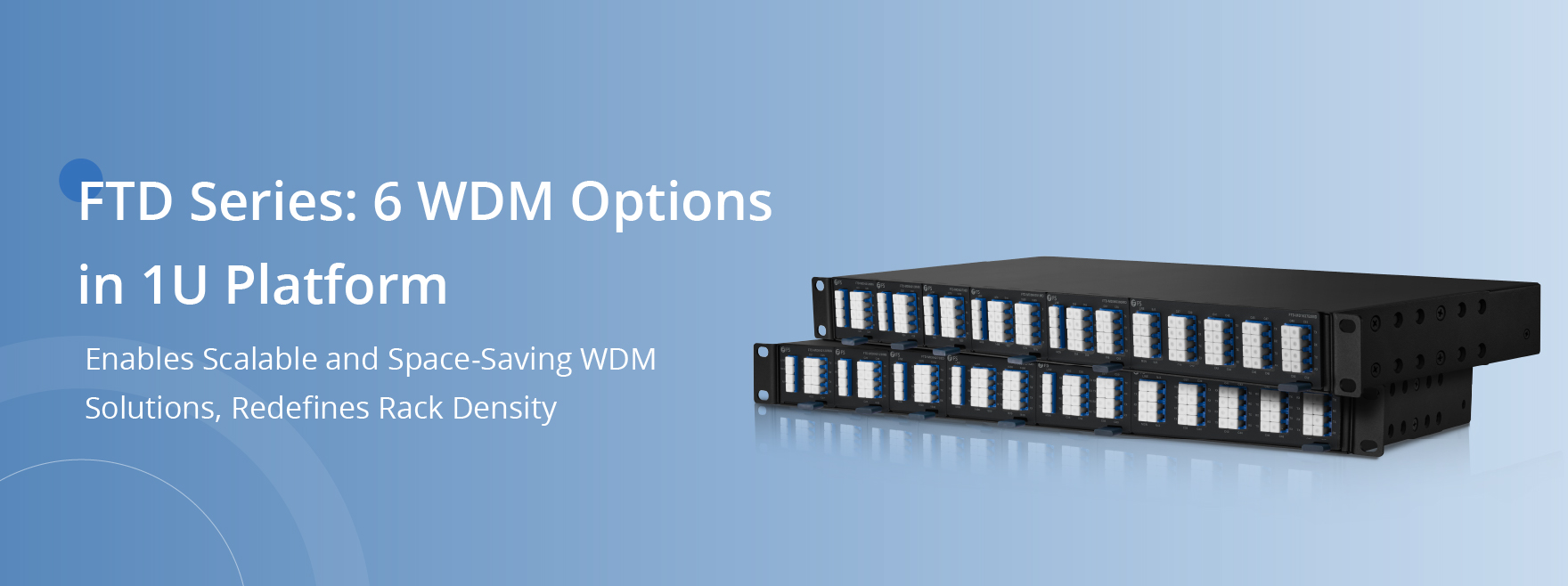
Responding to growth in distributed cloud, edge computing, and artificial intelligence workloads, FS reports the FTD Series is designed to help network operators make more efficient use of available rack space and optical fiber resources. The modular platform aims to simplify expansion, consolidate diverse wavelength types, and minimize the physical footprint at backbone and metro aggregation nodes.
The technical design enables up to nine modules per 1U chassis, accepting various combinations such as nine 4-channel, six 8-channel, or three 16-channel Mux Demux units. FS reports this configuration increases integration density by 125 percent compared to previous platforms. The FTD series supports dense WDM (DWDM), coarse WDM (CWDM), local area network WDM (LANWDM), optical WDM (OWDM), filter WDM (FWDM), and CEx WDM technologies. The platform supports 400G, 100G, 10G, and 1G Ethernet, synchronous digital hierarchy (SDH)/synchronous optical networking (SONET), Fibre Channel, as well as CATV and fiber-to-the-x (FTTx) deployments.
The FTD Series is designed as a passive platform, requiring no power or cooling, and uses a front-access plug-and-play modular design to simplify installation and upgrades. Individual modules can be added or swapped out as the network scales, allowing for operational flexibility without major infrastructure changes.
Bener Peng, product R&D manager at FS, stated, “The FTD Series is a high-density, flexible, and scalable passive WDM platform that delivers the latest generation of wavelength division solutions,” adding, “The FTD Series is fully compliant with ITU-T optical grid standards and seamlessly interoperates with FS’s optical transport products, as well as third-party equipment. This launch reflects our continuous innovation and commitment to delivering high-performance, future-ready optical transport solutions.”
Source: FS