
Editor’s Note (Updated March 16, 2026)
Important clarification: GenerMotor is not an independent operating company. It is a branded “invention project” created and marketed by Niches Marketing Consulting Group, a small marketing/consulting firm based in Taipei, Taiwan. The original announcement was a press release distributed via EIN Presswire. There is no evidence of a functioning corporate entity, manufacturing operations, revenue, or independent customers beyond this marketing effort.
The technology appears to be based on legitimate (though limited) patents filed by the same individual/group, but the “company” presence consists only of a basic landing page and these press materials. We have updated this post to reflect that context for accuracy and transparency.
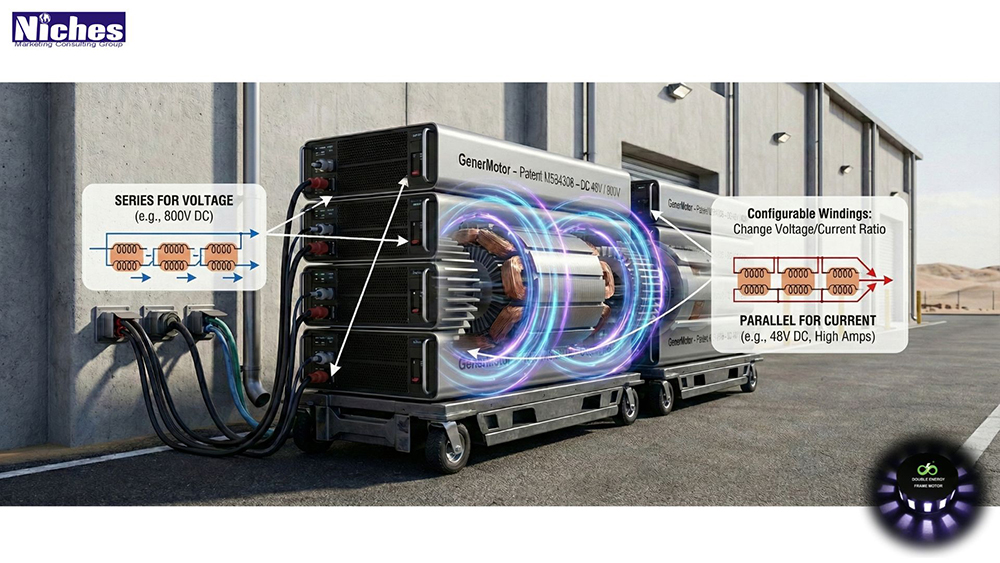
GenerMotor has announced an international launch of an HVDC-ready, stackable DC generator platform aimed at AI data centers, cloud operators, and server manufacturers facing power constraints tied to transformer shortages and high-voltage infrastructure delays. GenerMotor positions the system as a modular, on-site “power-generating battery” that can scale output voltage and capacity by adding DC modules in series and parallel, targeting 400–800 V high-voltage direct current (HVDC) architectures.
The platform is based on what GenerMotor describes as a patented multi-stator, flywheel-integrated design. It uses a flywheel-integrated rotor that combines mechanical energy storage and magnetic excitation in one rotating mass, with embedded magnets in hollow rotor walls that expose magnetic flux on both inner and outer faces. GenerMotor says this geometry enables stators to be placed inside and outside each rotor wall to capture work from a full 360-degree flux path, while concentric multi-stator rings generate AC that is immediately rectified into DC at each stator channel.
GenerMotor says each rectified stator output behaves like a small DC module (for example, in the 48 V range) that can be wired in series or parallel to form configurable DC voltages, including 400 V and 800 V HVDC buses “and beyond.” It also describes multi-channel outputs where each stator ring is an independent power channel with its own rectifier, allowing channels to be allocated to roles such as main HVDC power, storage charging, dedicated backup, or separate voltage tiers, while sharing a common rotor and mechanical infrastructure.
For monitoring and integration, GenerMotor says it embeds battery-management-system-class monitoring and control at the module level, with sensors tracking output voltage and current, rotor speed, stator and bearing temperatures, vibration signatures, and estimated state-of-health. It also specifies a CAN bus interface for module-level telemetry and commands, and says higher-level systems such as Supervisory Control and Data Acquisition (SCADA), data center infrastructure management (DCIM), or custom orchestration platforms can subscribe to module data streams for dispatch, derating, and service scheduling.
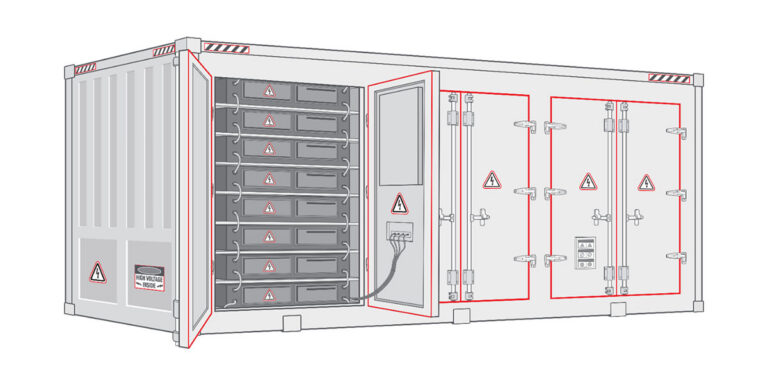
On deployment, GenerMotor says the modular form factor supports rack-adjacent placement to minimize DC cable lengths, pod-level deployment for specific facility zones, and mobile or containerized formats. Beyond data centers, the press release lists mobile power trucks (integrating GenerMotor DC generation with batteries, supercapacitors, inverters, and DC to DC converters) and microgrids where it can complement solar, wind, and battery storage. GenerMotor also reports collaboration with Speedtech Energy and states that pilot projects, reference designs, and joint demonstrations are being planned for 2026–2027.
Source: GenerMotor