
Supermicro is now shipping NVIDIA Vera Rubin NVL72 racks integrated with its Data Center Building Block Solutions (DCBBS) and direct liquid-cooling stack, DLC-2. For operators building out Rubin-class clusters, the immediate impact is schedule risk: pre-integrated, validated racks can reduce the amount of field-level bring-up work required to get a liquid-cooled AI pod online.
The company’s NVIDIA Vera Rubin NVL72 rack is a single liquid-cooled rack built around 72 NVIDIA Rubin GPUs and 36 NVIDIA Vera CPUs. Internally, it uses eighteen 1U compute trays, each configured with four Rubin GPUs and two Vera CPUs, connected through nine sixth-generation NVIDIA NVLink switch trays. Supermicro lists 216 TB/s of scale-up bandwidth for that NVLink fabric, plus 20.7 TB of HBM4 and up to 54 TB of LPDDR5X per rack.
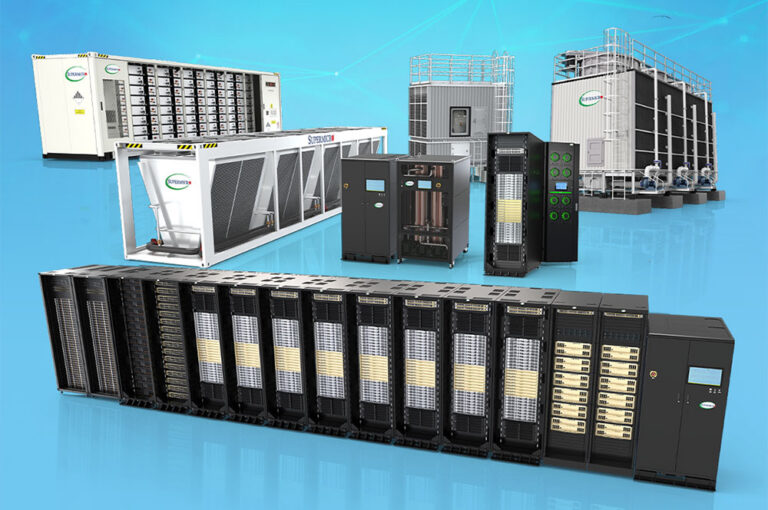
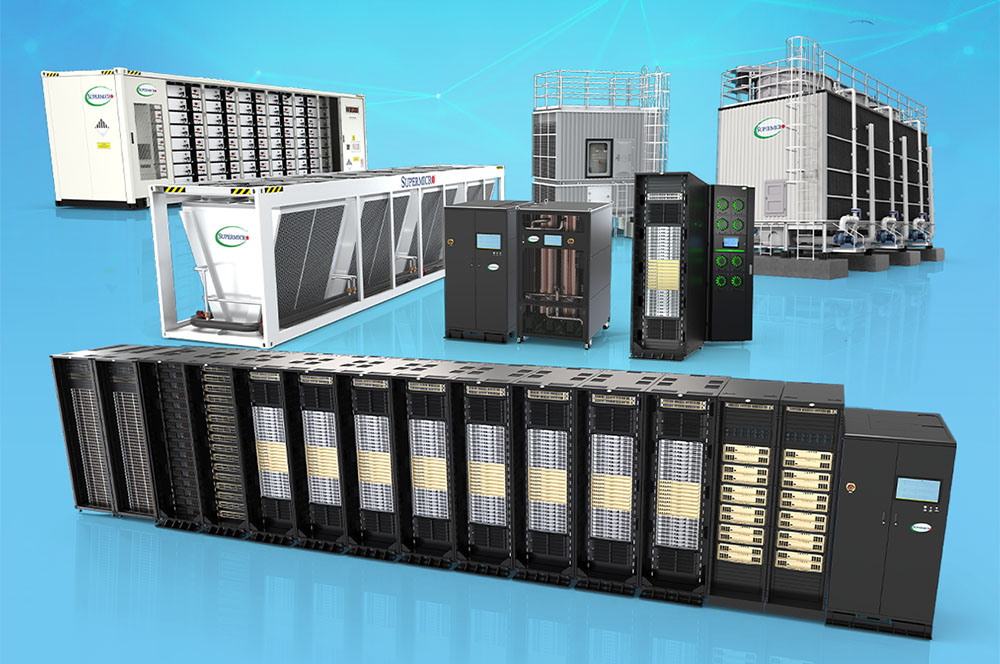
On the cooling side, Supermicro is offering an end-to-end liquid-cooling portfolio spanning cold plates, manifolds, hose kits, in-row cooling distribution units (CDUs), in-rack CDUs, liquid-to-air sidecar CDUs, rear door heat exchangers, and facility-side cooling towers. Supermicro also highlights that it tests and validates each rack with the full liquid-cooling stack.
For facilities planning, Supermicro’s in-row CDUs are rated at 1.8 MW per CDU, and the company describes deployments using n+1 redundancy. Rear door heat exchangers are positioned as an option to capture residual heat load.
Supermicro also ties the rack offering to DCBBS “Blueprints” intended to define a balanced bill of materials for a given power envelope, from 5 MW to gigawatt scale. In the configuration described as one Vera Rubin NVL72 Scalable Unit, the blueprint aggregates 1,152 NVIDIA Rubin GPUs and 331 TB of HBM4 across 16 compute racks, along with what Supermicro describes as balanced cooling capacity, power delivery, high-performance storage, context memory storage, and networking.
Liquid-cooled AI racks don’t just change heat rejection, they change integration. You’re now commissioning a full fluid distribution loop (cold plates through manifolds to facility heat rejection) alongside the usual power, networking, and management stack. The value of a “validated rack” only shows up when it reduces on-site troubleshooting and accelerates acceptance testing, especially at the densities implied by multi-megawatt CDU blocks.
“Our customers can now order a Scalable Unit and receive production-ready systems with end-to-end integration, because we design and build every layer between the cold plate and the cooling tower,” said Charles Liang, president and CEO of Supermicro.
More details: Supermicro.
Source: Supermicro