
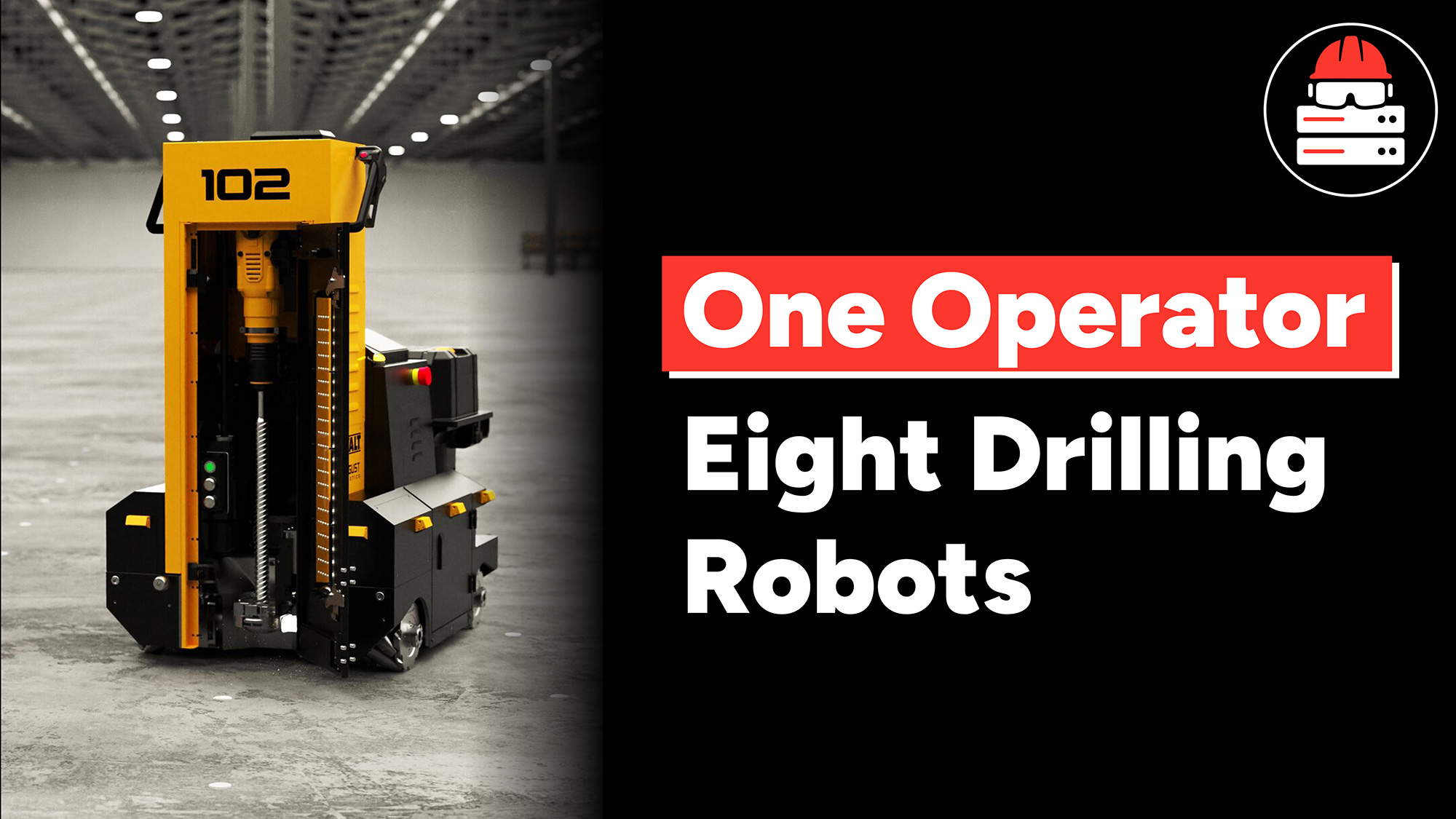
Seven thousand holes. That was the job on one of the first projects DEWALT’s drilling robot worked on, and the contractor had planned it the traditional way: one week to lay out every hole location on the slab, then six to seven weeks for a crew to drill them by hand. Four robots drilled the same 7,000 holes in one week.
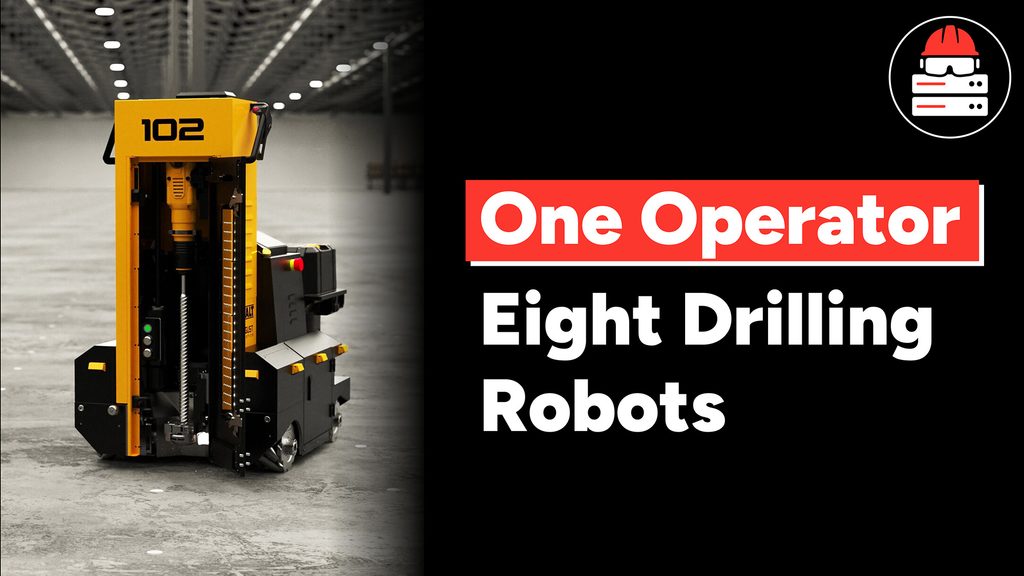
The robot is DALE, an autonomous concrete drilling robot that DEWALT developed with August Robotics, and Gordon Brookes is Lead Product Manager for DEWALT Robotics at Stanley Black & Decker. The idea started with a customer who was tired of drilling thousands of holes in data centers by hand. August Robotics already had a mobile robot built for autonomous floor marking in the convention space, and it could locate itself precisely on the floor. DEWALT added a rotary hammer and a dust extractor to it, and Brookes says the result puts every hole within an eighth of an inch. DEWALT launched DALE commercially in July 2026 after a year-long pilot that, according to the company’s launch announcement, cut 190 weeks from schedules across 26 data center construction phases.
Drilling sounds like the least interesting trade on site. It isn’t. Server racks and HVAC equipment can’t go into the hall until the holes are in the slab, which puts drilling squarely on the critical path.
The mechanics are what make DALE worth an engineer’s attention. The contractor’s building information model (BIM) becomes a grid of X and Y coordinates on a map server that runs self-contained on site, without internet access, and hands each robot its next batch of holes. A laser guiding station, which works like a surveyor’s total station, triangulates position off reference units placed on the building’s control points, and the robot lowers its drill on sample points so the contractor’s surveyor can confirm it’s on the mark. One operator can run several robots at once. Brookes describes fleets of two to eight. When the bit stops making progress, the robot can flag rebar instead of cutting through it, because rebar can raise structural questions the contractor has to answer. Cameras and depth logging flag dusty holes and holes drilled to the wrong depth for rework.
Scale matters, though. Brookes says jobs over 1,000 holes are a great fit for the robots, but a tight schedule can justify them on much smaller jobs. One client had only a couple hundred holes to drill and couldn’t afford to stop production, so the robots did it overnight.
The Data Center Engineer sat down with Brookes to talk about why slab drilling sits on the critical path, how a BIM model becomes a drill map, what happens when the bit hits rebar, and what the pilot changed before launch.
Watch the full interview
The conversation has been lightly edited for length and clarity.
For someone who hasn’t seen DALE, what does it do, and where does it fit into a data center construction project?
Gordon Brookes: The DALE robot came from a challenge issued to us by one of our customers. They had come to us and said, “Hey, we are drilling thousands of holes in data centers, and we’re doing it by hand, and it’s taking weeks to complete, and it’s a very repetitive, stressful job for our crews.”
So we partnered up with August Robotics, who is a leader in autonomous floor marking. They were using their robots for marking in the convention space, and they had developed a highly accurate system to be able to know where the robot was on the floor. So we were like, “Hey, if you have a highly accurate system, what if we took tools and put them onto your robot?”
We worked with them to add our rotary hammer and dust extractor to their robot, which allows the robot to go wherever it needs to on the job site and drill holes within an eighth of an inch every single time. This fits very neatly into data center construction, because they’re usually putting thousands of holes in an average data hall, and that needs to be done before they can do anything else in that building.
What made downward drilling a good target for automation, and what happens downstream if drilling falls behind?
None of the server racks or HVAC equipment can be installed into the server hall until they have those holes in the slab.
Brookes: Putting holes into the slab in a data center is part of the critical path. None of the server racks or HVAC equipment can be installed into the server hall until they have those holes in the slab.
So this became a critical path item for a lot of contractors. They were often running into issues where they were waiting for their teams to drill across the floor before they could do that work. And this work usually involves thousands of holes. So if it’s not being done, every other piece of work on that job site needs to shift to doing the holes in the slab.
We saw this as a great way to automate, because it’s a very repetitive job, but it’s also something that’s very mission-critical and time-sensitive.
Walk me through a job from approved drawings to the first hole. Who prepares the drilling points and checks them against site conditions?
Think of it like Battleship. Basically, we’re just taking the X and Y coordinates of where those holes need to go.
Brookes: Generally, we’ll work with both the general contractor and the mechanical contractor, who are responsible for the holes that are being put into the slab. We’ll actually work with the mechanical and general contractors’ modeling team. Often their BIM team is going to know exactly where all of those points need to go.
So we’ll coordinate with them to understand where all those points are, as well as any obstacles, things like walls that are going to be on the job site. We take all of that information and combine it into what we call a map, which basically is a grid of where all of the holes need to go on the slab.
Think of it like Battleship. Basically, we’re just taking the X and Y coordinates of where those holes need to go. Once we get all of those holes, we upload that onto a computer that we use to control all the robots. The nice thing about that is that it can be self-contained, so we don’t need internet access once we’re out on the job site. We just bring the plans with us.
Once we have that, we’ll set it up on the job site, and then we’ll validate with some key pieces of equipment to make sure that what we’ve gotten from the contractor aligns with the site realities.
How does DALE know where it is on a busy construction floor, and how do you check the plans against the site?
Brookes: What we’re going to do is validate their points against what we know we have on the model. We set up what are called reference beacons, and these sit on top of what are called control points. These are standard building control, known X and Y locations on the floor.
We’ll put our reference beacons on top of those to be able to use what we call a guiding station. Think of that like a total station. It shines a laser from the guiding station to those reference beacons to triangulate exactly where it is on the floor, and then we’ll compare those values against what the contractor has provided to us. So we’re going to check those points first to make sure: Is the building control that they gave us correct?
Then, after that, we’ll identify several sample points on the floor, points where we know we’re going to be drilling holes into the slab. We’ll have the robot drive to those locations and lower the drill on those points to validate that we’re touching the correct location of those holes, and then we’ll have the contractor’s surveyor check those points to make sure we’re aligning correctly to what the plans say.
That way, we’re always checking to make sure everything’s going to line up exactly as the plans are and as the building has actually been set up.
What hole sizes and depths can DALE handle, and how does it deal with rebar, dust, and a hole that doesn’t pass the quality check?
Brookes: We support a variety of holes, anywhere from a half inch up to an inch and a half in diameter, and we can drill up to 14 inches in depth. The robot is designed to do a couple things when it comes to dealing with the holes on the site itself. One is that it can drill through rebar if we want it to. Or, if we want, we can have the robot detect rebar.
Essentially, when it’s lowering that rotary hammer bit into the ground, if it detects rebar after it’s not making any progress, it’ll flag that hole on the system to say, “Hey, I’ve touched rebar.” That allows us to go back to the contractor and say, “Hey, do you actually want us to go and drill through rebar?” Often there can be structural questions when that comes up, so we’ll ask the contractor first if they want us to do that.
We also use a camera system on the robot to take pictures of each hole that we’re doing. Let’s say excessive dust got left behind. Maybe the dust extractor got clogged or the bag was full. We’ll flag that in our interface: Hey, that hole had a little bit too much dust, and we can send someone back to clean that up.
We’re also recording how deep each hole is going. If there was an issue with us not drilling the correct depth, we’ll flag that hole in the interface, and it will tell the contractor, “Hey, we had an issue with potentially rebar here. There was dust on this hole,” or the hole was the incorrect depth. That’s all flagged in our UI, so that we can provide it back to the contractor if we need to do any kind of work to correct it.
What does fleet-capable actually look like on site, and how do the robots divide the work while avoiding crews and equipment?
Brookes: Fleet-capable means that it’s not just one operator running one robot. That’s a real power of the August platform: we can have one operator running multiple robots. In practice, that could be two, four, six, or even eight robots all running at the same time.
I was mentioning earlier how we divide up the work via a computer, which we call a map server. That map server divvies out the work to each robot, so that it knows, “Hey, here’s the next 20 holes that I’m going to be putting into the slab.” That way, it’s dividing the work as efficiently as possible across the fleet of robots.
And it’s really neat. As you add more robots into the system, you can see the estimated completion time start dropping, because it starts factoring in, “Oh, hey, I’ve got another robot. I’ll be able to do another 20 or 30 holes per hour, given the site conditions here.”
The way they avoid people and everything else that’s going on is that there are advanced sensors built into each robot. There’s a LiDAR camera on the front of the robot, because on a job site, things are always changing. It’s never going to be clean. So it’s going to detect people or objects or things that are being put onto the ground. There are also sensors arrayed all around the sides of the robot to detect if it’s gotten too close to an edge or a wall. We can drill within six inches of an object, which is really handy on a really busy site where there might be crews working, people on platforms, things like that.
So not only do the robots divvy up the work that they need to do, they also have advanced sensors to stay out of the way of the workers who are on the floor. That way, the job can keep moving, and you don’t have to have the floor completely clear.
How much time does DALE actually take off a project schedule?
We took four robots to that same job site, drilled those same 7,000 holes, and we did it in one week.
Brookes: To give you some stats, we’ve done over 300,000 holes to date on job sites across the US and also internationally.
I always like to bring up one of the first projects that we worked on, where we were drilling 7,000 holes into the concrete slab. Traditionally, that contractor had allocated one week for layout, actually printing on the slab where each of those holes had to go, and then another six to seven weeks for a team of people to go in and drill all of that by hand. So that’s potentially seven to eight weeks for people to do that work.
We took four robots to that same job site, drilled those same 7,000 holes, and we did it in one week. So we were saving them anywhere from six to seven weeks off their project schedule for the act of drilling. And what that means is they can then allocate those workers and that schedule to other things on the job site.
These workers were usually the same people who were installing the server racks or the HVAC equipment that had to go over top. So that allowed them to protect against delays with other things on the job site and be more efficient at the same time.
What work still belongs to the crew, and what conditions make DALE a good fit?
We actually saw, in some cases, the contractors starting to follow behind the robots, installing that structural steel for that HVAC equipment right behind us.
Brookes: One of the things that we want to do with this robot is allow the workers who are doing the drilling to take on more valuable tasks. So we taught them how to use the robot. We train them how to use the tablet that controls the robot. That allows them to monitor things like the dust extractor, the bits, and the batteries of the robots, and they can see on that tablet, “Hey, I need to replace a dust extractor. It’s gotten full.” So we train them how to take care of all the consumables on the robots over time: replacing the bags, the batteries, and the bits.
That allows a group of folks to take care of the robots, and the rest of the folks that would’ve done that drilling can then work on installing the equipment behind the robots. We actually saw, in some cases, the contractors starting to follow behind the robots, installing that structural steel for that HVAC equipment right behind us.
They normally would not have done that, because humans doing the drilling would’ve taken too long, and they would’ve caught up, so it wasn’t worthwhile for them. So they were then able to follow behind us and do that work as the robots were drilling.
In terms of where it makes sense to use a robotic system like this, we generally tend to find that if it’s over 1,000 holes, that’s a great application for the robotic system. However, we’ve also seen situations where it’s less than that, where time is of the essence. We had a client who was installing cranes in their warehouse, where they were building a lot of their equipment, and any downtime there spent drilling and setting up the crane equipment would slow them down.
They only had a couple hundred holes that needed to be done. So instead of having people do that, we brought the robots out and drilled those same holes overnight, so they didn’t lose production time. Even though it was a couple hundred holes, timing was critical. It might have taken them a couple of days to do that by hand. The robots did it overnight and allowed their production facility to keep moving.
DALE went through a year-long pilot. What did that year reveal that you had to change before the commercial launch?
With a robot, you’re just drilling constantly.
Brookes: We spent a year really perfecting how the system worked. We worked across probably about a dozen job sites across the US to really understand how the system worked. That allowed us, one, to train our people on how to work on these job sites and how to understand the logistics of setting up a robot on a construction site. But we also discovered a couple things that we could do to make the robot better.
One is that we improved the software. We made it smarter about how we can fence off certain areas of the job that we don’t want to be worked on.
The other area was the tools that we were using on there. We weren’t used to running them constantly. When a person’s running them, they’re going to run it for a little bit and take a break, because that’s a lot of demand on their body. With a robot, you’re just drilling constantly. So we added some additional ventilation systems to the robot to keep the rotary hammers and the bits cool so that they perform better, and we also improved our dust collection design so that we were being more efficient with getting dust off the job site too.