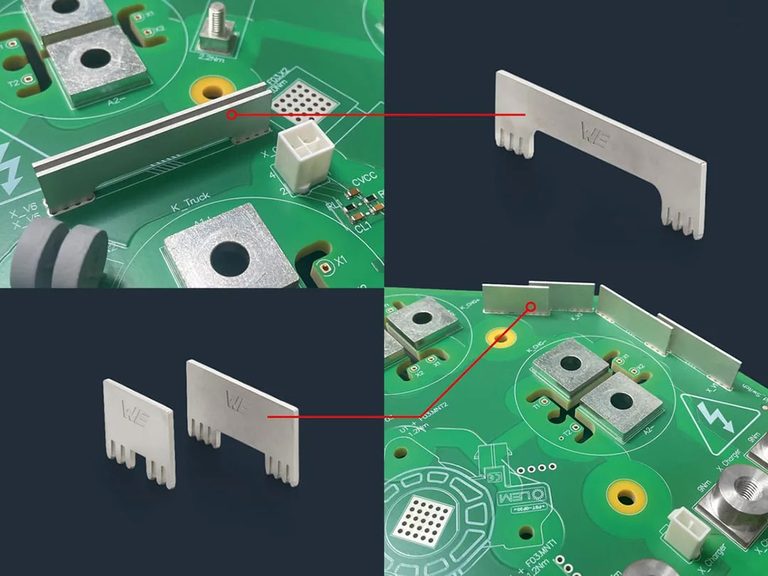

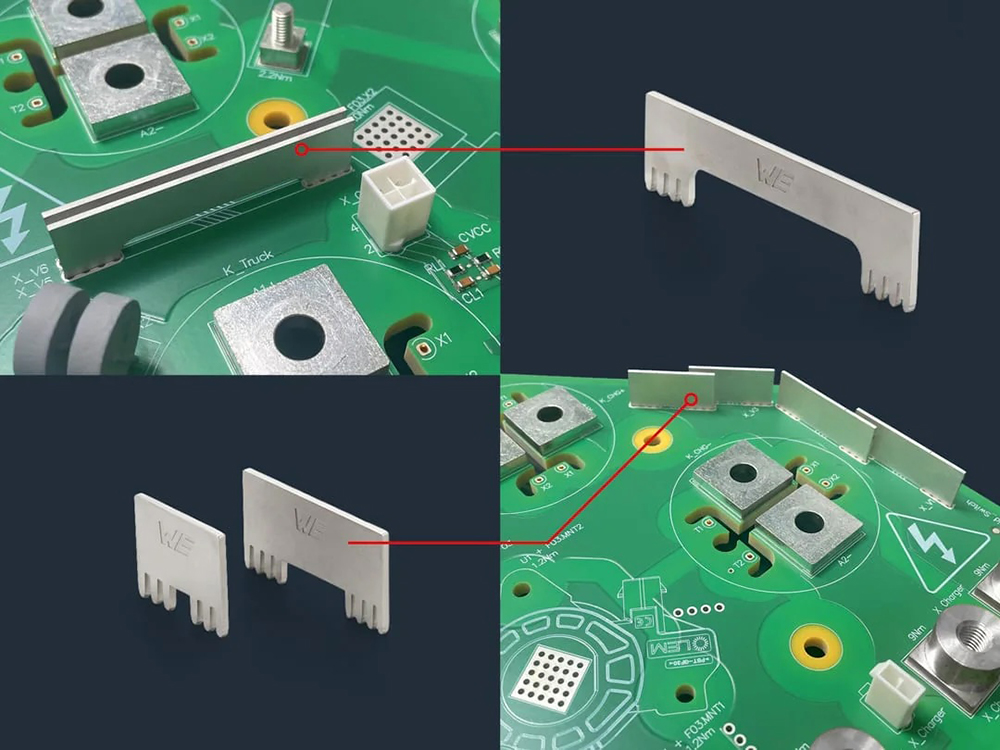
Würth Elektronik ICS has introduced the PowerBusbar PF, a vertical, press-fit busbar designed to bring higher current capacity to standard printed circuit boards while reducing PCB real estate. The component targets designs where copper weight and trace width on the board become the bottleneck, including AI data center power electronics, electric mobility, energy storage, and industrial automation.
The PowerBusbar PF is press-fit vertically into the PCB (PF stands for press-fit). Würth Elektronik ICS lists four standard sizes, with lengths from 19 to 59 mm, a height of 18.4 mm, and a thickness of 1.2 mm. By mixing lengths, designers can create different current paths, and the part can also bypass sections of a PCB, effectively acting as a high-current bridge when routing across the board isn’t practical.
For infrastructure teams and hardware designers, the practical point is straightforward: if you only need heavy copper in a few hotspots, paying for thick copper across an entire PCB is expensive and can constrain sourcing. A localized busbar approach can shift the design back toward standard FR4 in cases where only specific regions are exposed to high current loads, which can broaden supplier options and reduce material use.
Würth Elektronik ICS also ties the part to thermal performance. With its copper cross-sectional area and vertical geometry, the busbar can help move heat out of high-current regions and can function as a heat sink due to increased effective surface area. In measurements at a 40° C ambient temperature and 185 A current, Würth Elektronik ICS reports a temperature reduction of up to 53.5 K.
The company says the press-fit connection provides a secure, permanent mechanical and electrical interface and avoids the additional thermal stress associated with soldering during assembly.
Source: Würth Elektronik ICS