Axelera AI has detailed Titania, its third-generation chiplet-based AI accelerator architecture aimed at scaling data center inference without requiring 100 kW-plus liquid-cooled racks. The company is targeting “HPC-class” responsiveness within the power and cooling limits of existing data centers, including enterprise and lab environments.
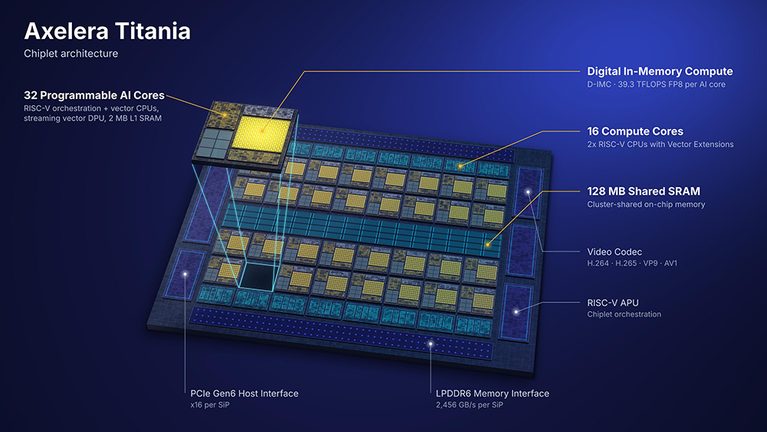
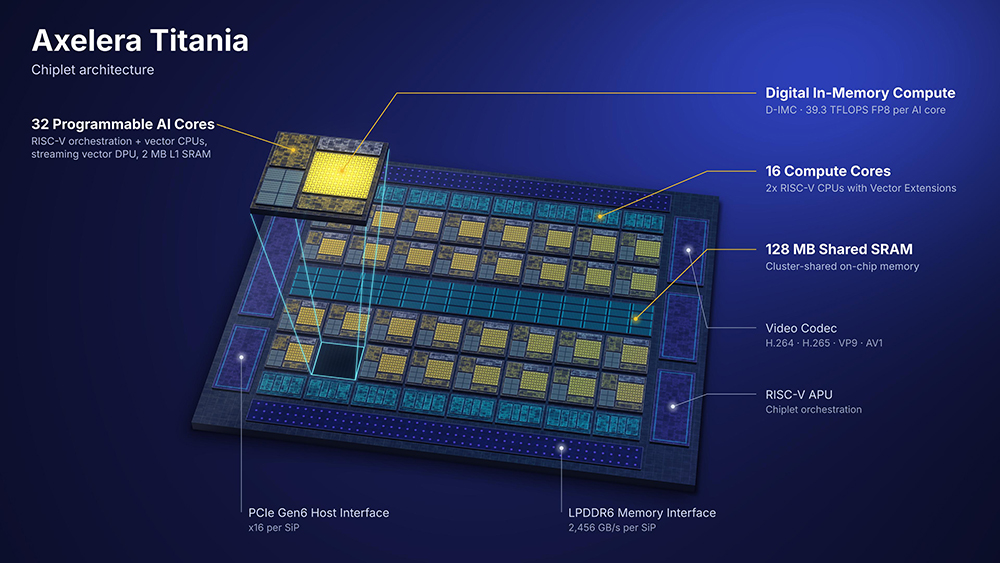
Titania is built as a system-in-package (SiP) containing two Titania chiplets. Axelera AI says Titania will be offered in multiple form factors, including standard PCIe cards and OCP-compliant UBB baseboards with eight Titania OAM modules connected in a scale-up network. The company also says these form factors will be available via OEM partners in an inference server configuration in both air- and liquid-cooled configurations, backed by more than $300 million in “confirmed Titania commitments.”
For data center operators, the most concrete question is whether an accelerator can fit inside the thermal, power, and mechanical constraints you already have. Titania’s pitch is straightforward: get higher inference throughput per watt and more usable performance per rack without redesigning facilities around ultra-high-density liquid-cooled GPU racks.
Architecturally, Titania combines Axelera AI’s Digital In-Memory Computing (D-IMC) approach with a chiplet design, LPDDR6 memory, scale-up connectivity, and programmable RISC-V compute. Axelera AI is emphasizing LPDDR6 over HBM, stating that LPDDR6 enables 128 GB per package at lower memory power and avoids dependence on HBM supply and packaging requirements. The platform is supported through the company’s Voyager toolchain, with stated support for tensor, expert, and pipeline parallelism, plus speculative decoding, KV cache offloading, and disaggregation.
Axelera AI also described a Titania reference server, codenamed AX8. The company says an eight-SiP AX8 configuration is designed to deliver 20 PFLOPS of FP8 compute, 1 TB of accelerator memory, and 19.6 TB/s of memory bandwidth in a standard 4U, air-cooled server, with 5–6 kW typical power. Axelera AI says one server will hold a 1.6 trillion-parameter model at FP4 with headroom for KV cache, that two systems fit within a 15 kW rack, and that five fit within a 30 kW air-cooled rack.
“For enterprises, it’s becoming impossible to own their own AI infrastructure due to high CAPEX expenditures including rebuilding their data center footprint,” said Fabrizio Del Maffeo, co-founder and CEO of Axelera AI.
On timing, Axelera AI said Titania goes into production in Q3 2027, with “customer deployment commitments” through the beginning of 2028. The company also said the Titania PCIe card is designed as a drop-in replacement for the Axelera Server 250p (a FHFL four-chip Europa card), allowing models deployed on Europa to move to Titania in 2028 without re-porting.
Source: Axelera AI