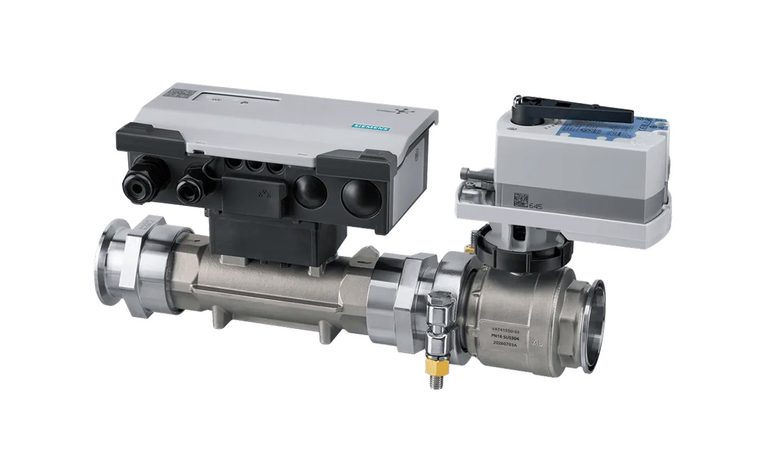
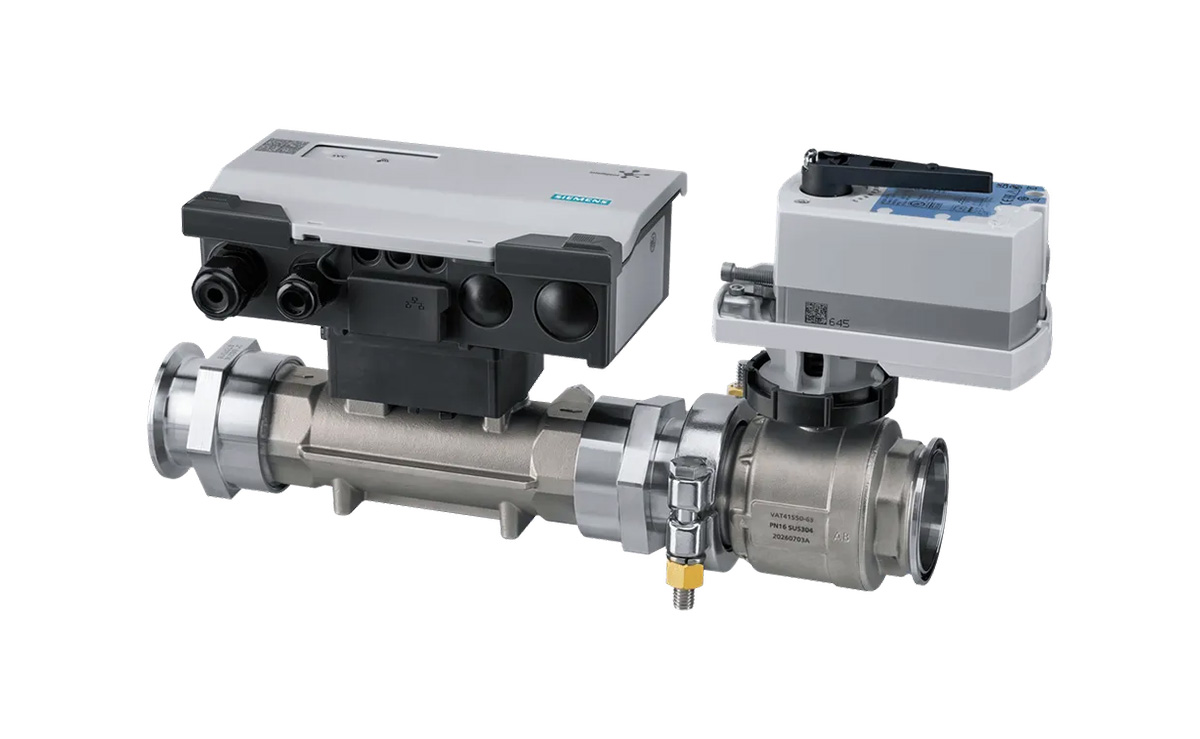
Siemens has added a stainless steel version of its Intelligent Valve for direct-to-chip rack loop cooling in AI data centers and high-performance computing environments. The new valve is aimed at liquid cooling deployments where coolant purity and media compatibility are becoming tighter requirements, and it’s positioned as an alternative to brass and other wetted materials.
The stainless steel design targets “increasingly stringent wetted material specifications” that Siemens attributes to leading chip manufacturers and hyperscale data center operators. For operators standardizing on specific chemistries and contamination controls in the rack loop, moving away from brass is a practical hardware change that can simplify materials compliance across a cooling fleet.
Installed in the hydronic cooling circuit, the valve continuously measures parameters including flow, temperature, and system performance, while actively controlling hydronic conditions. At the rack level, Siemens says the valve maintains stable differential pressure to keep coolant flow consistent and protect IT equipment, and it’s intended to reduce the risk of pressure peaks that could lead to leakage or damage to cold plates during commissioning, operations, and maintenance.
The valve is also designed to adapt automatically as servers or entire racks are added, removed, or replaced. It includes local control loops that can operate independently of a coolant distribution unit (CDU) controller, along with automatic presetting and open communication interfaces for integration into automation and monitoring systems.
That independence from the CDU controller is a design choice engineers will want to think through carefully. It can be helpful for resilience and modular expansion, but it also puts more emphasis on commissioning and controls integration so multiple loops don’t end up “fighting” each other in ways that show up as unstable differential pressure or tuning headaches at the rack level.
Siemens lists compatibility with water, water ethylene glycol, and water propylene glycol cooling media.
“AI is fundamentally changing the thermal requirements of data centers, with increasing compute density making liquid cooling a critical part of the infrastructure. Our role is to help customers manage this transition reliably and at scale,” said Nawfal Slimati, EVP Buildings Products at Siemens.
Source: Siemens