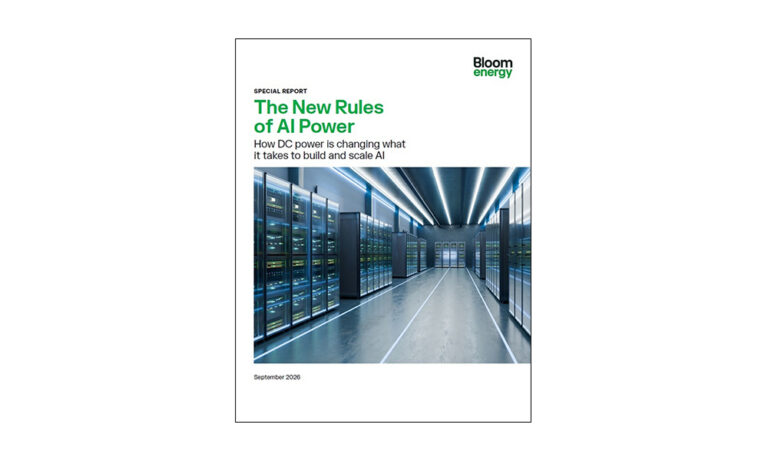

Bloom Energy published a special report, “The New Rules of AI Power,” arguing that data centers built around 800 V DC distribution could avoid multiple AC-to-DC conversion stages and reduce both electrical infrastructure and losses between the power source and AI racks. The report centers on Bloom’s solid oxide fuel cell systems, which the company says generate continuous 800 V DC power natively.
In its modeling for a 1 GW AI data center, Bloom estimates its 800 V DC approach would reduce non-compute capital expenditures by $3.6 billion (27%) and cut five-year total cost of ownership by $5.5 billion (9%) compared to “traditional AC solutions.” Bloom notes that actual project economics will vary based on factors including site design, energy prices, equipment costs, and other project-specific inputs.
The report’s technical premise is straightforward: most compute ultimately runs on DC, but the bulk grid and common onsite generation sources deliver AC, which then has to be stepped, converted, and conditioned multiple times before it reaches server power shelves. Bloom’s claim is that generating 800 V DC at the source eliminates those intermediate conversion stages and reduces the amount of gear needed between generation and compute.
Bloom also ties the shift to the direction of next-generation AI platforms. The company points to NVIDIA’s move toward an 800 V DC architecture, stating that NVIDIA has specified 800 V DC beginning with Rubin Ultra and the Kyber rack architecture for 2027 and later generations.
For data center engineers, the practical implication is less about the headline savings numbers and more about what changes in the one-line diagram. If you can deliver usable DC closer to the racks, you can potentially simplify sections of the power train and relieve pressure on components that are already long lead-time items in many projects. Bloom specifically calls out transformers and switchgear as constrained equipment where lead times are “measured in years.”
“AI is not just increasing electricity demand. It is catalyzing a positive transformation of how power is generated and consumed by becoming the first scale adopter of both onsite and DC power,” said KR Sridhar, founder, chairman, and CEO of Bloom Energy. He added, “AI, by presenting the challenge of consuming enormous amounts of DC power where compute happens, is enabling this transformation.”
Natalie Sunderland, Bloom Energy’s chief marketing officer, said, “Our 2026 Mid-Year Data Center Power Report found that data center leaders expect DC-based architectures to account for 58% of new deployments by 2030.”
The full report is available from Bloom Energy.
Source: Bloom Energy