A 50 V bus was fine when a rack drew a few tens of kilowatts. Push that rack into the hundreds of kilowatts and the arithmetic turns hostile: 5,000 to 10,000 A at 50 V, more current than any practical busbar can carry. The power supplies that used to sit inside the rack no longer fit there either, so they’ve been pushed out into a sidecar, which eats floor space that could hold revenue-generating racks.
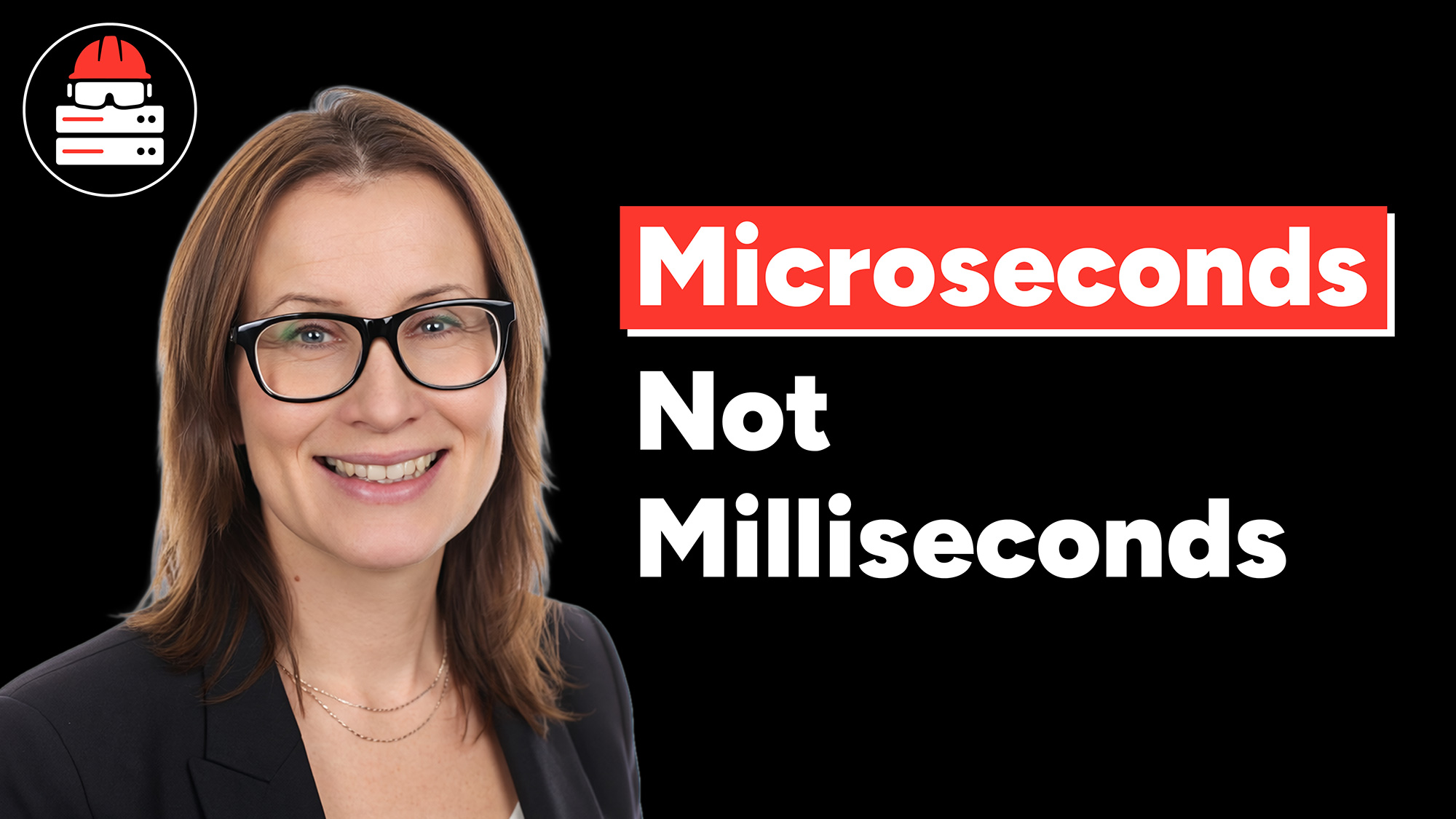
Fanny Björk has spent 23 years at Infineon and now runs application marketing for grid to load, or what the company brands grid to core: every conversion stage between the utility feed and the processor. She sees two shifts happening at once. Distribution voltage is climbing to 800 V DC, and the AC/DC conversion is leaving the white space altogether, moving into the gray space as a centralized transformer-rectifier unit or, eventually, a solid-state transformer that folds the line-frequency transformer and the rectifier into one box. Delete one galvanically isolated stage and you pick up roughly 1% in grid-to-load efficiency. Delete the sidecar and you get the floor back for racks that generate tokens.
DC brings a problem of its own. A DC grid has low impedance, and when a fault occurs in a dense AI hall the current rises far faster than a mechanical breaker can respond. Björk’s answer is the solid-state circuit breaker, which isolates a fault in a few microseconds, more than a thousand times faster than a conventional breaker. And then there’s the grid side. With the first 1 GW sites projected for 2027 and 5 GW campuses under discussion, transmission operators are asking data centers to bring their own generation and storage.
The Data Center Engineer sat down with Björk ahead of October’s OCP Global Summit to talk about why the 50 V era is ending, what a solid-state transformer actually replaces, why 2,300 V and 3,300 V silicon carbide suddenly has a market, and why the server-room team and the utility-yard team can no longer work in separate buildings.
Watch the full interview
The conversation has been lightly edited for length and clarity.
Why has OCP become such an important forum for next-generation power infrastructure?
Fanny Björk: I would say it’s the wideness that the Open Compute Project offers across all data center IT infrastructure, and now, since about a year ago, also moving upstream to the grid topics, with the power infrastructure topics added. This wideness, in combination with so many dedicated working groups within OCP, also allows going into depth in each discipline involved. It brings so many industries together. It’s all about innovating together and collaborating for impact, and OCP has become one key platform for speeding up what has to be done here.
AI is driving big changes in data center power architecture. What are the biggest shifts you’re seeing, and what’s driving them?
The 50 V ecosystem era will soon be over. The current cannot be supported by busbars if we are talking 5,000 to 10,000 A.
Björk: I think we can boil it down to two major shifts for AI data center power needs.
Number one is increased distribution voltages. This comes primarily from the fact that IT rack power is increasing massively, going from appliance levels of a few tens of kilowatts up to distribution power levels, megawatt scale. The 50 V ecosystem era for distributing the current in the IT rack will soon be over. The current cannot be supported by busbars if we are talking 5,000 to 10,000 A, which it would have to be with 50 V. So right now there is a strong trend to move up to 800 V distribution voltage to the power shelves in the IT racks, to lower the current, lower the thermal losses, and just make it more manageable. And this is also done with a disaggregated power sidecar, because the power supplies that have to deliver megawatt-scale power no longer fit into the IT rack the way data centers used to look, with power supply units integrated in the IT rack. So it’s this disaggregated power sidecar in combination with a higher distribution voltage.
The second major shift is to centralize the AC/DC power delivery to the IT racks. It’s often called infra-level power delivery. This is primarily driven by the need to get rid of the disaggregated power sidecar, which takes up a lot of space that cannot be used for revenue-creating IT racks. Tokens are generated by IT racks that are powered. By moving the power delivery out of the white space into the gray space, with centralized power delivery there in the form of a solid-state transformer, or a transformer rectifier unit as an intermediate step, you free up white space and reclaim it for revenue-creating IT racks.
In addition, centralized power delivery, then moving to 800 V DC distribution over longer distances throughout the data center, opens up direct exchange with on-site power sources and large battery storage systems. Renewable energy and energy storage are natively DC. So large-scale DC distribution eliminates a lot of power conversion stages and improves direct energy exchange and efficiency.
What problems are solid-state transformers solving, and why are they becoming so important?
It removes one galvanically isolated power stage, and this opens up an efficiency improvement of around 1%.
Björk: For centralized power delivery, the solid-state transformer is a north star. It’s really a key target to do this power delivery through a solid-state transformer, an SST. And why? It’s about grid-to-load efficiency and footprint. A solid-state transformer replaces the function of a conventional AC/AC line-frequency transformer connected to the grid, but in addition it can also take over the AC/DC rectifier stage that used to be the power sidecar. You can build this into one function.
It improves footprint, power density, and weight, and on a data center site, all real estate is valuable. And because it takes over both the functionality of a line-frequency transformer and the AC/DC power supply, it removes one galvanically isolated power stage, and this opens up an efficiency improvement of around 1%. That goes directly into the end-to-end grid-to-load efficiency of a data center. So that’s a big deal.
Power semiconductors sit underneath all of this but rarely get attention outside engineering circles. Why are they so critical to AI data center infrastructure?
Björk: Power semiconductors are one pillar enabling power distribution and power conversion, grid to load, or grid to core. At the same time, they are really at the heart of every power conversion stage, because no matter whether it is an AC-to-DC conversion stage, DC-to-AC, or DC-to-DC, none of these power stages can operate more efficiently than the power semiconductors inside allow for.
Another topic we’re hearing more about, particularly in North America, is BYOP: bring your own power. What does it mean, and why is it becoming important for AI data centers?
Björk: BYOP is a bit more serious topic than BYOB, bring your own bottle, which I think is where it originates. But bring your own power is really about energy autonomy. Power grid constraints are worsening now as the projections for AI data centers go to gigawatt scale, at some first sites already in 2027. The first 1 GW data centers are projected to be brought up in operation then, and even data center parks of 5 GW are in discussion in the industry. Then we are talking power demands the size of major cities. This cannot so easily be connected to the grid, and that’s why transmission system operators more and more demand that data center companies put large energy storage systems and power generation on site.
This is an essential development for moving forward with the next steps in the AI era. For these gigawatt data center sites, it’s a precondition for moving on. Power density is a prerequisite to enable the big AI brain for large language model training, for example. You cannot do that without power density, and this is what drives these gigawatt sites.
Data center companies, hyperscalers, and cloud service providers also have clear targets for carbon neutrality. So of course that also drives a lot of direction toward renewable energy in this on-site generation.
What engineering challenges do customers bring to you most often, and how have those conversations changed over the past few years?
Björk: They have indeed changed in the area of data centers. We are now talking a lot more about three-phase power supplies, compared to the single-phase power supplies it used to be when the power demand per IT rack was only a few tens of kilowatts. That means higher voltage classes of power semiconductor components: silicon, but a lot of silicon carbide and gallium nitride as well. This is sought after.
Also, DC distribution at high distribution voltages, 800 V or higher, leads the whole engineering community working on this to look into partially new ecosystems. When higher voltages are implemented, it’s not enough with only the power switch from Infineon in a certain voltage class, for example 1,200 V. The surrounding components, like auxiliary power, gate drivers, and so on, also need to fit. A lot of the discussions are around how the best-performing solution can be achieved when moving up in voltage.
And then there are all the ongoing solid-state transformer developments, where even higher voltages are needed, because the solid-state transformer is interfacing to the power grid at several tens of kilovolts. Actually, the prime grid voltage sought after is 34.5 kV AC. That requires modularization, because there are no 35 kV single power switches. Modularization is key in solid-state transformers. But even with this modularization, semiconductors in the voltage classes of 2,300 V and 3,300 V are now the prime trend. Just a few years ago there was no application looking for fast-switching CoolSiC MOSFETs in that voltage range. So these are very exciting times, especially working on the whole system solution with the whole ecosystem, so that everything fits in these higher-voltage schemes.
What’s the most common misconception you run into with customers building these next-generation data centers?
DC distribution is not easy when you are near loads, and near people especially.
Björk: I wouldn’t say I have encountered any misconception. I think for the whole engineering community, it’s clear to everyone what needs to be done. Higher distribution voltages, DC distribution, that solves so many things when distributing power at gigawatt scale. There are no misconceptions around that.
What I encounter more is that it’s really a new landscape of collaboration. In the past, getting the power to the data center was a minor topic compared to now. The server room engineering teams could work on the server room topics and didn’t have to talk so much with, let’s say, the utility yard infrastructure and electrical teams. But now, powering up gigawatt-scale data centers, and making the move to DC distribution with all the benefits that brings in energy access and energy efficiency, there are so many pillars that have to fit. Because DC distribution is not easy when you are near loads, and near people especially. 800 V DC is a challenge when it comes to protection schemes, fault isolation in zones of the data center, and so many things.
It’s not enough to just work on the topics for the server room. It has to fit through the whole power chain, from rack level all the way up to the main power infeeds. It has to be a fully protected scheme. This collaboration is very new for many people in the industry, but I also observe innovation here at a speed never seen before.
For engineers attending OCP, what will they find at the Infineon booth?
Björk: Infineon is going to have a booth in the exhibition area this year for the first time. We’re delighted to be represented there as a leading power semiconductor company, and we are going to showcase our innovations and solutions for the whole chain, grid to core. Starting from solid-state transformers, large energy storage systems, and solid-state circuit breakers, and then into the white space and the IT racks with high-voltage intermediate bus converters, medium-voltage IBCs, and the voltage regulator modules. And not to forget all the important protection schemes enabled by the solid-state circuit breaker components that we develop and are now releasing.
There are also going to be a couple of announcements around protection, and contributions in the sessions at OCP. For example, how energy buffering concepts enabled by power semiconductors can mitigate dynamic AI load patterns.
If you could leave engineers with one piece of advice as they prepare for next-generation AI facilities, what would it be?
The fault isolation speed that comes with solid-state circuit breakers is a few microseconds. More than a thousand times faster than conventional breaker alternatives.
Björk: Look into the move from AC distribution to DC distribution. Look into the enormous value of solid-state circuit breakers. The tripping speed, the fault isolation speed that comes with solid-state circuit breakers, is a few microseconds. More than a thousand times faster than conventional breaker alternatives.
And this is the fault isolation speed you need in a DC distribution environment, especially in combination with high power density, these dense AI workloads. A DC grid is really different than an AC grid. A DC grid is low grid impedance, and in combination with these dense AI workloads, any fault current that happens will rise at a very fast speed. Solid-state circuit breakers provide the fault isolation speed that is needed.
This is not yet so established in the electronics community. This is new land, but we are offering the solutions to move in this direction. At Infineon, we are not producing and selling circuit breakers, but we are selling the key components that go into the circuit breakers our customers develop.