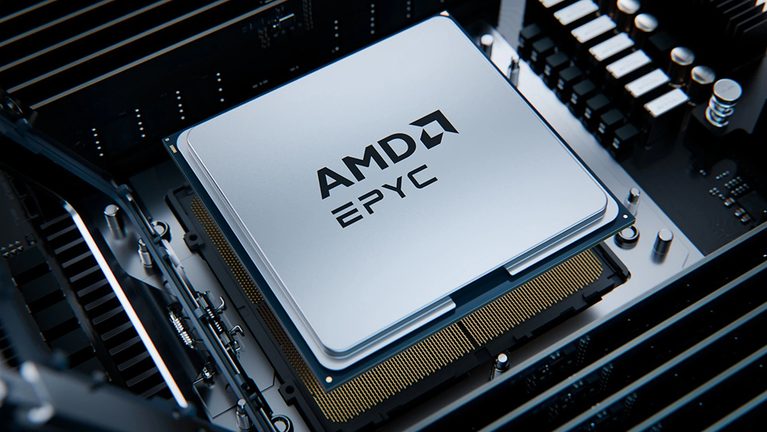
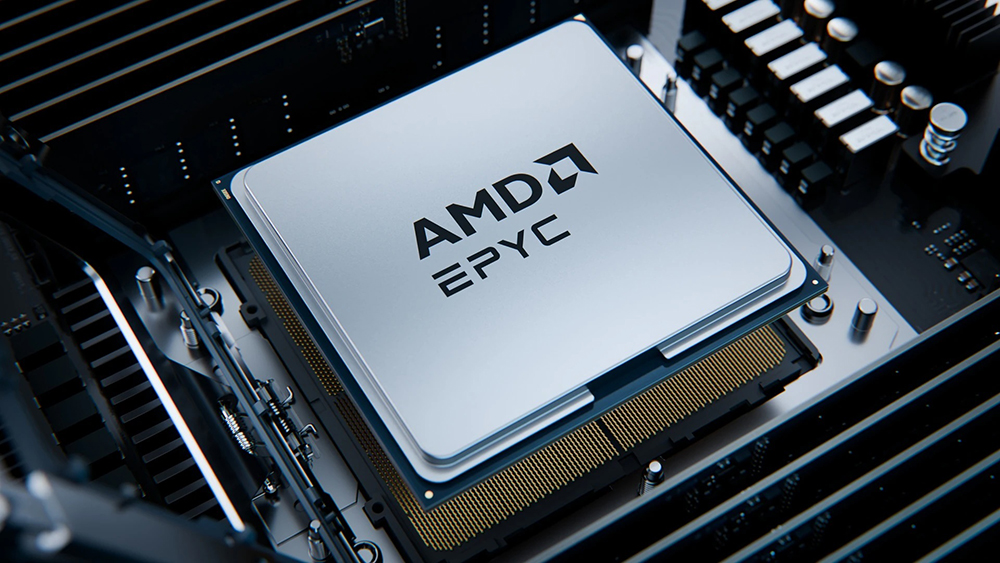
AMD has put its 6th Gen AMD EPYC server processors for the SP7 platform into general availability, with systems now shipping from “leading server vendors.” The CPUs are based on the new “Zen 6” architecture and are aimed at enterprise, cloud, HPC, and what AMD describes as “agentic AI” workloads.
On the silicon side, AMD called out the EPYC 9996 as a general-purpose part in the lineup and tied it to published SPECrate2017_int_base results and pricing. In AMD’s cited configurations, a two-socket EPYC 9996 system is listed at 512 cores with 600 W “Default CPU Power” per CPU, a 1Ku price of $14,904, and a SPECrate2017_int_base score of 5470. The footnotes also list a two-socket EPYC 9965 configuration at 384 cores, 500 W, $11,988, and a score of 3260.
AMD also used this launch to formalize a terminology shift: starting with the 6th Gen EPYC family, it uses “Default CPU Power” as its reference for processor power consumption, describing it as total power across compute and I/O dies for the stated performance target. For data center planners, that’s a reminder to sanity-check how CPU “power” numbers are being presented when you’re doing rack power envelopes, thermal design, and performance-per-watt comparisons across platforms.
For AI host-node use cases, AMD cited internal testing and projections around CPU-offload LLM inference, comparing a “6th Gen AMD EPYC 96c HF processor host node” against a 5th Gen EPYC 9575F in a two-socket configuration with SMT disabled. AMD’s claim here is “up to 1.8x” LLM output throughput versus the prior generation, with the methodology tied to PCIe bandwidth assumptions (Gen 5 x16 measured and Gen 6 x16 projected).
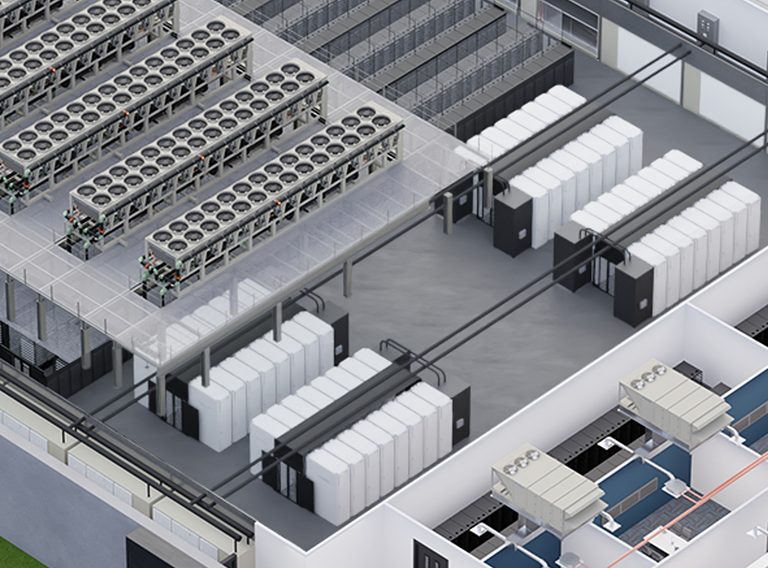
At the rack level, AMD described “AMD Helion” agentic AI racks with three variants: AMD Helion Liquid, AMD Helion Air, and AMD Helion Air Inference. AMD said some Helion rack configurations can reach up to 73,728 threads in one rack. The company also published an “agents per rack” estimate for EPYC 9996 servers in a 35 kW rack, modeling up to 20 servers per rack and showing up to ~1.18x more agents per rack under a power-limiting configuration it calls UPP (with a 15% lower combined SOC and DIMM power limit).
On the ecosystem side, AMD said Meta is acting as a lead customer and has been validating 6th Gen EPYC CPU-based platforms ahead of deployment “at scale.” Microsoft Azure is listed with Azure HDv2 (preview), Azure HXv2, and Azure ND MI455X v7 (based on AMD Helios) tied to the new EPYC generation. Oracle Cloud Infrastructure is expected to offer OCI Compute E7 instances powered by 6th Gen AMD EPYC, with AMD saying those instances will be generally available soon.
“AI is significantly expanding the role of the CPU across every layer of the data center,” AMD senior vice president and general manager Dan McNamara said.
Source: AMD