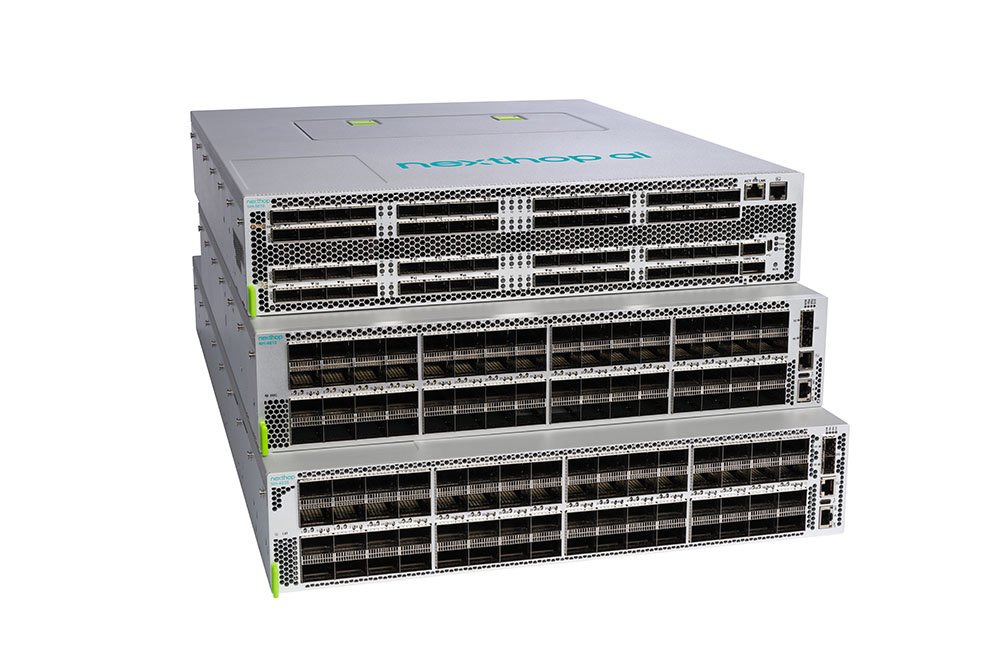
Nexthop AI announced a launch portfolio of Ethernet switching platforms aimed at scale-out, scale-across, and front-end network applications in cloud and AI data centers. Alongside the switch lineup, the company also introduced its “Disaggregated Spine” architecture, which it says is designed to improve efficiency and deployment velocity while supporting open networking stacks such as SONiC and FBOSS.
Nexthop says the Disaggregated Spine architecture was developed in collaboration with “a large hyperscaler” and breaks a traditional chassis model into “independent, optimized, functional tiers.” The company describes two tiers: a scale-across leaf tier (data center fabric-facing) and a scale-across spine tier (data center interconnect-facing). Nexthop says the design includes deep buffers, line-rate MACsec encryption, and expanded routing tables, and claims “30% lower cost” and “30% lower power consumption” versus “legacy chassis-based systems.” The company also positions the architecture as a way to facilitate adoption of open network operating systems such as SONiC.
On the open networking side, Nexthop says it’s a SONiC Governing Board member of the Linux Foundation and claims that it’s become “amongst the top 10 global contributors” to the SONiC project. Nexthop also says its switches can run “any version” of SONiC or FBOSS that hyperscalers choose, and that it offers “a hardened, supported” distribution called the Nexthop Network Operating System powered by SONiC for “NeoClouds.”
The hardware lineup includes three named systems, each tied to a Broadcom switch ASIC generation. The NH-4010 is positioned by Nexthop as “the industry’s lowest power 51.2 Tbps switch” based on Broadcom Tomahawk 5 silicon; the company claims its system design can save customers 15–20% power in “like-for-like configurations,” translating to “10s of Megawatts” of savings at scale. The NH-4220 is described as “the industry’s highest density 102.4 Tbps air cooled system” based on Broadcom Tomahawk 6 silicon, and Nexthop says it’s engineered to support migration from previous generations “without requiring disruptive changes to rack or fiber plants.” The NH-5010 is described as “the first deep-buffer, scale-across spine switch” based on Broadcom Qumran 3D silicon, intended to enable the Disaggregated Spine architecture for hyperscalers.
Nexthop also says its platforms include “advanced real-time telemetry” for congestion control, load balancing, and real-time layer 1 and optics monitoring, with the goal of improving network performance and link reliability.
“They are partnering with the community on several new initiatives, including pioneering new concepts like the Disaggregated Spine,” said Dave Maltz, Principal Network Architect for Azure Networking at Microsoft. Asad Khamisy, senior vice president and general manager, Core Switching Group at Broadcom, said: “Nexthop’s deep system expertise and integration of our low-power switching silicon have enabled scalable, highly power-efficient solutions.” Nexthop said its platforms and software solutions are “already shipping to leading Hyperscalers,” and that it also has a “complementary optics portfolio” focused on layer 1 validation to improve stability and deployment speed.
Source: Nexthop AI