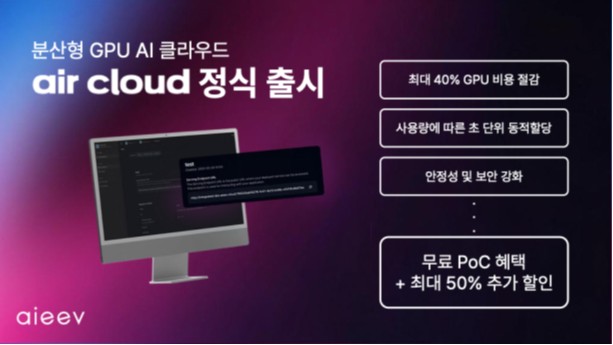
AIEEV has announced the launch of Air Cloud, a distributed, inference-only artificial intelligence (AI) cloud platform that connects idle graphics processing units (GPUs) from consumer and enterprise sources. The company says Air Cloud enables low-cost AI inference by aggregating underutilized GPUs worldwide into a single platform, eliminating the need for conventional data center infrastructure.
According to AIEEV, Air Cloud leverages idle gaming GPUs found in PC cafés and connects personal devices such as Dnotitia’s Mnemos, a large language model (LLM) device, to supply compute resources for AI model inference. This distributed architecture is designed to provide execution optimization, cost efficiency, payment stability, and robust security—results AIEEV says are validated by nine months of technical testing with around 20 AI companies. The company claims that this approach allows AI workloads to run and deploy without the complicated setup or staffing expertise typically required with traditional data center environments.
Air Cloud targets organizations with rising AI inference needs and is positioned as an alternative to expanding conventional public clouds, which the company notes face high capital and energy challenges. The primary application focus is on AI inference services, with a particular emphasis on startups and small to medium-sized enterprises that require scalable, cost-effective infrastructure.
Sejin Park, CEO of AIEEV, stated, “For AI infrastructure, service competitiveness requires not only speed and cost but also stability. Thanks to its distributed architecture, Air Cloud ensures service continuity even in the event of failures,” said Park.
AIEEV plans to link more than 100,000 consumer GPU nodes globally by 2026 as part of its effort to become a major provider of affordable, scalable AI inference. The company has participated in several government and industry support programs, including Samsung Electronics’ C-Lab startup incubator, Daegu City’s ABB project, SK Telecom’s AI Startup Accelerating program, and the Ministry of SMEs and Startups’ TIPS and Deep Tech GMEP project.
Source: AIEEV