
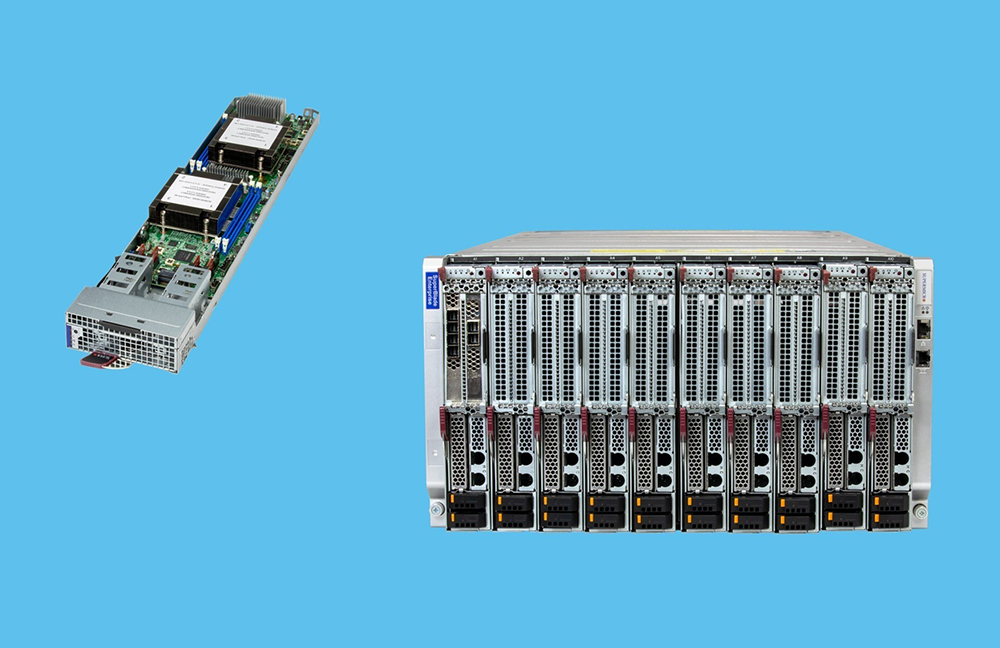
Supermicro has announced its MicroBlade blade-server platform based on AMD EPYC 4005 series processors, positioning it as the industry’s first and highest-density blade platform built on this processor family. Supermicro says the goal is a density-optimized system for scale-out and multi-tenant environments, with a design intended to support longevity by allowing use of AMD EPYC 4005 processors alongside previous processor versions.
The company’s new 6U enclosure supports up to 40 server nodes per chassis, and Supermicro says it can scale to up to 320 server nodes in a standard 48U rack. “Our flexible blade architecture enables customers to mix different node types with different CPUs within a single enclosure and can incorporate up to 320 server nodes in a standard 48U rack,” said Charles Liang, President and CEO of Supermicro. “Supermicro continues to lead the industry in delivering advanced, energy-efficient platforms to market that maximize scalability, lower total cost of ownership, and protecting data center investments for the long term.”
Per-node hardware includes one AMD EPYC 4005 series processor, two DDR5 error-correcting code (ECC) unbuffered dual in-line memory module (UDIMM) slots at up to 5600 MT/s, two PCI Express (PCIe) Gen5 E1.S solid-state drives (SSDs), and one M.2 SSD. Networking is dual-port 25 GbE (Gigabit Ethernet) via the Broadcom BCM57414, and the platform includes Trusted Platform Module (TPM) 2.0, signed firmware, a hardware root of trust, Intelligent Platform Management Interface (IPMI) 2.0, keyboard-video-mouse (KVM) over IP, and Redfish application programming interface (API) support.
At the enclosure level, Supermicro says the system integrates two 25G Ethernet switches with 100G uplinks at the back of the chassis, with the stated aim of reducing cabling and lowering total cost of ownership. The platform also supports mix-and-match configurations across single-wide and double-wide nodes, which Supermicro says enables flexible configurations within the same blade system.
For operations teams, the MicroBlade chassis management module (CMM) provides remote control of server blades, power supplies, cooling fans, and network switches. Supermicro says CMM supports per-server power capping and power allocation management, remote reboot and reset, remote BIOS access, and operating system console access via Serial over LAN (SOL) or embedded KVM, with monitoring and control handled by a separate processor to keep those functions operating regardless of CPU state or power-on status.
Source: Supermicro