Ventiva has unveiled its Zoned Cooling reference design at CES 2026, describing it as a new thermal-management architecture that targets airflow and cooling capacity to specific heat-generating components rather than pushing air broadly through a chassis. Ventiva positions the approach as a response to higher sustained AI workloads and on-device inference that increase localized heat density and strain conventional fan-based cooling.
Ventiva says Zoned Cooling directs cooling “precisely to the components that generate the most heat – such as CPUs, GPUs, and AI accelerators,” aiming to reduce wasted airflow and improve thermal efficiency. The company’s design is based on its ionic cooling technology, which it says “delivers micro-channeled airflow” and uses electrohydrodynamic (EHD) flow to move ionized air molecules in an electric field, producing airflow without mechanical fans.
For data center systems, Ventiva claims traditional fan-based cooling is inefficient in a 1U server because “only 25 percent of airflow reaches the compute components, while the remaining 75 percent is used to remove heat,” and notes uneven airflow can contribute to hotspots and processor throttling. Ventiva says Zoned Cooling enables localized cooling for high-heat components (including CPUs, GPUs, and NPUs) and claims it can “save up to 5% of a server’s overall power budget,” reduce hotspots and throttling to help maintain peak AI performance, and lower sustained temperatures to reduce thermal stress on components. It also describes its approach as “an augmentative cooling solution for hybrid, liquid solutions in data centers.”
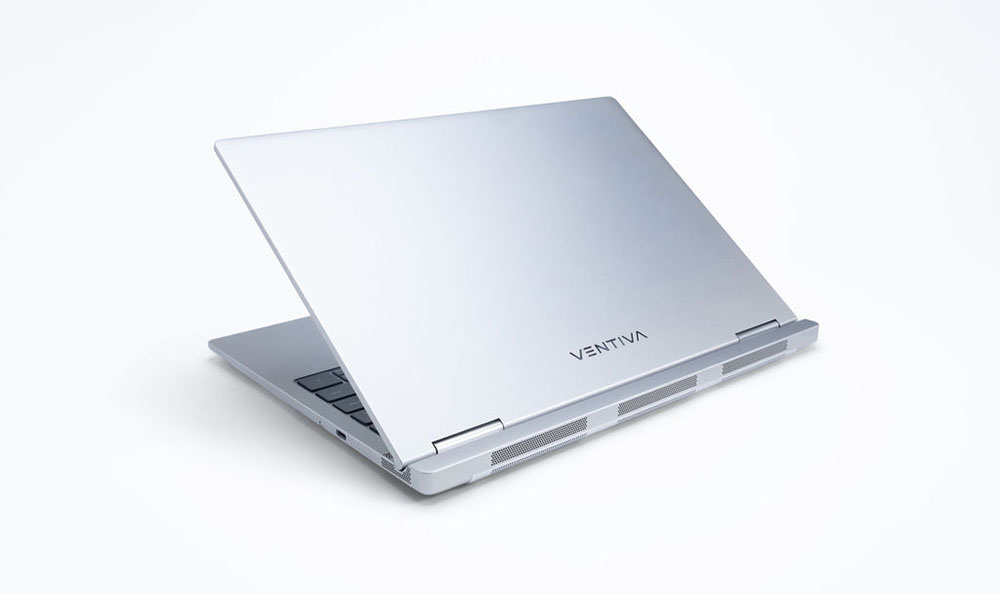
Ventiva is also showcasing an AI-ready laptop platform intended to demonstrate system-level design impacts for original equipment manufacturers (OEMs) and original design manufacturers (ODMs). In this laptop reference design, Ventiva positions all vents at the rear edge of the device and replaces mechanical fans with its thermal management subsystem. The company claims benefits including up to 7,200 mm² of reclaimed motherboard area, simplified construction and reduced inventory requirements, modular and scalable thermal components to lower total cost of ownership, and thinner and quieter designs for AI workloads.
Ventiva says its AI-ready laptop reference design uses three 62 mm Ventiva modules and supports a 28 W CPU and 44.3 W total platform power in a sub-16 mm chassis. The design “accommodates up to a 77 Whr battery,” supports a 2280 solid-state drive (SSD) form factor, and is “Microsoft Copilot+” ready, according to Ventiva. The company adds that a parallel module array with rear-edge venting reduces impedance, increases cooling efficiency, and provides a scalable thermal pathway for future systems.
Source: Ventiva