
Ferveret says a benchmark study conducted with UCLA’s Computer Science Department found its waterless data center cooling approach, the Adaptive Phase Cooling Solution, delivered a 15% improvement in computational efficiency (TFLOPs/kW) versus direct-to-chip (DTC) liquid cooling, alongside zero water consumption and a reported facility-level PUE of 1.03.
Per Ferveret, the work was conducted in collaboration with UCLA’s Intelligent Connectivity Laboratory (ICON Lab) and used NVIDIA H200 GPUs as the reference platform. The benchmark measured server-level computational efficiency in TFLOPs/kW (tera floating-point operations per second per kilowatt of server power). Ferveret also reports a PUE of 1.03 at the facility level, which is a different metric than TFLOPs/kW and reflects facility infrastructure efficiency rather than GPU-only performance.
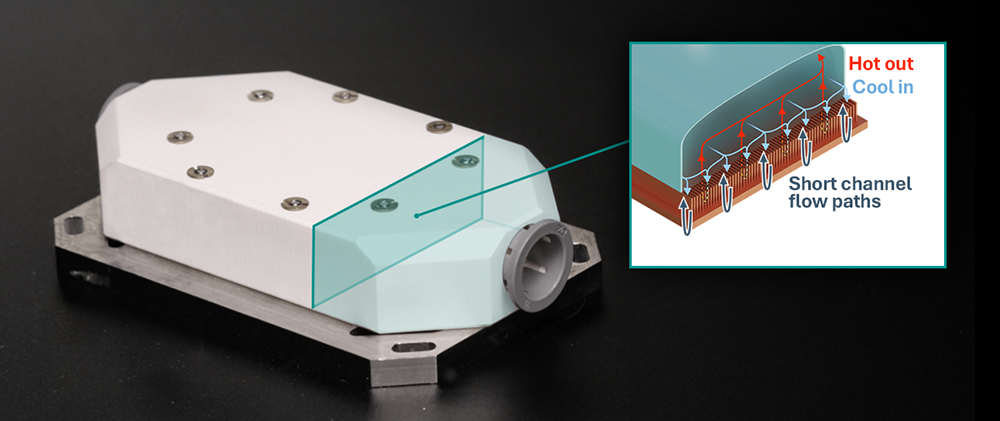
The company positions Adaptive Phase Cooling as a liquid-cooling method “inspired by nuclear reactor systems” that use subcooled boiling. Ferveret’s description contrasts subcooled boiling with saturated boiling: smaller bubbles detach more frequently and recondense in surrounding subcooled liquid, which “continuously refreshes the liquid at the chip’s surface,” improving rewetting and heat transfer. Ferveret says test results show lower operating temperatures and the ability for chips to run reliably at higher power levels, but the announcement doesn’t include temperature deltas, coolant type, flow rates, heat flux limits, or mechanical integration details (for example, cold plate design, CDU (coolant distribution unit) interfaces, or serviceability).
For data center operators, the headline claims to watch here are the TFLOPs/kW delta versus conventional DTC and the “zero water consumption” assertion. If both hold in production deployments, the approach could change the constraint set for where high-density GPU systems can be deployed, especially in locations where water availability or permitting makes evaporative or water-dependent cooling a hard sell. But the announcement doesn’t specify whether the benchmark was run at equal GPU power limits, equal clocks, or equal thermal setpoints, which matters when comparing sustained clock behavior across cooling approaches.
Omid Abari, Associate Professor in the UCLA Computer Science Department, said, “Our recent study shows that Ferveret cooling reduces the time required to train machine learning algorithms by enabling hardware to operate at higher sustained clock speeds.” Reza Azizian, CEO of Ferveret, said the solution “eliminates the need for water while dramatically improving computational efficiency.”
Separately, Ferveret said “leading investment firms and venture capitalists” backing the company include TO VC, Aramco Venture, Cerberus, Y Combinator, Baruch Future Ventures, Verso Capital, Acclimate Ventures, Cathexis Ventures, Valkyrie, E14, and Climate Capital. The announcement does not disclose funding amount, valuation, customer deployments, pricing, or commercial availability timelines.
Source: Ferveret