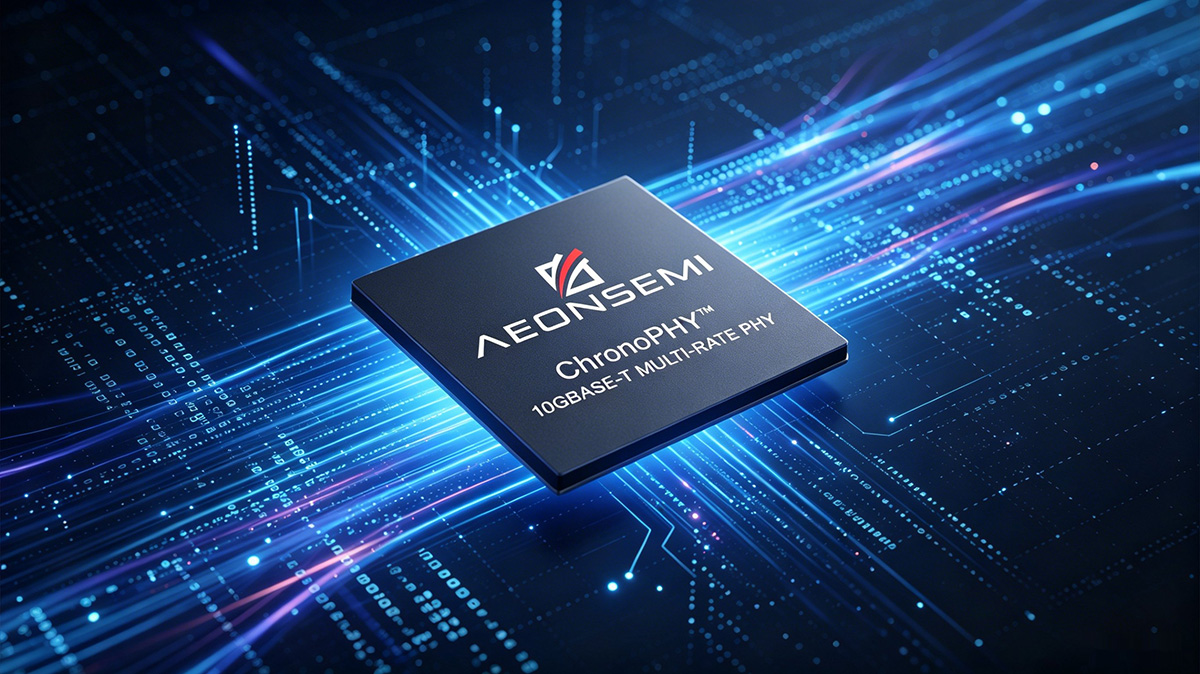
Aeonsemi has started production shipments of its second-generation ChronoPHY 10GBASE-T Ethernet PHY, the AS22010, targeting deterministic, low-latency copper Ethernet at the edge. The company is pitching the device for designs such as Wi-Fi 7 and Wi-Fi 8 access points, XGS-PON CPE, multi-gigabit enterprise edge gear, and AI edge infrastructure where timing, interference tolerance, and thermal budget are all under pressure.
At 10G over 100 m, the AS22010 cuts typical per-port power by 40% versus Aeonsemi’s first-generation ChronoPHY, while also improving link stability, electromagnetic interference (EMI) immunity, and synchronization accuracy. Aeonsemi ties the timing improvements to support for ITU-T G.8273.2 Class D timing performance, and positions ChronoPHY as an Ethernet PHY architecture designed for low-jitter and low-latency operation in time-sensitive networking use cases including wireless infrastructure, AI edge, industrial automation, and real-time Ethernet systems.
On the feature side, the AS22010 supports six speeds—10GBASE-T, 5GBASE-T, 2.5GBASE-T, 1000BASE-T, 100BASE-TX, and 10BASE-Te—and is compliant with IEEE 802.3an, 802.3bz, 802.3ab, and 802.3u, including Energy-Efficient Ethernet (EEE). Aeonsemi also calls out enhanced EEE behavior across supported rates, with faster wake and recovery aimed at bursty AI and edge traffic patterns.
For time sync, the PHY supports IEEE 1588v2 PTP and IEEE 802.1AS gPTP, with 1 ns PHY timestamp resolution and a stated low 10 ns end-to-end packet delay variation across link conditions. A variant, the AS22010J, adds an integrated low phase-noise SyncE PLL, plus any-rate fractional SyncE output from 25 MHz to 250 MHz, and is positioned to simplify designs using SyncE.
For data center and edge engineers, the blunt takeaway is that shaving PHY power at 10GBASE-T can be a practical thermal win in dense edge enclosures and fanless or low-acoustics designs, especially when you’re trying to keep copper for cost and installation reasons but still need tighter timing for coordinated systems.
The AS22010 family is specified for an industrial temperature range of –40 °C to +85 °C and comes in a 7 mm × 7 mm BGA package. Samples, evaluation boards, and production quantities are available now.
“AI is pushing high-speed Ethernet from the data center to the edge, where energy efficiency and deterministic timing are becoming increasingly critical,” said Yunteng Huang, CEO of Aeonsemi.
Aeonsemi did not provide pricing.
Source: Aeonsemi