
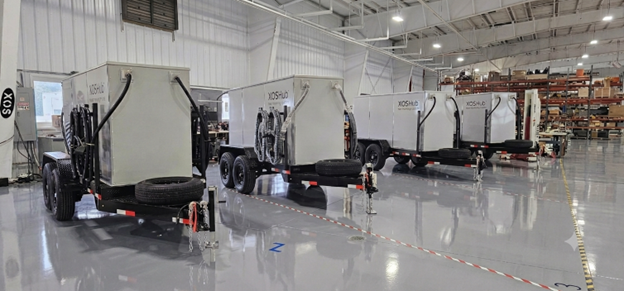
Xos has launched the 2.5 MWh Power Hub, a behind-the-meter energy storage and hybrid power system aimed at data centers and other facilities that can’t wait on multi-year US grid interconnection timelines. The company pitches the containerized unit as a way to bring megawatt-scale power on-site within days of delivery, rather than years of utility work.
The Power Hub line scales from 1.2 MWh to 4.0 MWh and ships inside a standard intermodal container. Xos describes the system as fully integrated, with power conversion, plant controls, and generator dispatch logic included, and a standard 480 V three-phase output.
Configurations and power output
Xos is offering three core configurations. The 1.2 MWh Power Hub is rated for 0.6 MW continuous output. The 2.5 MWh Power Hub is rated for 1.2 MW continuous output and is described as “intermodal-ready,” with an optional 500 kWe dual-fuel genset for hybrid operation. A 4.0 MWh Power Hub option targets applications needing “maximum stored energy per square foot” (Xos did not list a continuous MW output figure for the 4.0 MWh configuration in the materials provided).
For larger sites, Xos says multiple units can be combined through an external power combiner to build multi-megawatt-hour, multi-megawatt plants using standardized blocks.
Why data center engineers should care
Behind-the-meter capacity has moved from “nice to have” to a schedule-protection tool for power-constrained builds, especially where transformer, switchgear, and interconnection work can gate occupancy. A containerized BESS/hybrid block with integrated controls can simplify procurement and integration, but operators will still need to evaluate how it fits into their protection scheme, grounding, and operational model—particularly if it’s being used for sustained, generator-backed operation rather than short-duration peak shaving.
Xos also argues the system addresses genset behavior under transient-heavy loads, saying it can absorb load swings so generators can run more efficiently at steadier operating points, reducing fuel consumption and emissions per MWh delivered.
Dakota Semler, CEO of Xos, said, “We engineered this product to do three things that conventional energy storage systems cannot: arrive on a standard truck, energize without a microgrid controller, and make every kilowatt-hour of fuel-fired generation cleaner and more efficient. This is not a battery. It is a deployable power plant.”
Xos said the Power Hub is built on the architecture behind its Xos Hub mobile EV charging platform and that more than 250 MWh of Xos energy storage is already operating in commercial service across North America. The company said manufacturing will take place at its Xos Hub production facility in Tennessee.
Source: Xos