
Independent third-party benchmarking found that Accelsius’ NeuCool two-phase, direct-to-chip cooling held an NVIDIA B200 GPU’s junction temperatures 9° C below the server’s factory single-phase cooling, and the gap grew as the facility water warmed. Single-phase performance on 45° C facility water was matched by NeuCool on 54° C water.
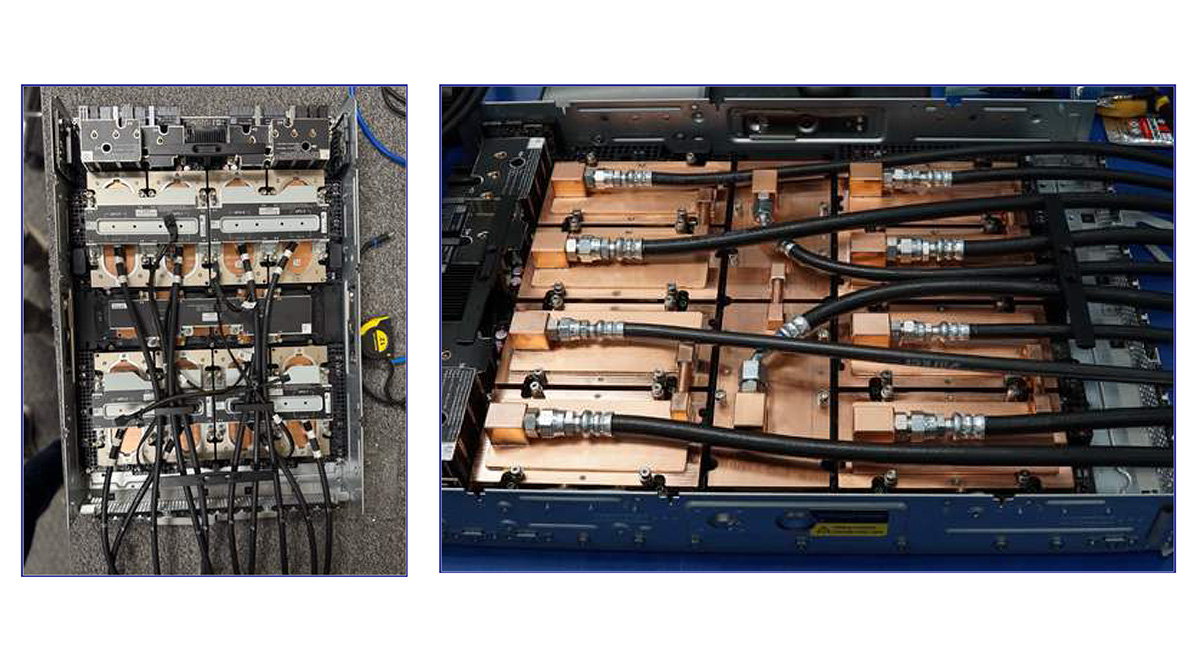
A third-party systems integrator ran the comparison on a commercially available eight-way NVIDIA B200 GPU server, pitting the server’s factory-installed single-phase direct-to-chip cooling against NeuCool across roughly 40,000 operating points under simulated AI workloads. It varied GPU core, high-bandwidth memory (HBM), and CPU power to map thermal behavior across the conditions a production server actually runs into.
Raising facility water flow from 1.5 liters per minute per kilowatt (LPM/kW) to 3.0 LPM/kW widened NeuCool’s thermal advantage over single-phase from 9° C to 14° C and lifted the workable facility water supply temperature to 59° C. Single-phase cooling, Accelsius says, does not see comparable gains from higher facility water flow.
Accelsius puts the value of warmer water at roughly 4% in annual energy savings for every 1° C of added facility water temperature, and says running above 50° C opens free cooling across most of the world for much of the year. Free cooling rejects heat through dry coolers or cooling towers without running mechanical chillers, which are among the largest energy draws in a data center’s cooling plant. NVIDIA has set 45° C as its facility water target, and CEO Jensen Huang has pointed to warmer water as a route to more efficient AI infrastructure.
Accelsius’ NeuCool IR150 integrated rack is already rated for 45° C facility water. Two-phase cooling absorbs heat by boiling a refrigerant at the chip rather than warming a stream of water, and Accelsius says the physics of vaporization let that approach keep its edge as the facility water heats up. Single-phase systems lean on the temperature gap between the water and the chip to move heat, so warmer water eats directly into that cooling margin. Boiling stays closer to a fixed temperature regardless of inlet conditions, which is the physical basis for the widening separation the test found in the warm-water range.
Accelsius detailed the full results in a white paper, “Warm-Water Ready: Benchmarking Two-Phase vs. Single-Phase Direct-to-Chip Cooling on an NVIDIA B200 Server.”
Source: Accelsius