
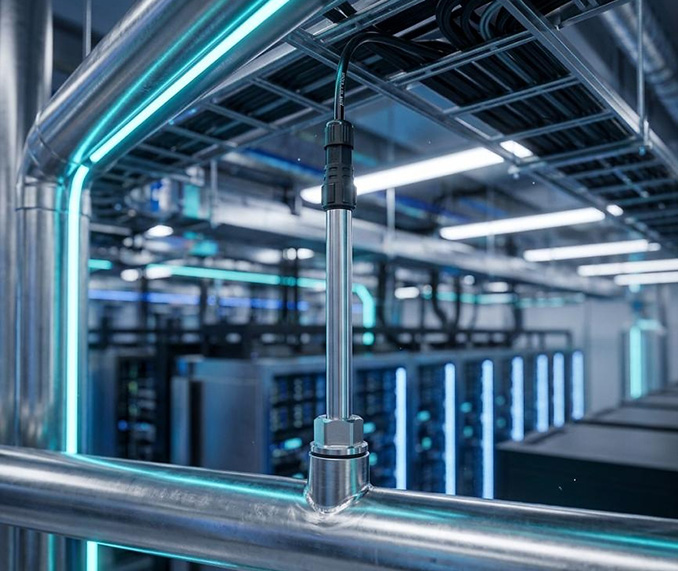
Rika Sensor is pushing water quality monitoring sensors for liquid-cooled AI data centers, targeting real-time visibility into coolant conditions that can drive corrosion, scaling, and heat-transfer degradation if left unchecked. The company is pitching online monitoring as an alternative to periodic manual sampling, with remote data transmission and alerting as part of the value proposition.
The product set described includes pH sensors, electrical conductivity (EC) sensors, turbidity sensors, dissolved oxygen sensors, and integrated online water quality monitoring systems. Rika Sensor says its designs incorporate temperature compensation, anti-interference features, and corrosion-resistant materials for long-term monitoring in liquid cooling loops.
In a liquid cooling system, the coolant is part of the thermal design, but it’s also a materials and reliability problem: conductivity shifts, pH drift, suspended particles, and dissolved oxygen changes can all accelerate corrosion or fouling. For operators trying to keep DLC (direct liquid cooling) loops stable over long service intervals, continuous measurement can be more actionable than lab-style spot checks—if the sensors hold calibration and survive the chemistry and temperature range of the loop.
Rika Sensor points to deployments in “multiple liquid cooling projects,” including a liquid-cooled data center project in Europe that monitored coolant conductivity, pH, and turbidity for real-time alerting tied to purity and corrosion risk. The company also says it has a strategic partnership with a Chinese liquid cooling system manufacturer to provide customized water quality sensors for liquid cooling units used in data centers and energy storage power stations.
An overseas liquid cooling system customer’s technical director, identified as Henry, said, “Rika water quality sensors provide our liquid cooling circuits with stable online monitoring capabilities, which significantly reduces O&M costs and the risk of equipment failure.” Rika Sensor GM Michael added, “We’re always committed to focusing on customer challenges and applying sensing technology across the liquid cooling industry, providing global customers with more reliable and easier-to-integrate monitoring solutions.”