
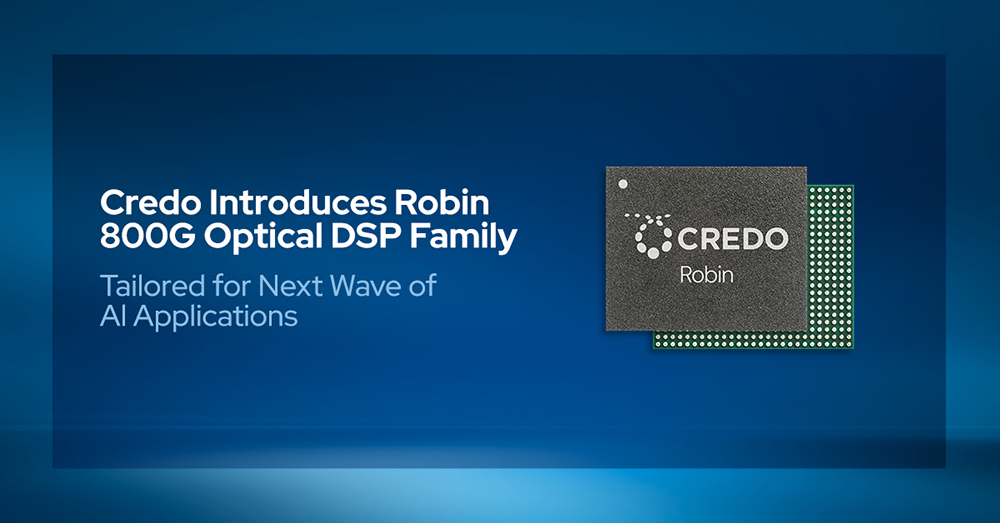
Credo has launched its Robin optical DSP family, including Robin 800G and 400G devices aimed at AI-driven data center networks. The company says the family targets rising demands around bandwidth, power efficiency, and scalability in 800G-class optical transceivers used in hyperscale environments.
Robin is built on Credo’s sixth-generation DSP architecture, and the lineup includes variants for both fully retimed transceivers and Linear Receive Optics (LRO). The family also includes dedicated variants with integrated Silicon Photonics (SiPh) and EML drivers, giving module designers multiple integration paths depending on optics choices and transceiver architecture.
On the electrical side, Credo highlights integrated, low-power, high-swing laser drivers that can operate up to 3.3 Vpp. The company also claims a “highly compact substrate” that saves up to 50% PCB space versus competing devices, positioning Robin as a way to simplify board layout while potentially improving manufacturability for dense transceiver designs.
For data center operators, the key practical point is that optics power and module density remain a real constraint as 800G ports proliferate in AI fabrics. A DSP family that combines retimed and LRO options, plus tighter integration of drivers and photonics interfaces, is directly aligned with the day-to-day tradeoffs engineers make between power, thermal headroom, and how quickly modules can be qualified and ramped.
Credo lists additional features including “superior receiver sensitivity and BER performance” intended to handle challenging optical channel impairments, along with Ethernet link health monitoring features aimed at robust operation in demanding environments.
Robin optical DSP variants
The Robin family includes:
Robin 800 (800G DSP optimized for multimode applications)
Robin 802 (800G DSP with integrated SiPh and EML driver for single-mode applications)
Robin 850 (800G LRO DSP optimized for multimode applications)
Robin 852 (800G LRO DSP with integrated SiPh and EML driver for single-mode applications)
Robin 400 (400G DSP optimized for multimode applications)
Robin 402 (400G DSP with integrated SiPh and EML driver for single-mode applications)
“A highly compact substrate saves up to 50% PCB space versus competing devices, simplifying layouts and reducing manufacturing costs,” said Chris Collins, AVP of Sales & Optical Product Marketing at Credo.
Credo said the Robin DSP family is available now.
Source: Credo