
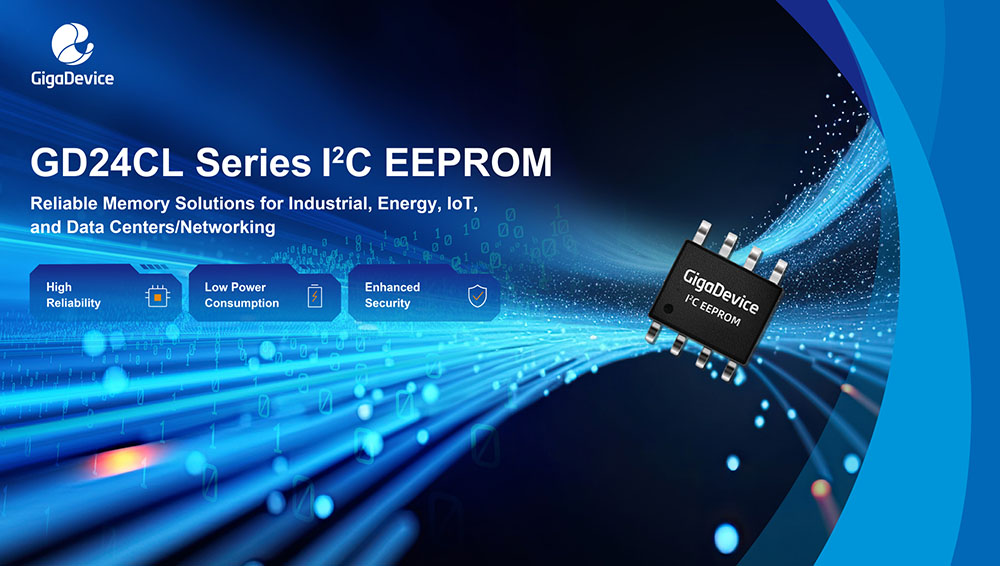
GigaDevice has introduced the GD24CL series, its first I²C EEPROM family, targeting long-term storage of configuration data in systems that need high endurance, data integrity features, and hardware-level write protection. The company points to use cases that include industrial equipment, energy, IoT endpoints, data centers, and networking gear.
The GD24CL series is rated for up to 4 million program/erase cycles and up to 100 years of data retention. The devices also integrate hardware Error Correction Code (ECC) to improve data integrity, and they support an operating temperature range of -40°C to 125°C.
On the interface side, GD24CL supports three I²C clock frequency options—100 kHz, 400 kHz, and 1 MHz—and supports byte-level random read and write operations. For engineers, that combination matters because EEPROM is often used for small but frequently updated parameters, calibration constants, identities, and configuration blocks, and byte-level access can reduce unnecessary write traffic compared with page-style writes.
For security and data-protection features, the devices include a Write Protect (WP) pin for hardware write protection, and a write-lockable Security Page. Once the Security Page is locked, it becomes permanently non-writable.
GigaDevice lists a 1.7 V to 5.5 V operating voltage range, with standby current as low as 1 µA, read current as low as 1 mA, and write current as low as 1.5 mA. The parts are offered in SOP8 150 mil, TSSOP8 173 mil, and UDFN8 2 × 3 mm packages.
The GD24CL series is planned to span densities from 32 Kb to 1 Mb. The first device is the GD24CL256B (256 Kb), with samples available now. GigaDevice also lists 128 Kb and 512 Kb variants scheduled for the first half of next year.
GigaDevice is primarily known for Flash memory and 32-bit MCUs, so an EEPROM family is a straightforward but practical addition for system designers that want to source non-volatile configuration storage alongside their main controller and memory components.
Source: GigaDevice