

Fabric.AI and Kopin published a jointly authored white paper on MicroLED optical interconnect technology for next-generation AI data centers, framing data movement as the primary scaling constraint for large AI clusters. The paper focuses on the companies’ Neural I/o MicroLED-based optical interconnect platform and compares it with copper and laser-based optical approaches.
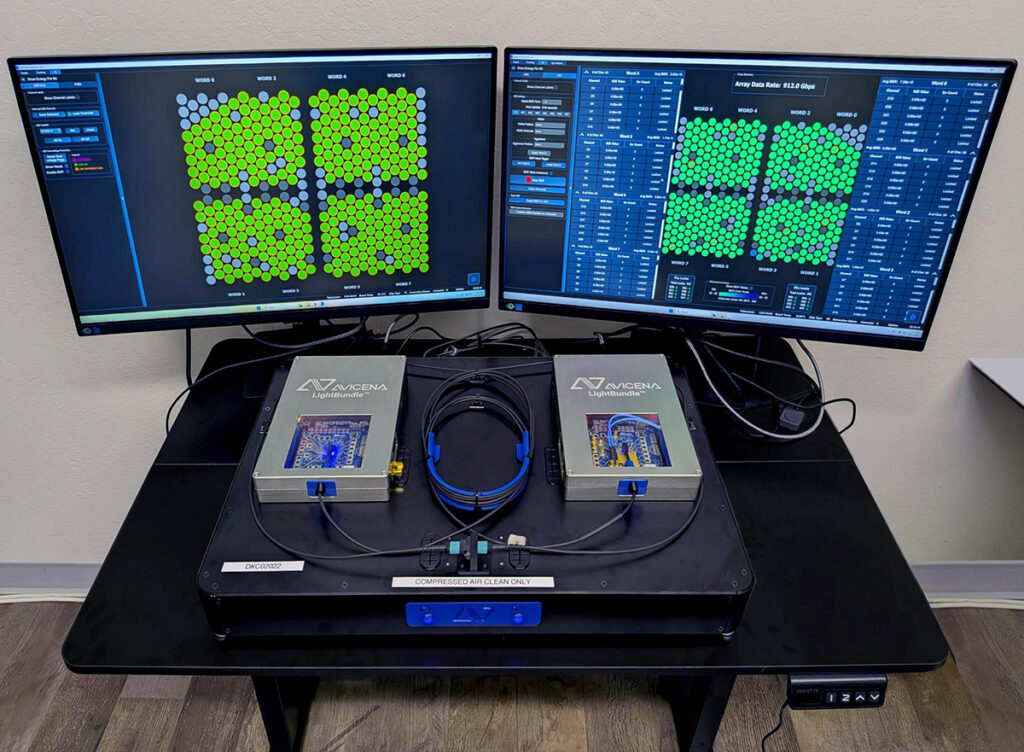
In the paper, MicroLED links are described as using a massively parallel architecture—moving data over hundreds to thousands of simple, low-power parallel channels rather than a small number of high-speed serial lanes. The companies argue this architecture can deliver sub-picojoule-per-bit energy efficiency and scale aggregate link bandwidth toward 20 Tb/s and beyond on published industry roadmaps.
That scaling direction matters for data center engineering because interconnect energy shows up twice: in the IT power budget and in the cooling system needed to reject the resulting heat. But the key performance numbers here are forward-looking and roadmap-based, not measured results from a shipping Fabric.AI or Kopin product, so engineers should treat the efficiency and bandwidth figures as targets rather than validated device specs.
The paper also claims MicroLED arrays can scale bandwidth by adding emitters within the same physical footprint, “without redesigning data center cabling, connectors, or topology.” It includes a roadmap analysis describing how channel count and per-channel speed can compound toward 20+ Tb/s links.
Kopin CEO Michael Murray said, “The industry has spent decades making individual lanes faster, and that era is ending,” adding that “MicroLED technology changes the axis of scaling entirely.” Fabric.AI CEO Josh Silverman said, “Every conversation about AI infrastructure eventually arrives at the same bottleneck: moving data between chips,” and described the white paper as a framework for “why an architecture built on parallelism rather than lane speed is the path through that bottleneck.”
Fabric.AI describes itself as developing AI infrastructure technologies to address bandwidth, latency, and power limitations, and says Neural I/o targets communication between AI accelerators, processors, memory, and networking systems. Kopin says it develops MicroLED technology, optical interconnect devices, and related optical components used across multiple markets, including data centers.
Source: Fabric.AI