
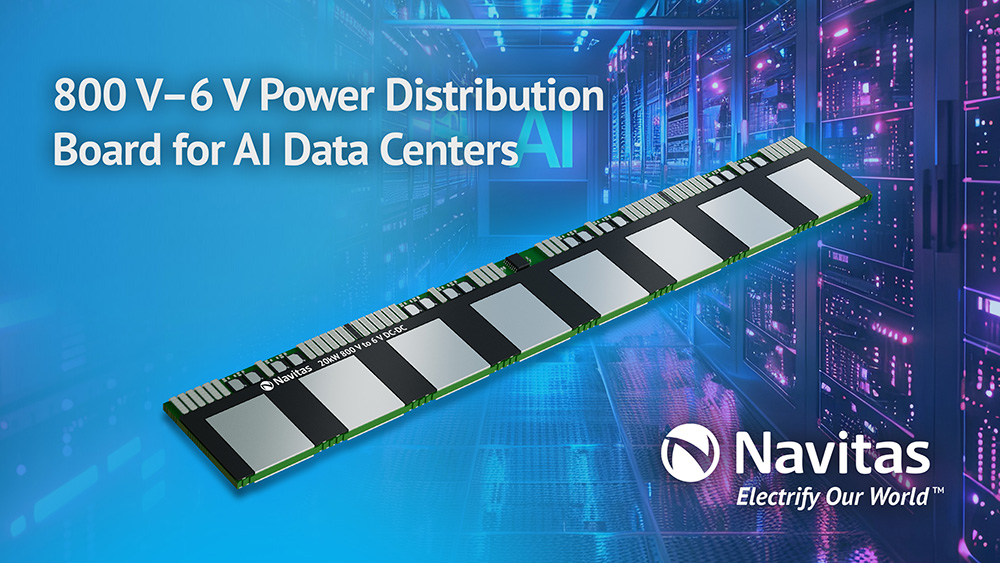
Navitas Semiconductor has introduced an 800 V-to-6 V DC-DC power delivery board (PDB) built around its GaNFast gallium nitride technology, aiming to move GPU server trays to a single-step high-voltage conversion stage. The board is designed to eliminate the traditional 48 V intermediate bus converter (IBC) stage inside the tray, a change that targets higher end-to-end efficiency and more usable board area as rack power climbs.
The 800 V–6 VDC-DC PDB converts directly from 800 V to 6 V in one power stage. Navitas frames the design as aligned to 800 VDC data center power infrastructure, and ties the need to future high compute and power-density systems based on NVIDIA MGX architecture, where it expects direct 800 V-to-6 V (or 12 V) conversion to become a requirement for maximizing rack power density and overall efficiency.
On performance targets, the board is designed for up to 96.5% peak efficiency at full load with a 1 MHz switching frequency, and it’s rated at a power density of 2,100 W/in³. Navitas also describes the board as “approximately 20% thinner than a mobile phone,” positioning the ultra-low profile as enabling very close integration with the GPU board to improve transient performance and power distribution efficiency.
Hardware details include a primary side that uses 16 × 650 V GaNFast FETs in a DFN8×8 dual-cooled package, configured in a stacked full-bridge. The center-tapped outputs use 25 V silicon MOSFETs. Navitas attributes the 1 MHz switching frequency to enabling smaller passives and planar magnetics, which it links to achieving the stated power density.
Dropping an intermediate bus stage is a concrete architectural move, not a marketing tweak: every conversion stage adds loss, thermal load, and PCB area pressure, and it can complicate mechanical integration in GPU trays. But the engineering tradeoffs are real, too—pushing higher-frequency conversion and ultra-low-profile packaging can tighten layout, EMI, and cooling constraints, especially when the goal is close-coupled power near accelerators.
“By eliminating an entire conversion stage, we lower system cost and power losses while freeing up valuable board space, enabling customers to dedicate more real estate to compute, memory, and GPUs and to unlock maximum performance for AI workloads,” said Chris Allexandre, President and CEO of Navitas Semiconductor.
Source: Navitas Semiconductor