
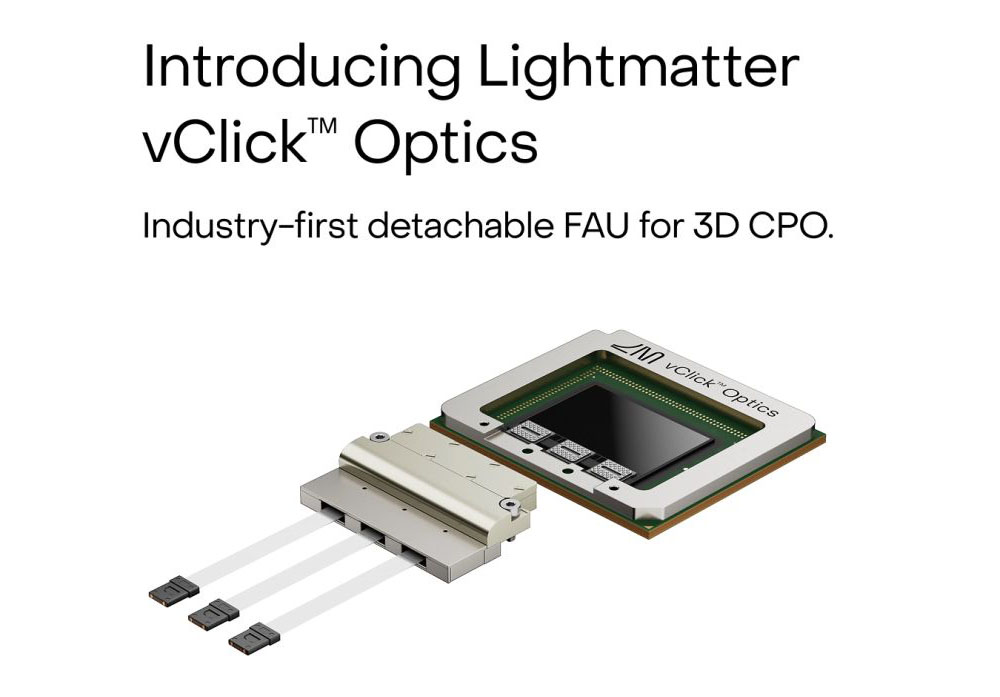
Lightmatter introduced vClick Optics, a detachable fiber array unit (FAU) interface designed for co-packaged optics (CPO) workflows that rely on advanced packaging and high-volume production. The company is positioning vClick as a way to make 3D photonic interconnects more deployable and field-serviceable, with the technical hook being a demonstrated insertion and re-insertion loss of less than 1.5 dB.
vClick Optics targets the “known-good optical engine” problem in CPO manufacturing: the idea is to validate optical engines earlier, before committing them into expensive package builds that also integrate high-cost ASIC die. Lightmatter links that approach to a “shift left” in the assembly cycle by integrating vClick capability into the wafer fabrication process, so optical engines can be verified before final integration into an XPU or switch package.
On the optical side, Lightmatter states vClick supports broadband (up to 80+ nm) Coarse Wavelength Division Multiplexing (CWDM) as well as Dense Wavelength Division Multiplexing (DWDM). The company also says the interface is designed to avoid active fiber alignment during production, with the goal of reducing assembly and test time.
Packaging compatibility is a core part of the pitch. Lightmatter says vClick is mold-and-grind compatible and has been demonstrated in ASE advanced packaging flows. The implementation combines SENKO SEAT and MPC Connector solutions with Lightmatter’s vertically expanded-beam photonic technology, creating a detachable optical interface between fiber arrays and photonic integrated circuits (PICs).
Detachable optics are a practical operator concern as much as a packaging one. If co-packaged optics is going to be serviceable in real deployments, the mechanical and optical repeatability of a disconnectable fiber interface matters, because every dB of loss directly impacts optical power budget and operational margin. Lightmatter’s < 1.5 dB insertion and re-insertion loss claim is aimed squarely at that constraint for “100 Tbps or more” CPO bandwidth targets.
“The increasing complexity in advanced AI chip packages and their production processes necessitates a move toward a known good optical engine at the wafer level,” said Ritesh Jain, SVP, Engineering and Operations of Lightmatter. “With vClick Optics, we are providing physical optical engine connectivity that integrates seamlessly into the world’s largest and most advanced semiconductor supply chains, ensuring that our L-Series 3D CPO platform is hyperscale volume-ready.”
Lightmatter also disclosed eClick Optics, described as an edge-coupling approach aimed at larger die complexes, including those associated with the Passage M1000 reference platform. Lightmatter says eClick uses an edge-attach method to minimize impact on PIC die area and is intended as a complementary alternative for specialized, large-format hardware.
Source: Lightmatter