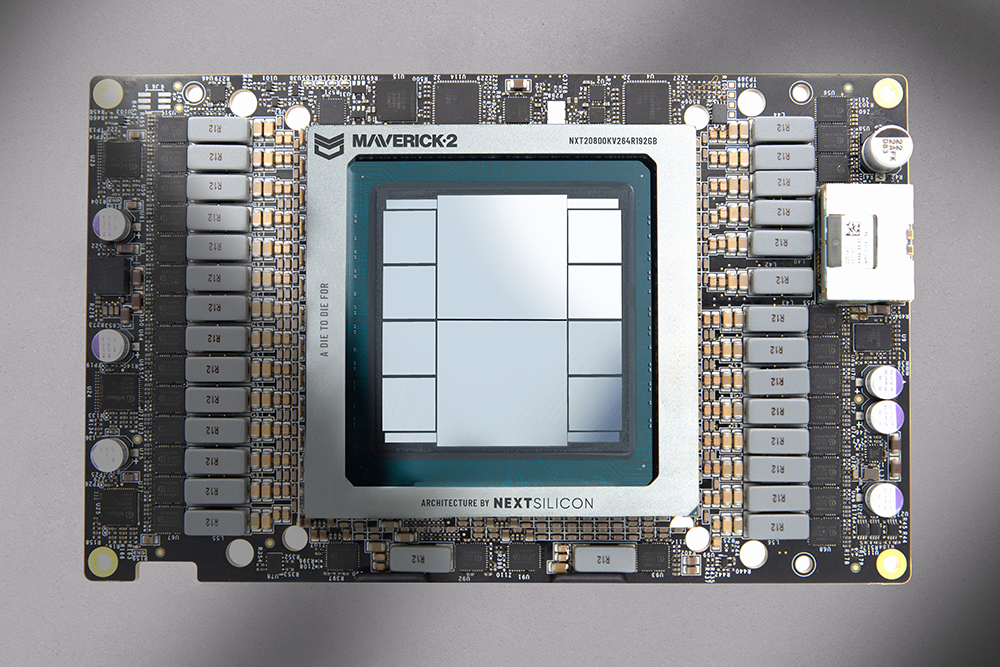
NextSilicon has released technical details for Maverick-2, its new processor designed for high-performance computing (HPC) and artificial intelligence (AI) workloads in data centers. The company claims Maverick-2 delivers up to 10 times the performance of leading graphics processing units (GPUs), while using 60 percent less power on algorithmically complex workloads. It enables users to run existing code—including CUDA, Fortran, C/C++, and Python—without modification or custom optimizations, aiming to simplify deployment and reduce time-to-results for demanding data center tasks.
Built on NextSilicon’s Intelligent Compute Architecture, Maverick-2 utilizes dataflow hardware capable of real-time adaptation to workload characteristics, regardless of software branching or parallelism. This architecture shifts overhead away from dedicated silicon, allowing more hardware resources for computation. According to benchmarking data released by NextSilicon, Maverick-2 achieves key results such as 10 times higher PageRank graph analytics performance on 25 GB-plus graphs compared to top GPUs, 32.6 GUPS (giga-updates per second) at 460 watts (22 times faster than CPUs and nearly six times faster than GPUs), and 600 GFLOPS on the High-Performance Conjugate Gradients (HPCG) benchmark at 750 watts—matching GPU performance at half the power.
The processor requires no proprietary software stacks or lengthy porting cycles. These features target hyperscale data centers, colocation providers, and technology vendors seeking acceleration of workloads such as AI inference, graph analytics, agent-based real-time decision making, and scientific computing. Maverick-2 is already deployed in production environments including Sandia National Laboratories’ Vanguard-II supercomputer.
Sandia National Laboratories has reported initial results from its deployment, with James H. Laros III, Senior Scientist and Vanguard program lead, commenting, “The out-of-the-box HPCG performance results are impressive, showing real promise for advancing our computational capabilities without the overhead of extensive code modifications. Maverick-2’s dataflow approach demonstrates strong potential in real-world scenarios, and we’re continuing to explore its full performance envelope.”
NextSilicon concurrently revealed Arbel, an enterprise-grade high-performance RISC-V processor core implemented on Taiwan Semiconductor Manufacturing Company’s (TSMC) 5 nm process, designed to compete with flagship cores from Intel and AMD in data center environments.
Maverick-2 is available in product volumes in the fourth quarter of 2025, with more details and benchmarking data provided on NextSilicon’s website.
Source: NextSilicon