

UTStarcom debuted concept prototypes of an Optical Circuit Switching (OCS) platform aimed at AI data center networking, showing both silicon photonics and MEMS-based approaches at CIOE 2026. The company is targeting AI cluster scaling limits that show up as power, latency, and thermal pressure in electrical packet switching fabrics.
The idea behind UTStarcom’s OCS approach is to add a dynamic optical switching layer to an AI data center network so high-volume traffic can be carried over direct photonic paths, reducing reliance on Optical-Electrical-Optical (O-E-O) conversions and packet processing for those flows. In hybrid architectures, UTStarcom describes OCS operating alongside electrical packet switches (EPS), with automated optical-path reconfiguration, dynamic topology changes, resource pooling, and optical-layer redundancy.
UTStarcom outlined three intended outcomes for the integrated OCS solution: improved AI cluster performance by reducing buffer-related queuing delays, packet loss, and latency for large-scale training and inference; lower CAPEX and OPEX by reducing the number of optical transceivers along with power, cooling, rack footprint; and protocol- and bit-rate-transparent fiber channels intended to accommodate future optical line-rate increases without replacing the physical switching fabric.
OCS prototypes and software stack
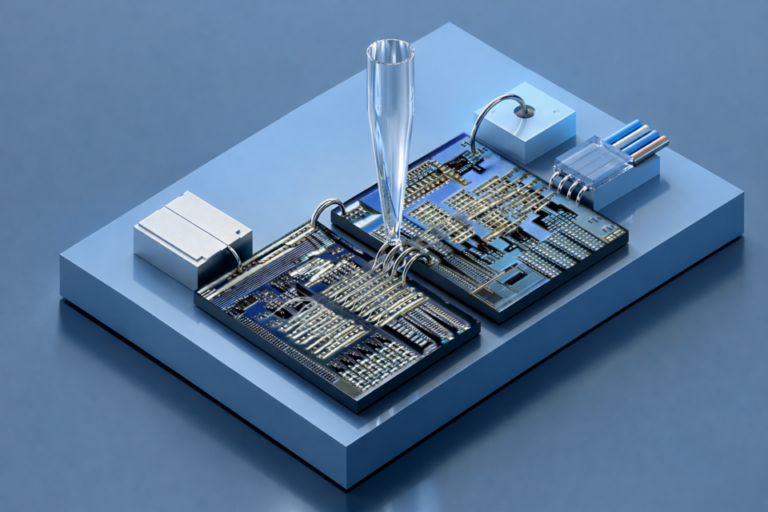
The company showed two 64×64-radix OCS concept prototypes. The UOS64 is a silicon photonics (SiPho) design built around chip-scale Photonic Integrated Circuits (PICs), intended for fast optical switching, high-density integration, and scalable optical path automation. The MOS64 prototype uses a Micro-Electro-Mechanical Systems (MEMS) micro-mirror core, with UTStarcom highlighting low insertion loss, minimal channel crosstalk, and fast optical path switching as design goals.
Alongside the hardware prototypes, UTStarcom described an in-house software management ecosystem: SONiC-based OCS platform software paired with an SDN controller and a SOO Station OCS management platform. UTStarcom says the software exposes open southbound and northbound interfaces (SBI/NBI) so higher-layer orchestrators can automate optical-path provisioning, implement topology-on-demand, and simplify optical fabric management.
OCS is attractive in AI fabrics because it can move bandwidth without burning power in per-hop packet processing. But the practical test is operational: how quickly the optical layer can reconfigure, how well it integrates with orchestration, and how predictably it behaves under real AI traffic patterns.
“By bringing both Silicon Photonics and MEMS-based OCS prototypes to CIOE 2026, we demonstrated our vision for a transparent, highly automated optical layer,” said Dr. Lingrong Lu, Chief Technology Officer of UTStarcom. UTStarcom said the OCS platform remains in active development.
Source: UTStarcom