
Para Light has launched its ThermaFlat SiC MOSFET family, introducing two series—ThermaFlat I and ThermaFlat II—aimed at reducing temperature-driven RDS(on) drift in high-power designs. The company is pitching the devices at applications where junction temperature swings can push conduction losses up and force more aggressive thermal design.
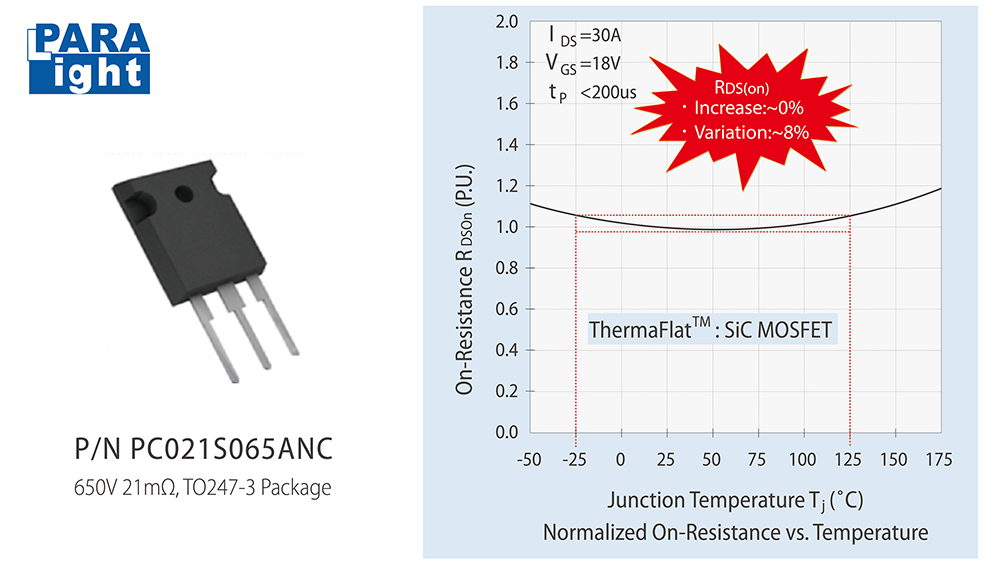
The core technical claim is “Ultra-Low RDS(on) Drift Technology,” which Para Light says keeps on-resistance relatively flat across operating temperature. In benchmark testing cited by the company for a 650 V, 21 mΩ TO-247 device, RDS(on) changes by about 8% as junction temperature moves from -25°C to +125°C. Para Light also says its 1200 V ThermaFlat family applies a similar low temperature coefficient for high-power conversion architectures.
RDS(on) drift matters because it compounds exactly where power designers least want surprises: as silicon and SiC devices heat up under load, higher on-resistance increases conduction losses, which adds heat, which can drive still more loss. If the temperature coefficient is flatter in real systems—not just in a lab curve—that can translate into more predictable thermals, less margin-chasing in heatsinking and airflow, and potentially higher usable power density. But those benefits hinge on how the parts behave in a given topology, gate-drive scheme, and thermal stack-up.
Para Light split the lineup into two series. ThermaFlat I offers 650 V and 1200 V options in “industry-standard packages” and is intended to fit mainstream converter topologies. ThermaFlat II combines the company’s low-drift approach with a high VGS(th) architecture, targeting higher noise immunity and false turn-on prevention. Para Light says ThermaFlat II can operate without a negative gate-off voltage supply, which would allow simpler gate-drive circuitry, fewer components, and lower BOM cost.
On target deployments, Para Light lists AI data center and server power supplies, BBU and UPS systems, EV charging stations, grid-connected energy storage systems, photovoltaic inverters, variable frequency drives, and industrial automation. The company also says it plans to expand the family with additional voltage classes, current ratings, and package configurations.
Source: Para Light