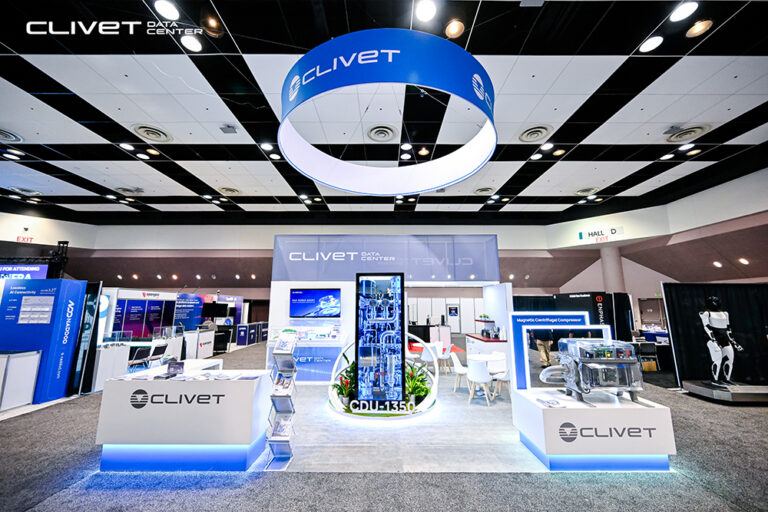

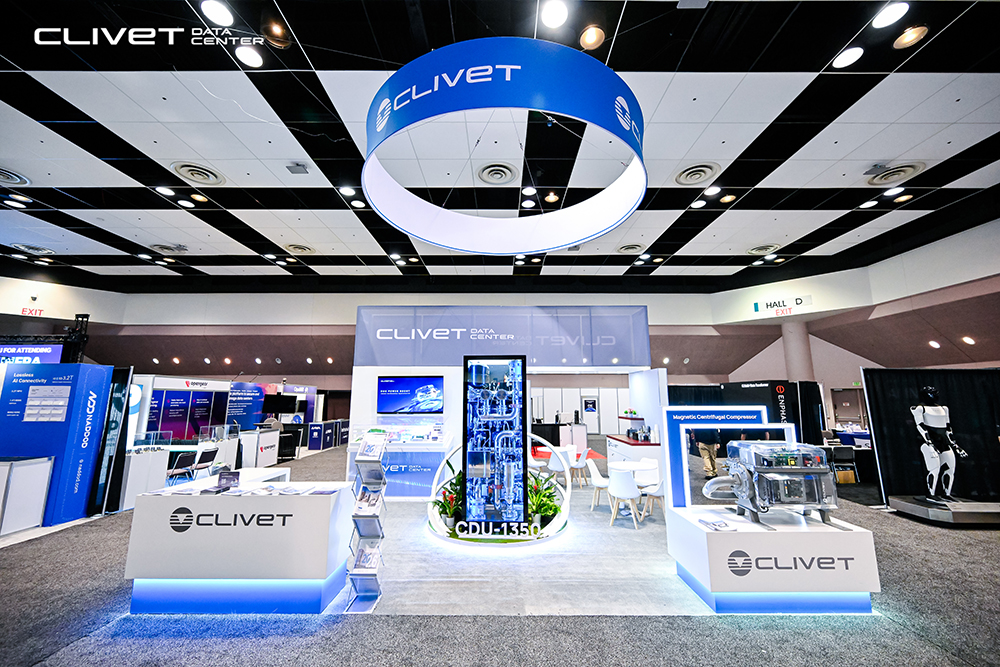
Clivet used AI Infra Summit 2026 in Santa Clara, California, to debut its next-generation magnetic levitation technology and to show a broader data center cooling portfolio that spans cooling sources, liquid cooling distribution, and supporting products. The company also demonstrated a joint power-and-cooling coordination solution with CLOU aimed at AI workloads.
The core hardware in Clivet’s lineup is a next-generation magnetic levitation compressor built on what it calls a “DUO POWER BOOST” dual-rotor variable-speed architecture. Clivet described the compressor as using a two-stage compression structure in which two rotors and their impellers can adjust speed independently based on operating conditions, with the goal of adapting to different flow rates and pressure ratios. Clivet said the design accounts for data center load variations, water temperature conditions, and system operating strategies as part of the cooling source design to support optimization under complex operating conditions.
Across the rest of the portfolio, Clivet showed magnetic levitation cooling sources, magnetic CDUs, high-capacity CDUs, fan walls, and terminal units. An air-cooled magnetic levitation chiller targets facility-side cooling, while a magnetic CDU combines a cooling source with liquid cooling distribution functions. Clivet also showed a high-capacity CDU intended for secondary-side heat exchange and distribution, with capacity ranging up to 3 MW at a 3 K approach temperature difference (ATD) or up to 5 MW at a 5 K ATD. The CDU includes predictive temperature control intended to keep fluctuations within ±0.5°C, and Clivet said key components support online replacement to help maintain continuous operation in high-availability environments.
For operators, the practical takeaway is that Clivet is treating chiller plant behavior and liquid cooling distribution as a coordinated system rather than isolated boxes. That approach lines up with what engineers run into on high-density AI floors, where load swing, water temperature, and controls strategy can matter as much as nameplate capacity.
Clivet said the portfolio can be configured through different product combinations based on project climate conditions, rack density, and supply requirements. In the joint demonstration with CLOU, CLOU contributed energy storage and power delivery capabilities, while Clivet supplied thermal management products and solutions for high-density computing environments. Clivet emphasized that for high-density computing projects, power configuration, thermal design, space layout, and operations and maintenance planning need to be considered together early in the project lifecycle.
Source: Clivet