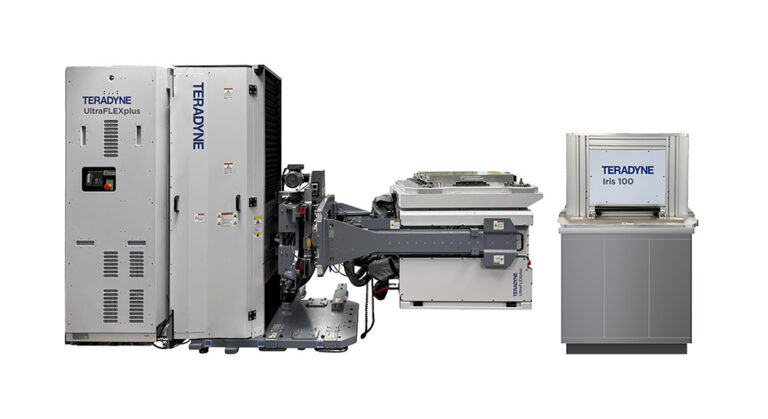

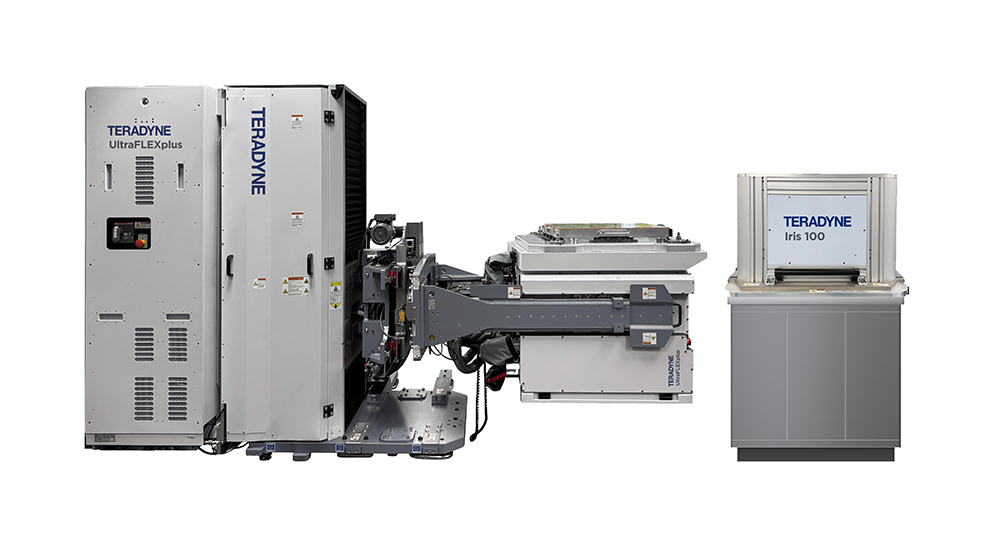
Teradyne has introduced the Iris 100, a production-ready optical test platform for microLED devices aimed at high-volume manufacturing. The system is designed to bring semiconductor-grade optical test into microLED production, with an eye on applications including optical data interconnects used in AI data center architectures.
Iris 100 measures every individual emitter in a microLED array and integrates directly with Teradyne’s UltraFLEXplus platform to combine optical and electrical test in one setup. Teradyne says the goal is to let manufacturers add microLED optical test to test fleets already running at scale, rather than building an isolated optical test flow.
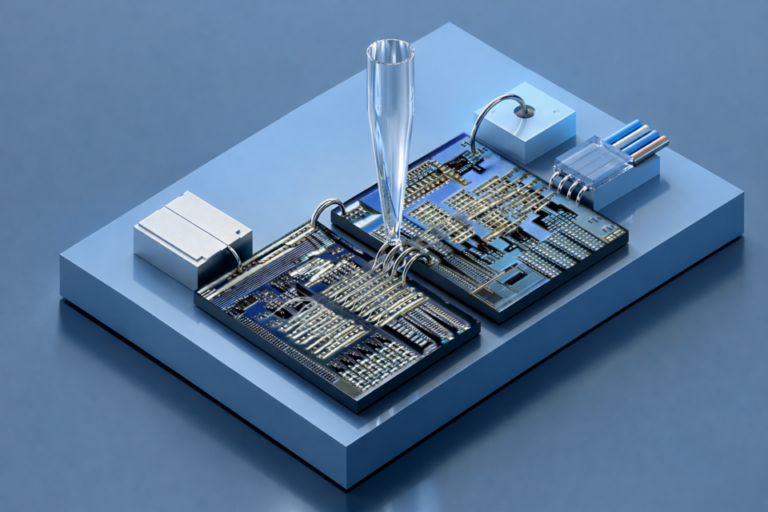
On instrumentation, Iris 100 uses a spectrometer and a high-resolution camera to measure spectral response across the array, plus per-pixel luminance and uniformity. Teradyne also points to test parallelization and image-processing algorithms intended to characterize full arrays containing millions of microLEDs with high throughput.
The platform runs on Teradyne’s IG-XL software and is designed to flag optical defects early in the manufacturing process, including dead or stuck pixels and cluster defects. Iris 100 also includes a NIST-traceable calibration workflow for absolute measurements that can be correlated across lots, wafers, and manufacturing sites.
For data center engineers, the practical tie-in is optical I/O: if microLED-based optical interconnects are going to move from prototypes into supply chains that can support AI-scale builds, they’ll need production test that matches semiconductor throughput and traceability expectations. Bench-top optical instruments can characterize devices in the lab, but they aren’t built for volume manufacturing economics.
“MicroLED is shifting from lab to volume production for both AR microdisplays and, increasingly, optical interconnects, which are becoming foundational to how AI data centers scale beyond copper,” said Shannon Poulin, president of the Semiconductor Test division at Teradyne. “Both technologies demand per-emitter test at production throughput, and Iris 100 delivers that today on test infrastructure our customers already run at scale.”
Teradyne positioned Iris 100 as a follow-on to Photon 100 for silicon photonics and co-packaged optics test introduced earlier this year. The company also pointed to its 2025 acquisition of Quantifi Photonics as part of a broader expansion in photonic and optical test. Iris 100 supports wafer test and final test, and Teradyne said it has a roadmap to add photodetector test capabilities in the same insertion.
Source: Teradyne