
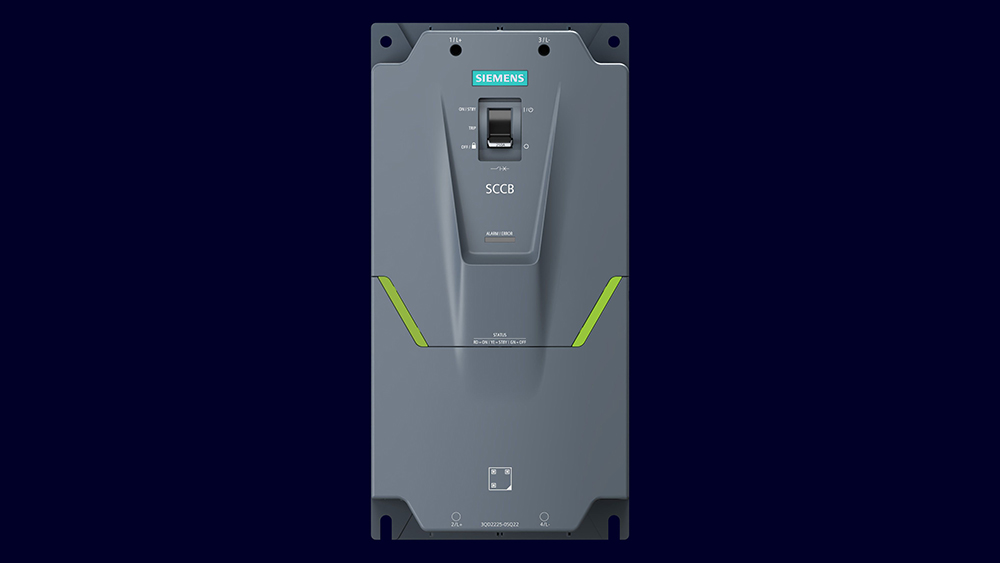
Siemens and Infineon are partnering to use silicon carbide (SiC) power modules in Siemens’ SENTRON 3QD2 semiconductor circuit breakers, targeting electrical protection for data centers, production facilities, and battery storage systems.
Infineon will supply SiC power modules for the product, with Siemens pointing to efficiency, power-density, and reliability gains in the protection platform.
The SENTRON 3QD2 is a solid-state (semiconductor) circuit breaker that uses semiconductor components and protection algorithms to interrupt fault current.
Siemens describes interruption times in the microsecond range, and characterizes that as up to 1,000 times faster than conventional electromechanical breakers that typically operate on the millisecond scale.
The companies are tying that speed to direct current (DC) grids, where fast interruption can help protect equipment and maintain uptime in power-critical environments like AI data centers.
As part of the collaboration, Siemens is integrating Infineon’s 62 mm CoolSiC MOSFET module at 1200 V into its protection concepts for the 3QD2.
For engineers evaluating DC distribution architectures, that combination—solid-state interruption plus SiC switching devices—signals continued momentum toward faster-acting protection schemes that can better match the fault dynamics and selectivity challenges of DC buses.
But “faster” isn’t automatically “easier”: deploying solid-state protection at scale still puts pressure on coordination, system design, and how operators validate behavior under real fault conditions.
“AI data centers and factories are becoming increasingly electrified and complex. This increases vulnerability to electrical failures and drives the demand for more sustainable, efficient and reliable power distribution systems,” said Andreas Weisl, Executive Vice President and Chief Sales Officer of Industrial and Infrastructure at Infineon.
Markus Grabmeier, CEO Electrical Products at Siemens Smart Infrastructure, said, “Our new direct current portfolio offers innovative solutions that not only improve energy efficiency but also enable the development of resilient, future-proof infrastructure.”
Source: Siemens