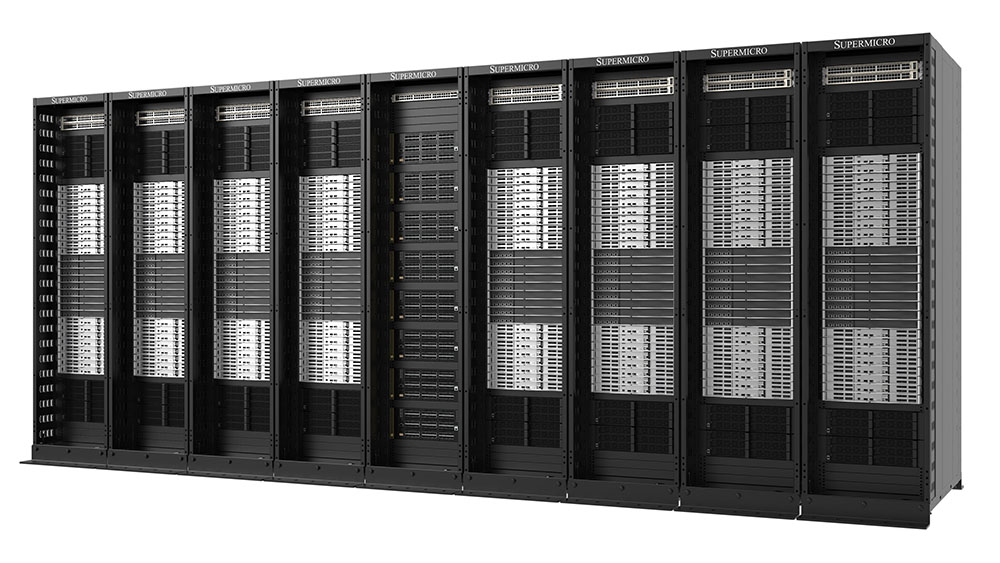
Supermicro has announced expanded manufacturing capacity and liquid-cooling capabilities, in collaboration with NVIDIA, to support first-to-market delivery of data center-scale systems optimized for the upcoming NVIDIA Vera Rubin and Rubin platforms. Supermicro says its Data Center Building Block Solutions (DCBBS) and US-based in-house design and manufacturing are intended to accelerate time to deployment for liquid-cooled AI infrastructure.
Supermicro says it is positioned to rapidly deploy the NVIDIA Vera Rubin NVL72 and NVIDIA HGX Rubin NVL8 systems. In the announcement, Supermicro highlights its rack-scale and liquid-cooled integration approach, including in-row Coolant Distribution Units (CDUs) and its advanced Direct Liquid Cooling (DLC) technology, as part of an end-to-end liquid-cooling technology stack designed to streamline production and deployment of fully liquid-cooled Vera Rubin and Rubin platforms.
The flagship NVIDIA Vera Rubin NVL72 SuperCluster is described as a rack-scale system that combines 72 NVIDIA Rubin GPUs, 36 NVIDIA Vera CPUs, NVIDIA ConnectX-9 SuperNICs, and NVIDIA BlueField-4 DPUs, connected with NVIDIA NVLink 6. Supermicro says the design scales out with NVIDIA Quantum-X800 InfiniBand and NVIDIA Spectrum-X Ethernet. Performance and memory specifications listed include 3.6 exaflops NVFP4, 1.4 PB/s HBM4 bandwidth, and 75 TB of fast memory. Supermicro says its implementation is built on the third-generation NVIDIA MGX rack architecture and uses an enhanced data center-scale liquid-cooling stack with in-row CDUs to enable warm-water cooling intended to reduce energy consumption and water usage while increasing density.
For the 2U liquid-cooled NVIDIA HGX Rubin NVL8 Systems, Supermicro describes a compact eight-GPU platform for AI and high-performance computing (HPC) workloads. The company lists 400 petaflops NVFP4, 176 TB/s HBM4 bandwidth, 28.8 TB/s NVLink bandwidth, and 1600 Gb/s NVIDIA ConnectX-9 networking SuperNICs. Supermicro also says it will offer rack-scale configuration options supporting next-generation Intel Xeon or AMD EPYC processors, including a high-density 2U busbar design for rack integration using Supermicro’s advanced DLC.
The press release also lists platform-level components and features tied to the Vera Rubin platform, including NVLink 6 interconnects; the NVIDIA Vera CPU with custom Arm cores (88 cores and 176 threads), 1.2 TB/s LPDDR5X memory bandwidth, and 1.8 TB/s NVLink-C2C bandwidth to GPUs; a third-generation Transformer Engine; third-generation Confidential Computing with a unified, GPU-level trusted execution environment; and a second-generation reliability, availability, and serviceability (RAS) engine with real-time health checks without downtime. Supermicro adds that the platform benefits from NVIDIA Spectrum-X Ethernet Photonics based on the Spectrum-6 Ethernet application-specific integrated circuit (ASIC) (102.4 Tb/s switching on TSMC 3 nm, with 200G SerDes co-packaged optics and fully shared buffers), and lists SN6800, SN6810, and SN6600 models with port counts and cooling options. It also references Supermicro-based storage solutions using a Petascale all-flash storage server and JBOF system supporting the NVIDIA BlueField-4 DPU running data management solutions.
Source: Supermicro