
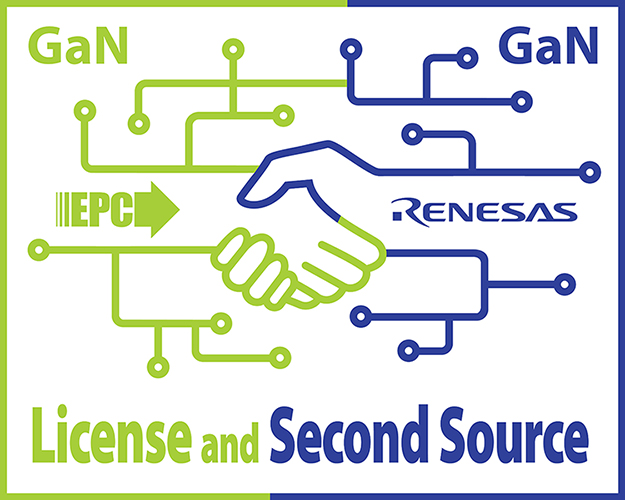
Efficient Power Conversion (EPC) has announced a comprehensive gallium nitride (GaN) technology licensing and second-sourcing agreement with Renesas Electronics. EPC says the deal gives Renesas access to EPC’s low-voltage enhancement-mode gallium nitride (eGaN) technology and EPC’s existing supply-chain ecosystem, with the stated goal of accelerating adoption of high-performance GaN devices in high-volume markets including AI data center power.
Under the agreement, Renesas will second-source “several of EPC’s popular GaN devices that are already in mass production,” according to the announcement, positioning the arrangement as a supply assurance and resiliency play for customers using those parts. EPC and Renesas also plan to collaborate “over the next year to establish internal wafer fabrication capabilities for these products.”
EPC notes that designers are pushing for higher efficiency and power density, and it argues that silicon device limits are increasingly constraining performance and miniaturization. The announcement states that, compared with silicon, GaN transistors offer “higher efficiency, faster switching speeds, and significantly smaller form factors,” and it links those attributes to evolving power-conversion architectures “ranging from consumer electronics to AI data centers.”
Renesas recently completed its acquisition of Transphorm “to strengthen its high-voltage GaN portfolio,” and it says its GaN targets applications including AC-DC power supplies, EV chargers, solar inverters, and industrial motor drives. Renesas positions the addition of EPC’s low-voltage eGaN as expanding its product coverage “spanning low- to high-voltage applications,” including “AI power architectures from 48 V down to 12 V and 1 V,” plus client computing and battery-operated applications.
“Expanding our business into low‑voltage GaN allows us to serve the fastest‑growing power segments,” said Rohan Samsi, VP, GaN Business Division at Renesas. “This agreement with EPC complements our established high-voltage 650V+ portfolio and enables us to capitalize on high-volume markets such as AI power architectures from 48V down to 12V and 1V, as well as client computing and battery-operated applications.”
Source: Efficient Power Conversion