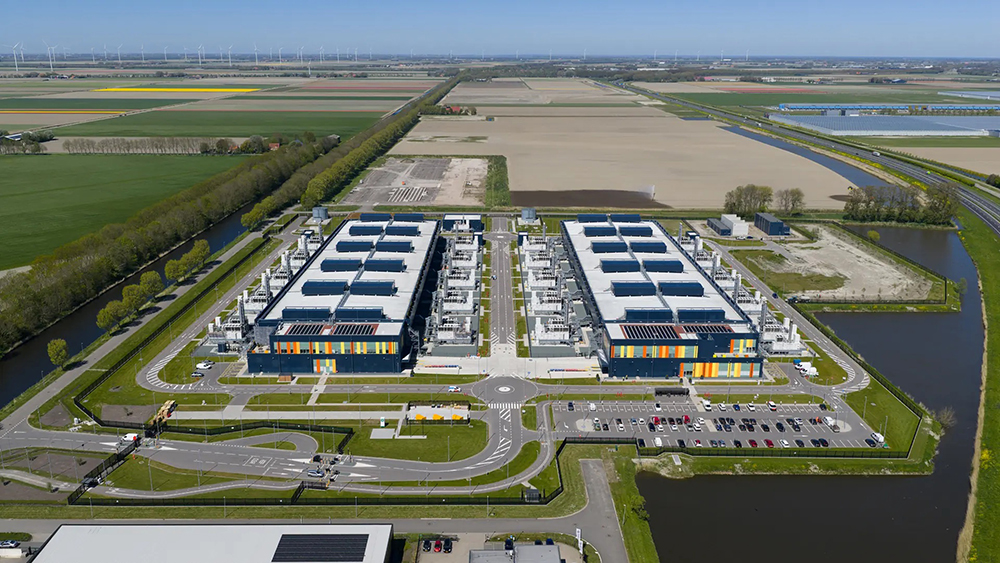


Airsys has opened its new 60-acre global headquarters and manufacturing campus in Woodruff, South Carolina, establishing what the company describes as its primary production hub for zero-water, high-density cooling systems aimed at AI data center deployments. The campus is expected to create 215 jobs and is designed to shorten supply chain lead times for North American operators by building domestic inventory and manufacturing capacity. Airsys also opened its first European manufacturing facility in Hungary in February 2026.
LiquidRack
In April, Airsys launched its next-generation LiquidRack, a rack-level liquid cooling platform now accepting pilot deployment candidates. The product is aimed at operators who need higher compute density than air cooling allows but want to avoid the infrastructure commitment of full immersion or centralized direct-to-chip systems.
LiquidRack integrates fluid distribution, pumping, and thermal management directly within the rack—using spray-based cooling at the server level and a 2U cassette-based design that retrofits into existing infrastructure without a facility redesign. Dielectric fluid consumption is up to 80% lower than immersion systems, and the platform supports compressor-less operation with dry coolers, eliminating water usage while reducing mechanical complexity. It also works with adiabatic and traditional chiller architectures. Performance envelope: 0.5–8 kW per server, up to 80 kW per rack.

The 40–80 kW range is the gap LiquidRack is targeting. “A meaningful share of enterprise and edge workloads is expected to sit within the 40–80 kW-per-rack range, inside facilities that were never designed for liquid cooling,” said Alex Cordovil, Research Director at Dell’Oro Group. “Rack-level liquid cooling architectures can offer a pragmatic path to higher densities without the infrastructure overhaul that full retrofits require.”
Airsys is rolling out a framework around two efficiency metrics, which the company is advocating alongside the Open Compute Project.
- Power Compute Effectiveness (PCE) measures how effectively a facility converts input power into actual compute output—useful in power-constrained grid interconnection environments where maximizing compute per watt matters more than minimizing overhead power alone.
- Return on Invested Power (ROIP) reframes electricity as a capital asset with a measurable return, tying thermal design decisions directly to balance sheet outcomes.
Source: Airsys