
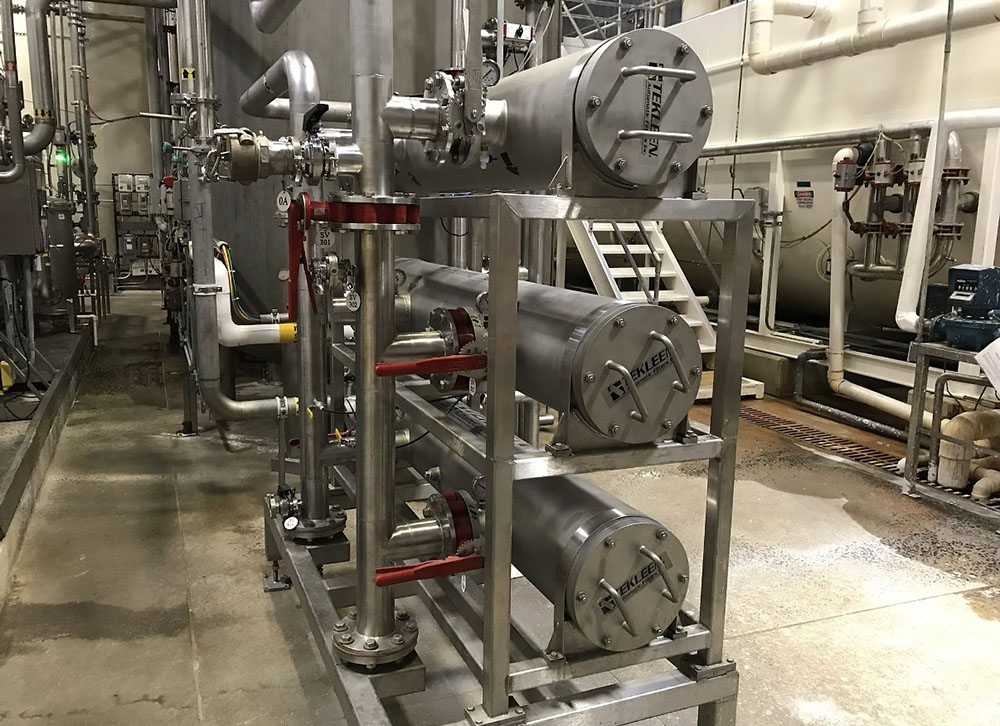
Tekleen is pointing to recent deployments of its automatic self-cleaning water filtration systems in hyperscale data centers and heavy industrial manufacturing, where facilities are reporting lower water use and reduced maintenance tied to filtration. Reported outcomes include up to a 96% reduction in filtration cleaning water use, uninterrupted flow during backwash, and payback periods typically in the 18 to 24 month range.
In cooling-water applications where facilities are replacing disposable cartridge and bag filters, Tekleen says operators are reducing replacement media purchases and labor associated with filter changeouts, along with production interruptions and operator time. In sites replacing traditional sand media filtration, reported savings are tied to reduced backwash water consumption, uninterrupted flow during automatic cleaning, and reduced maintenance requirements.
One cited hyperscale data center application used Tekleen filtration in a mission-critical cooling system. An engineering analysis for that site found up to a 96% reduction in filtration cleaning water use while maintaining uninterrupted flow during each automatic backwash cycle. Tekleen says its system cleans the screen in under 10 seconds while filtration continues.
For operators, the practical point is straightforward: in large cooling loops, filtration choices can show up directly in WUE (water usage effectiveness) through backwash consumption and indirectly through the maintenance burden that drives operational risk. But the strongest claims here are based on site-specific engineering analyses, so engineers will want to map water quality, solids loading, and backwash frequency to their own loop conditions before treating the numbers as transferable.
In a heavy industrial example, a North American steel manufacturing facility reported improvements after implementing Tekleen filtration in its cooling-water system, including reduced manual maintenance, improved spray nozzle performance, and lower water and wastewater handling costs. The facility estimated operational savings of $40,000 to $50,000 annually per cooling loop, before other potential effects such as avoided downtime, reduced chemical consumption, pumping efficiency changes, and extended equipment life.
Nagui Elyas, CEO of Tekleen, said, “Industrial facilities are increasingly evaluating water filtration based on total operational impact rather than initial purchase price.” Dan Flanick, Tekleen’s CRO, said customers are reporting “significant reductions in water used during automatic backwash” alongside maintenance and reliability improvements.
Tekleen did not name the customer sites, noting that company names, facilities, personnel, and certain operating data were omitted or generalized, and that actual results vary by system configuration, water quality, operating conditions, and local utility costs.
Source: Tekleen