
Rivvor says it has demonstrated sub-THz wireless links aimed at replacing some short-reach copper and optical connections inside high-density AI racks, with the goal of supporting both scale-up and scale-out interconnects. Recent lab results cited by the company include a 1600 ns round-trip latency measurement in an enclosed rack environment and error-free multi-Gbps peer-to-peer mmWave data transfer.
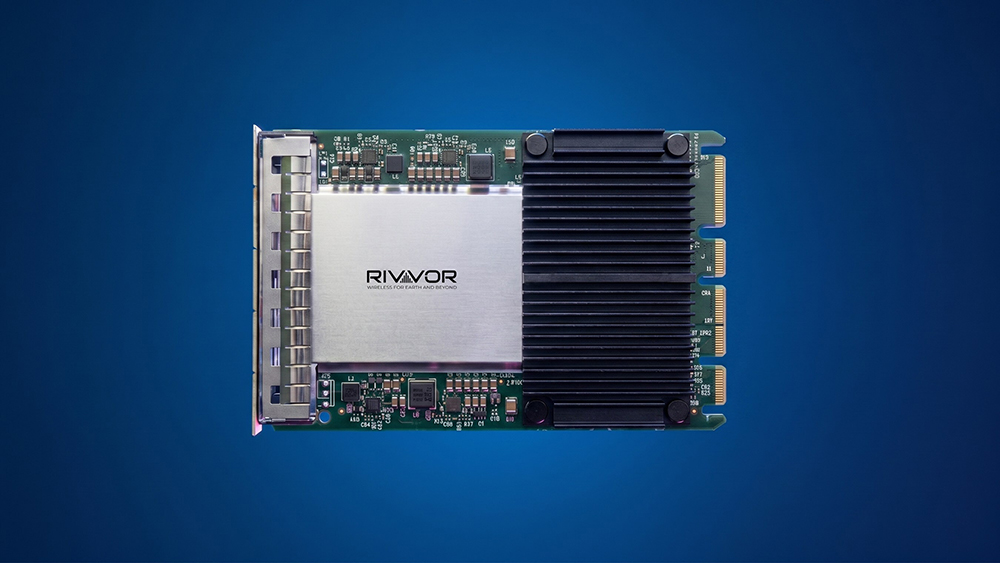
The company is developing a wireless chipset family intended to ship in Wireless Network Interface Cards (WNICs) and rack-level controllers that fit into existing OEM server and rack designs. Rivvor also outlined a roadmap that targets production ASICs with nanosecond-scale latency and high throughput.
Wireless inside the rack is a direct attack on practical constraints that show up as racks get denser: cable bulk, serviceability, and the operational friction of any topology change that requires hands-on recabling. But the engineering bar is high—latency, determinism, and error behavior under real thermal, airflow, and EMI conditions are what will decide whether wireless can move beyond niche links and into the interconnect stack operators trust for accelerator fabrics.
Two in-rack approaches
Rivvor described two architectures that it plans to run on the same chipset. Its “Direct Path Architecture” uses steerable sub-THz beams and software control to reconfigure paths inside standard 19-inch racks in under 1 ms, and can extend from intra-rack to short inter-rack links. The second approach, “Bounded Electromagnetic Corridor (BEC),” aims to use mechanical structures in high-density compute systems as bounded RF pathways, with Rivvor targeting “Petabit-class capacity per rack.”
CTO and co-founder Konstantin Tiutin said the company is “engineering the production silicon for sub-microsecond round-trip latency and per-link throughput up to 1.6 Tbps, with inter-rack paths targeting up to 50 Tb/s,” and that “first silicon is targeted for early 2028.”
CEO and co-founder Nazym Paltachev argued that fixed cabling locks in topology changes at build time: “Cables freeze the network topology the day the rack is built. Rivvor unlocks dynamic reconfigurability of the interconnects within the rack.”
Rivvor, founded in 2025 and headquartered in Roseville, California, said it is engaging enterprise and infrastructure partners on integration paths and contributing to the Open Compute Project. More details are available at rivvor.com.
Source: Rivvor